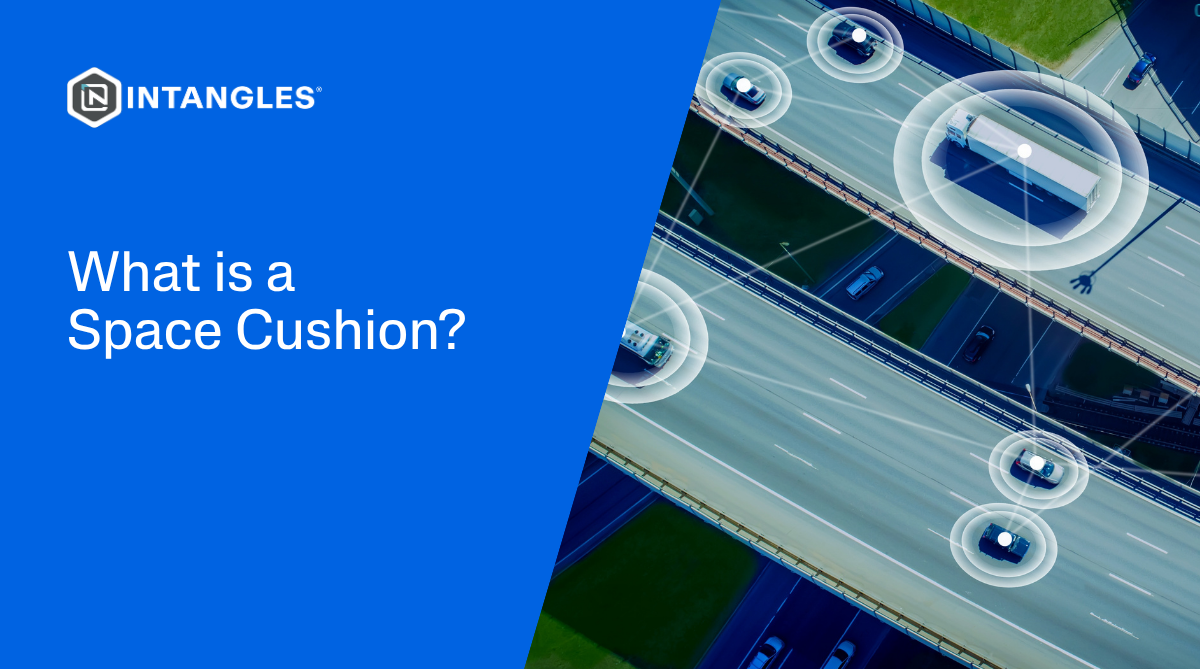
Space cushion refers to the buffer of empty space maintained around a vehicle on all sides during operation. In commercial trucking, maintaining an adequate space cushion is one of the most fundamental and measurable safe driving practices. It gives drivers the time and physical distance needed to perceive a hazard, decide on a response, and execute a braking or steering maneuver before a collision occurs.
KEY TAKEAWAYS
- A space cushion is the empty space maintained around a vehicle to allow adequate reaction time and stopping distance in traffic.
- Commercial trucks require significantly larger space cushions than passenger vehicles due to longer stopping distances, wider turning radii, and greater mass.
- The seven-second following distance rule is the industry standard for commercial vehicles under normal conditions. Adverse weather, speed, and load increase that requirement.
- Space cushion violations including tailgating and following too closely are among the most cited unsafe driving behaviors in FMCSA roadside safety programs.
- Rear-end collisions involving commercial vehicles are consistently among the most preventable and most costly crash types in US trucking.
- Fleet telematics and driver monitoring systems make space cushion behavior measurable, trackable, and correctable at fleet scale.
In this guide, we cover what space cushion means for commercial vehicle operators, how to calculate the right following distance, which areas of the vehicle are most difficult to manage, and how fleet technology supports space cushion compliance in 2026.
Why space cushion matters more for commercial trucks
Under ideal conditions, a passenger vehicle traveling at 65 mph needs about 316 feet to stop. A fully loaded Class 8 tractor-trailer at the same speed needs about 525 feet, more than 200 feet farther, or roughly the length of two football fields, due to vehicle mass, air brake system response time, and the dynamics of a coupled trailer.
This stopping distance reality is the core reason commercial drivers need a larger space cushion than most road users expect. At highway speeds, a following distance that looks adequate from inside the cab may leave as little as one to two seconds of reaction time, far less than the four to seven seconds needed to perceive a hazard and bring a loaded truck to a complete stop safely.
The consequences of insufficient following distance in commercial trucking extend beyond driver safety. A rear-end collision involving a commercial vehicle creates vehicle damage, cargo loss, potential driver injury, FMCSA inspection and reporting obligations, CSA score impacts, insurance claims, and potential litigation.
How to calculate space cushion: The seven-second rule
The industry standard for commercial vehicles under normal driving conditions is a seven-second following distance. This is measured using a fixed reference point on the road:
- Watch the vehicle ahead pass a fixed object such as a sign, bridge, or road marking
- Count seconds until your vehicle reaches the same object
- If you reach it in less than seven seconds, you are following too closely
Adjustments for conditions:
| Condition | Recommended adjustment |
| Rain or wet pavement | Add 2 to 3 seconds |
| Snow or ice | Double the base following distance |
| Night driving | Add 1 to 2 seconds |
| Heavy load or steep downgrade | Add 2 to 4 seconds |
| Reduced visibility (fog, glare) | Add 2 to 3 seconds or more |
| Urban stop-and-go traffic | Maintain at least one vehicle length per 10 mph of speed |
These are minimum adjustments. In practice, experienced commercial drivers increase their cushion further when road conditions deteriorate.
Space cushion vs. following distance: What is the difference?
The terms are related but not identical.
| Space cushion | Following distance | |
| Scope | Covers all four zones around the vehicle: front, rear, sides, and backing | Focuses specifically on the gap between your vehicle and the one ahead |
| Application | A broader defensive driving strategy | One measurable component within that strategy |
| Control | Requires active management of all zones simultaneously | Measured by the seven-second rule |
| FMCSA relevance | Informs overall driver risk scoring | Following too closely is a directly citable violation |
Space cushion is the overall strategy. Following distance is the most measurable and most frequently cited element of that strategy.
Five keys to space cushion driving
The Smith System, developed in 1952 and still widely taught in commercial driver training programs, provides a structured framework for space cushion management. It defines five operating principles that work together.
Aim high in steering
Scan the road at least 15 seconds ahead rather than focusing on the vehicle immediately in front. This gives drivers advance warning of hazards and more time to adjust speed and position before a reaction becomes urgent.
Get the big picture
Maintain the seven-second following distance and scan mirrors every five to eight seconds to stay aware of what is behind and beside the vehicle. Space cushion management requires awareness in all directions, not just forward.
Keep your eyes moving
Avoid fixing on any single object for more than two seconds. Active eye movement prevents the tunnel vision that develops during highway monotony and reduces the delayed reaction time that comes with fatigue.
Leave yourself an out
Position the vehicle so there is always an escape route available: a lane to move into, a shoulder with adequate clearance, or enough space ahead to stop without contact. This principle links space cushion directly to emergency maneuver planning.
Make sure they see you
Use headlights, turn signals, horn when necessary, and eye contact at intersections to confirm that other road users are aware of the truck’s presence. A space cushion only works if surrounding drivers understand where the truck is and can adjust accordingly.
Space cushion around the entire vehicle
Space cushion is not only about what is in front of the truck. Commercial vehicle safety programs address four zones.
| Zone | Key considerations |
| Front | Seven-second minimum following distance, adjusted for speed and conditions |
| Rear | The space behind the truck is controlled by following drivers. Drivers can create more rear cushion by reducing speed and allowing tailgating vehicles to pass |
| Sides | Wide turns, lane changes, and merging require clear lateral space. Blind spots on both sides of a Class 8 truck extend further than most car drivers realize |
| Backing | Before backing, the driver should exit and walk the area to identify obstacles. Backing is one of the highest-risk maneuvers in commercial trucking and should be minimized where possible |
The rear zone is widely considered the most difficult to control because it depends on other drivers’ behavior rather than the truck driver’s decisions. When a vehicle is tailgating, commercial drivers are trained to reduce speed gradually to create more space and encourage the following driver to pass, rather than attempting to accelerate away.
Space cushion statistics for US commercial fleets
According to the FMCSA Large Truck and Bus Crash Facts, rear-end collisions are consistently among the most common crash types involving large trucks in the US. The National Highway Traffic Safety Administration (NHTSA) reports that driver behavior factors, including following too closely and inadequate reaction time, are contributing factors in the majority of preventable commercial vehicle crashes. Following too closely remains one of the most frequently cited unsafe driving violations in FMCSA roadside safety programs.
These numbers reinforce why space cushion is not just a training topic but an operational risk management priority for US fleet operators.
Common space cushion mistakes in commercial fleets
| Mistake | Why it matters |
| Applying passenger-car following distances | Car drivers typically use a two-second rule. Commercial trucks need at least three times that under normal conditions |
| Not adjusting for weather or road conditions | A seven-second gap on dry pavement is insufficient on wet or icy roads |
| Driving too fast on downgrades | Gravity extends stopping distance on grades. Many drivers maintain highway speeds without increasing following distance |
| Ignoring blind spot management | Side space cushion failures often result from lane changes made without adequately checking blind spots |
| Waiting until hard braking is required | By the time a driver brakes hard, the space cushion has already failed. Prevention requires continuous adjustment, not reactive response |
| Underestimating fuel and load effect | A heavier load increases stopping distance. Drivers who maintain the same following distance regardless of load are consistently under-cushioned when loaded |
Space cushion, FMCSA compliance, and CSA scores
Following too closely is a citable moving violation under FMCSA regulations and is tracked in the Unsafe Driving BASIC of the CSA Safety Measurement System. Multiple citations accumulate over a 24-month window and affect a carrier’s safety rating, insurance rates, and shipper relationships.
Rear-end collisions involving commercial vehicles frequently trigger FMCSA accident reporting requirements under 49 CFR Part 390, and depending on injury or fatality outcomes, may require a Crash Preventability Determination from FMCSA. A driver with a documented history of following too closely citations is in a significantly weaker position in that process.
How Intangles supports space cushion and driver safety
Intangles is a digital twin company serving the transportation and logistics industry across 18 countries, with more than 500,000 vehicles on the platform and a predictive AI accuracy rate of 96%. The InGenious device connects directly to the vehicle OBD port, with no modifications or additional sensors required, and feeds real-time ECU and operational data into the InRoute platform continuously.
Space cushion compliance is a driver safety and risk management issue that fleets increasingly monitor using telematics, driver scoring, and predictive analytics. At fleet scale, it requires systematic monitoring rather than periodic manual observation. Intangles’ driver performance tracking captures and scores behavior exceptions across the fleet continuously, enabling fleet managers to identify space cushion risk before it becomes a crash or a CSA citation.
| Capability | How it helps fleet managers |
| Driver behavior monitoring | DriveIQ monitors over 20 driver behavior exceptions including harsh braking, which is a direct indicator of insufficient following distance. Scores are normalized per distance and duty cycle for fair peer-to-peer comparison. |
| Operational loss quantification | Harsh braking events are mapped to financial impact including wear on brake components and tires, giving fleet managers a cost-based case for driver coaching programs. |
| Coaching triggers | Real-time notifications to dispatchers and fleet managers when driving behavior exceptions exceed defined thresholds, enabling immediate intervention on high-risk patterns. |
At fleet scale, space cushion compliance is a driver behavior monitoring challenge. Telematics platforms that track harsh braking, following distance proxies, and driver scoring enable fleet managers to identify and coach high-risk drivers systematically, rather than relying on self-reporting or post-incident review.
Explore the platform or get in touch with our team to find out more about how Intangles assists fleets in tracking driver performance, operational losses, and vehicle health
KNOW MORE
Frequently Asked Questions
What is a space cushion in driving?
A space cushion is the buffer of empty space maintained around a vehicle during operation. It gives the driver time to perceive hazards, make decisions, and execute braking or steering responses before a collision occurs. For commercial trucks, the minimum standard is a seven-second following distance ahead of the vehicle under normal conditions.
What is the seven-second rule for commercial trucks?
The seven-second rule means a commercial vehicle should take at least seven seconds to reach a fixed point after the vehicle ahead passes it. This is measured by counting seconds from when the vehicle ahead passes a road marker until your vehicle reaches the same point. Less than seven seconds means you are following too closely.
Why do commercial trucks need a larger space cushion than cars?
A fully loaded Class 8 truck at highway speed requires roughly twice the stopping distance of a passenger car. Greater vehicle mass, air brake response time, and trailer dynamics all extend stopping distance. Commercial drivers also manage larger blind spots and wider turning radii, requiring more buffer space on all sides of the vehicle.
Which part of the space cushion is hardest to control?
The rear zone is the most difficult because it depends on the behavior of the driver behind the truck rather than the truck driver’s own actions. When a vehicle is tailgating, commercial drivers are trained to gradually reduce speed to create more space and allow the following vehicle to pass, rather than trying to accelerate away.
How does space cushion affect CSA scores?
Following too closely is a citable moving violation under FMCSA regulations. Citations are tracked in the Unsafe Driving BASIC of the CSA scoring system and accumulate over a 24-month window. Multiple violations raise the carrier’s percentile score, increasing the likelihood of FMCSA interventions, audits, and higher insurance premiums.
Can telematics detect space cushion violations?
Telematics systems cannot measure following distance directly without forward-facing sensors. However, harsh braking events captured through ECU data are a strong proxy for insufficient following distance, since hard braking typically indicates the driver did not have adequate space ahead to stop gradually. Monitoring and coaching on harsh braking is the most practical fleet-scale approach to space cushion compliance.




We’re looking forward to meeting you