KEY TAKEAWAYS
- There are 6 DOT inspection levels. Level 1 (North American Standard) is the most comprehensive and most common, covering 37 inspection points.
- In 2025, 22.6%% of CMVs inspected during CVSA International Roadcheck were placed out of service. Brakes, tires, and lights caused the majority of those orders.
- Vehicles that pass Level 1, 5, or 6 inspections receive a CVSA decal valid for 3 months, protecting them from repeat roadside inspections during that period.
- Every roadside inspection feeds into your FMCSA CSA score. Out-of-service violations now score twice as heavily under the 2026 CSA overhaul.
- The 2026 CVSA Roadcheck focuses on cargo securement — fleets should audit load securement protocols before the May 2026 enforcement peaks.
Over 3.5 million DOT roadside inspections are conducted annually across the United States, and they happen without notice. An FMCSA-authorized inspector can flag your driver at a weigh station, pull them over on the highway, or select them at a fixed checkpoint. What happens next depends entirely on whether your fleet was ready before that moment arrived.
These inspections follow six distinct levels defined by the Commercial Vehicle Safety Alliance (CVSA) under the North American Standard Inspection Program. Each level covers a different scope, from a full 37-step driver-and-vehicle examination to a driver-only credential check to a specialized inspection for radioactive shipments. The level an inspector runs is not announced in advance.
That last point matters more than most fleet managers realize. Every roadside inspection result feeds directly into your FMCSA Compliance, Safety, Accountability (CSA) score, and under the 2026 CSA overhaul, out-of-service violations carry double the weight they used to. Knowing what each level checks is not a compliance formality. It is the foundation of a daily inspection discipline that keeps your fleet off the out-of-service list.
This blog covers all six levels, the violations that most commonly ground vehicles, how the 2026 CSA changes affect your scoring, and how telematics fits into year-round inspection readiness.
What is a DOT inspection? Who conducts it and what triggers one
DOT inspections are conducted by FMCSA-authorized state law enforcement officers, not federal employees. The CVSA sets the standards and criteria. FMCSA funds and regulates the program. State troopers and commercial vehicle enforcement officers carry out the actual inspections.
Any commercial motor vehicle over 10,001 lbs GVWR is subject to inspection. So are hazmat carriers of any weight and vehicles transporting nine or more passengers.
Four things typically trigger a stop. First, the PrePass weigh station algorithm flags a carrier based on CSA score or out-of-service history. Second, a visible mechanical violation draws the attention of a highway patrol officer, such as a broken light, loose cargo, or obvious tire damage. Third, random selection at a checkpoint. Fourth, carrier-specific enforcement targeting based on FMCSA data patterns.
One thing worth understanding before you get to the six levels of DOT roadside inspections: you cannot know which level the inspector will conduct until you are stopped. That is why preparation for all six levels is the only viable strategy.
The 6 DOT inspection levels: What’s checked at each
Level 1: North American Standard Inspection (Most common)
Level 1 is the most comprehensive inspection in the program and the one your fleet is most likely to encounter. It covers 37 individual checkpoints across both the driver and the vehicle, and it typically takes 30 to 60 minutes to complete. A clean pass earns a CVSA decal valid for three consecutive months.
On the driver side, inspectors check CDL validity and class, medical certificate currency, ELD or paper logbook records, hours-of-service compliance, drug and alcohol prohibition compliance, and seat belt use. Driver qualification files may also be reviewed if accessible.
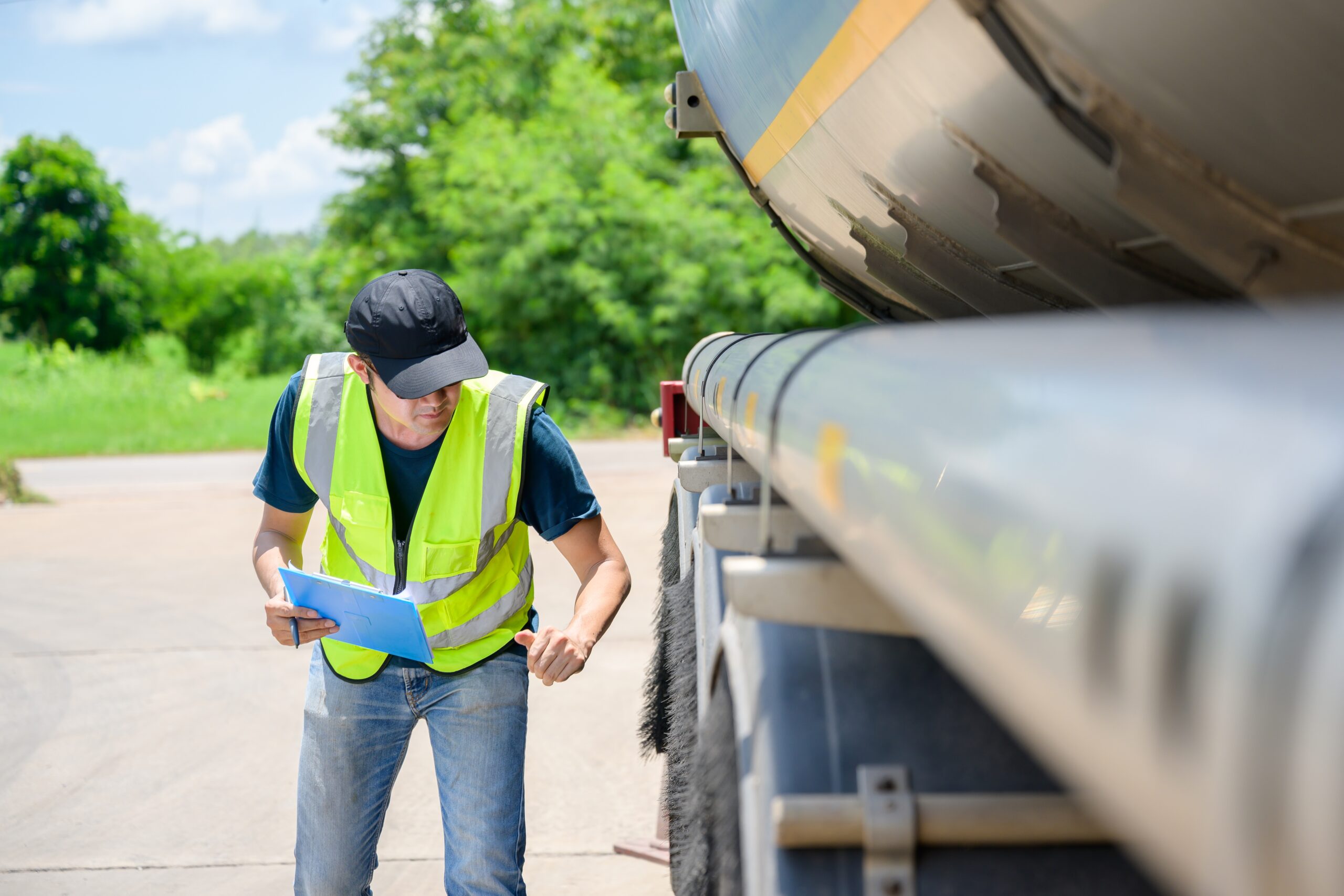
On the vehicle side, the inspection covers brake systems and adjustment, steering mechanisms, lighting (headlights, taillights, clearance markers, reflectors), tires and wheels, fuel system integrity, exhaust system, coupling devices, cargo securement, and the driver vehicle inspection report (DVIR).
Because Level 1 covers driver HOS compliance and ELD records alongside the full mechanical check, this is the inspection where documentation failures and vehicle deficiencies are most likely to surface simultaneously. For fleets looking to reduce HOS and documentation-related violations, driver behavior monitoring provides visibility into the same compliance factors inspectors review at Level 1. The decal awarded on a clean pass is the most valuable protection a vehicle can carry at a roadside stop.
Level 2: Walk-around driver and vehicle inspection
Level 2 covers everything visible above ground. The inspector does not go under the vehicle. Duration is typically 15 to 30 minutes, and no CVSA decal is awarded.
Driver documents are checked the same way as Level 1: CDL, medical certificate, ELD, or logbook records. Vehicle items include external lighting, tires visible from outside, coupling devices, and cargo securement. The cab interior is also reviewed for seat belt use, mirrors, and windshield condition.
The practical implication is straightforward: Level 2 catches exactly what a thorough pre-trip walk-around should have already caught. If your drivers complete honest daily inspections, Level 2 produces zero violations.
Level 3: Driver-only inspection
At Level 3, the vehicle is not inspected at all. The inspector focuses entirely on the driver. This typically takes 10 to 20 minutes and does not result in a CVSA decal.
Items checked include CDL validity and appropriate class for the vehicle being operated, medical certificate currency, ELD or logbook records, hours-of-service compliance, seat belt use, FMCSA Drug and Alcohol Clearinghouse status, and drug and alcohol prohibition compliance.
The operational standard here is simple: your driver must be able to produce a valid CDL, a current medical certificate, and organized ELD records in under two minutes. If they cannot, the inspection is likely to escalate. Expired medical cards, HOS log discrepancies, or any flag in the Clearinghouse system can result in a driver being placed out of service on the spot. Staying on top of driver qualification data and HOS patterns in your telematics platform is what makes Level 3 a non-event.
Level 4: Special study inspection
Level 4 is a targeted research inspection used by FMCSA or CVSA to study a specific violation pattern across multiple vehicles over a set period. An inspector at a fixed checkpoint might examine one item, such as brake pad wear, across every truck passing through for two weeks. The data feeds national safety trend analysis and shapes future enforcement priorities. No CVSA decal is awarded.
Whatever Level 4 targets at a given time almost always reflects a pattern already visible in national CSA data.
Level 5: Vehicle-only inspection (No driver required)
Level 5 inspections happen at terminals and facilities when the vehicle is present without its driver. Duration is typically 30 to 45 minutes, and a CVSA decal is awarded on a clean pass, making this one of only three levels where that protection is available.
The mechanical scope mirrors the vehicle portion of a Level 1 inspection: brakes, tires, lights, steering, fuel system, exhaust, coupling, and cargo securement are all examined. Driver documents are not reviewed because no driver is present.
The implication that catches some fleets off guard is this: terminal inspections can happen while your driver is on home time. A vehicle parked at your facility is still subject to inspection, and its mechanical condition is entirely your responsibility at that moment. Vehicles need to be in Level 1-ready condition at all times, not just when a driver is behind the wheel.
Level 6: Enhanced NAS inspection for radioactive shipments
Level 6 applies exclusively to highway route controlled quantities (HRCQs) of radioactive materials. It is a full Level 1 inspection with an additional layer: radiation detection equipment is used to verify containment integrity and confirm the vehicle and shipment meet all radiological transport requirements. A CVSA decal is awarded on a clean pass.
Carriers that haul HRCQ radioactive materials are subject to specialized FMCSA and Department of Energy regulations that go well beyond standard CMV compliance.

What gets a vehicle placed out of service: The top violations in 2026
22.6% of CMVs inspected during the 2025 CVSA International Roadcheck were placed out of service. Brakes, tires, and lights drove the vast majority of those orders, and in nearly every case, the defect existed before the driver left the terminal that morning.
Brake defects are the single largest OOS category, year after year. At the 2025 Roadcheck, inspectors identified 3,304 brake system violations, accounting for 24.4% of all vehicle OOS findings. When combined with “20% defective brakes” citations, brake-related issues made up over 41% of all vehicle OOS violations. A steering axle brake that is inoperative is an automatic OOS. So is any condition where 20% or more of a vehicle’s service brakes are non-functional.
Tires ranked second. At the 2025 Roadcheck, 2,899 tire-related violations were recorded, accounting for 21.4% of all vehicle OOS violations. Common causes include flat tires, tread below minimum depth, exposed cord, improper repairs, and tires not rated for the load being carried.
Lighting inoperative clearance markers, tail lights, or reflectors is often called the gateway violation. A lighting defect visible to an inspector on the highway is almost always what triggers a deeper Level 1 inspection. The mechanical problems that follow would not have been found without the lighting issue opening the door.
Cargo securement is the 2026 enforcement focus. In 2025, 18,108 violations were issued for cargo not secured to prevent leaking, spilling, or falling. The 2026 CVSA International Roadcheck named cargo securement as its primary vehicle focus area.
Operating an out-of-service vehicle carries a fine of up to $19,277 per occurrence. Beyond the fine, a single OOS violation adds double-weighted points to your CSA score and can push insurance premiums up 10 to 30%, signaling compliance risk to freight brokers and shippers.
How DOT inspections affect your CSA score: The 2026 changes
Every roadside inspection result flows into FMCSA’s Safety Measurement System (SMS). Violations add points to compliance category scores, and carriers that cross investigation thresholds face escalating scrutiny: higher insurance premiums, exclusion from shipper-approved carrier lists, and increased likelihood of a full DOT compliance audit.
Three 2026 changes directly affect how fleet managers should think about inspection readiness.
The 12-month violation window
Under the updated SMS methodology, a carrier’s percentile is only calculated in a given category if it has received a violation in that category within the past 12 months. Violations older than 12 months no longer count toward your percentile. This makes recent inspections significantly more impactful in both directions. A clean stretch of inspections now produces faster score recovery than the old 24-month window allowed.
Vehicle maintenance driver observed compliance category
FMCSA’s approved SMS prioritization update introduced a new “Vehicle Maintenance: Driver Observed” compliance category. Violations that a driver should have caught during a pre-trip walk-around, bald tires, inoperative lights, and visible fluid leaks now score in a separate category from violations found during scheduled maintenance. Pre-trip inspection quality is no longer visible to FMCSA. It has its own score.
OOS violation severity weighting
FMCSA replaced the old 1 to 10 severity scale with a two-tier system. Out-of-service violations now carry a severity weight of 2; all other violations carry a weight of 1. An OOS brake citation hits your Vehicle Maintenance score twice as hard as a non-OOS brake warning. Preventing OOS conditions, not just violations in general, is the priority.
How to keep your fleet inspection-ready: Telematics and pre-trip inspection
The vehicles that fail DOT inspections are almost always the ones showing early deterioration signals for weeks before the inspection. The brake system that grounds a truck at a weigh station did not fail overnight. The data trail was there.
Real-time OBD-II telematics catches the three most common OOS categories before an inspector does.
On brakes: OBD-II monitoring tracks brake system pressure, air brake circuit integrity, and ABS fault codes. A degrading brake system produces anomalous readings, pressure drops, circuit irregularities, fault code sequences, and days before it fails a physical inspection check.
Related article: What is OBD-II? A US Fleet Management Guide for 2026
On tires: TPMS sensor data flags pressure drops before the driver’s pre-trip walk-around catches a slow leak.
On lighting: Modern telematics platforms flag lighting circuit faults in the vehicle diagnostic data feed before the driver notices a bulb failure.
Digital DVIR through a mobile app creates a documented inspection record for every pre-trip and post-trip check. During a DOT audit, that record is the evidence that demonstrates a real, systematic inspection program to FMCSA, not a paper exercise that gets signed regardless of what the driver actually checked.
In Intangles, every vehicle’s VIN is the data anchor that connects GPS activity, driver behavior scores, DTC fault codes, and maintenance records into a single operational profile. The predictive maintenance layer flags brake performance trends, tire pressure anomalies, and lighting circuit faults before they become inspection violations. The driver behavior monitoring data captures HOS patterns, log accuracy, and compliance behavior, the same factors that Level 1 and Level 3 inspectors evaluate. If you are building or tightening a broader compliance program, the fleet safety program guide covers how vehicle inspection and telematics fit into a complete safety structure, including Step 5, which covers inspection and maintenance protocols specifically.
Explore how Intangles connects VIN-based vehicle intelligence with driver behavior monitoring to help fleets identify compliance risks before they become roadside violations.
KNOW MORE
Frequently Asked Questions
What is a DOT inspection, and who conducts it?
A DOT inspection is a roadside examination of a commercial motor vehicle, its driver, or both, conducted to verify compliance with FMCSA safety regulations. Inspections are carried out by FMCSA-authorized state law enforcement officers, not federal agents. The CVSA defines the six inspection levels and the criteria inspectors follow. Any CMV over 10,001 lbs, hazmat vehicle of any weight, or vehicle transporting nine or more passengers is subject to inspection without prior notice. To understand how violations from these inspections affect your carrier profile, you can review FMCSA’s inspection violation data directly.
What is the most common DOT inspection level?
Level 1, the North American Standard Inspection, is the most frequently conducted inspection. It covers 37 checkpoints across both the driver and vehicle and typically takes 30 to 60 minutes. It is the only level that simultaneously reviews driver credentials, HOS and ELD records, and the full mechanical condition of the vehicle. A vehicle that clears Level 1 with no critical violations qualifies for a CVSA decal valid for three consecutive months, the only roadside credential that protects against repeat inspections during that window.
What violations will get a commercial vehicle placed out of service?
Brake defects are the top OOS category in every recent inspection cycle, accounting for over 41% of vehicle OOS violations at the 2025 CVSA International Roadcheck when combined with “20% defective brakes” citations. Tires are second at 21.4% of vehicle OOS violations, followed by lighting defects. Operating with an OOS condition carries fines of up to $19,277 and adds double-weighted points to your CSA Vehicle Maintenance score under the 2026 SMS system. Fleets that monitor brake health, tire pressure, and lighting circuit status in real time through a platform like Intangles’ predictive health monitoring catch these conditions before they reach the roadside.
What is a CVSA decal, and how do you get one?
A CVSA decal is applied to a commercial vehicle after it passes a qualifying inspection with no critical vehicle violations. It signals to other inspectors that the vehicle has recently been checked and cleared. Decals are valid for three consecutive months from the date of issuance and are awarded only after Level 1, Level 5, or Level 6 inspections. During the 2025 International Roadcheck, 16,521 decals were distributed across North America.
How should fleet managers prepare for a DOT inspection?
Preparation is not a pre-inspection checklist. It is a year-round discipline. Drivers should complete honest pre- and post-trip DVIRs every day. Mechanical defects should be repaired before vehicles return to service. ELD records and driver qualification files need to be current and accessible. Intangles gives fleet managers real-time visibility into brake health, tire pressure, lighting circuit status, and driver HOS compliance, the exact categories inspectors examine at Levels 1, 2, and 3.






We’re looking forward to meeting you