KEY TAKEAWAYS
- A straight truck is a single-unit commercial vehicle where the cab and cargo body share one continuous frame, structurally different from a tractor-trailer combination.
- Box trucks, dump trucks, stake trucks, and reefers are all types of straight trucks. A box truck is one category, not a synonym for the whole class.
- Straight trucks typically max out around 33,000 lbs GVWR, roughly half the capacity of a tractor-trailer combination.
- A CDL is required whenever the vehicle’s rated GVWR exceeds 26,001 lbs, based on the door jamb certification label, not the truck’s actual weight at the time of driving.
- Most straight trucks over the CDL threshold require a Class B CDL. Some configurations and combinations push into Class A territory.
- Any straight truck with a GVWR over 10,001 lbs is a commercial motor vehicle under FMCSA’s definition and is subject to DOT roadside inspection, regardless of route type or local-only operation.
A box truck gets pulled over at a weigh station. The driver has no CDL. The GVWR on the door jamb reads 26,500 lbs. What follows is an out-of-service order, a CSA violation, and a fleet manager pulling records to figure out where the gap was. The vehicle was not overloaded. No one was speeding. The compliance gap was structural, built into how the vehicle was spec’d and how the driver roster was assigned.
Under FMCSA’s definition in 49 CFR Part 383, a straight truck is a commercial motor vehicle where the cab and cargo body are built on a single continuous chassis. There is no detachable trailer, no fifth-wheel coupling, and no articulation point. That structural fact separates a straight truck from a tractor-trailer, and it carries real consequences for vehicle classification, driver licensing, and DOT compliance exposure.
“Box truck” and “straight truck” get treated as interchangeable terms, and they are not the same thing. Box trucks are one configuration within a broader class that also includes dump trucks, stake trucks, refrigerated units, and flatbeds built on a single-frame chassis. Getting the classification right matters for vehicle spec decisions, CDL requirements, DOT inspection exposure, and how a mixed fleet gets monitored.
This blog covers what makes a straight truck a straight truck, how the vehicle types within that class differ, the GVWR rule that determines CDL requirements, common fleet use cases, and the DOT inspection threshold tha
Straight truck vs. tractor-trailer: The structural difference
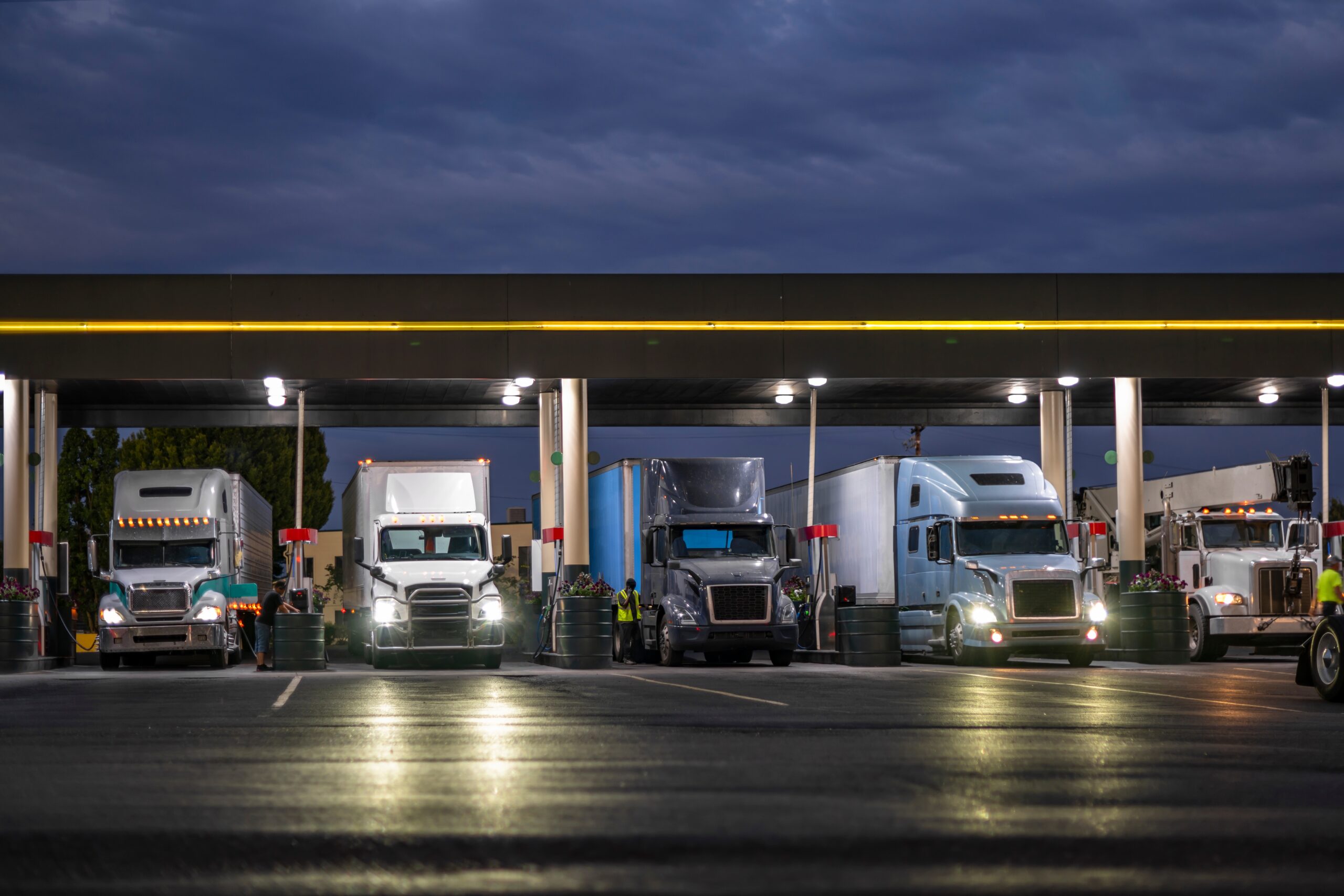
A tractor-trailer is two vehicles. A tractor pulls a trailer attached through a fifth-wheel coupling, and the two units can be separated or re-coupled with a different trailer. A straight truck is one vehicle. The cargo body is mounted directly onto the same frame as the cab, and neither part can be separated from the other.
This design distinction results in a very definite operational trade-off. The straight truck does have a true maneuvering advantage, especially when working in cities, small loading docks, and residential areas, where the turning circle of the tractor-trailer becomes a limiting factor. The trade-off for the straight truck, however, is carrying capacity, which can be as high as 33,000 lbs GVWR, compared to twice that of the combination truck.
The maneuverability advantage is real. Shorter wheelbase, no trailer swing, and tighter turning radii make straight trucks the default choice for last-mile delivery, urban food distribution, and any route where vehicle length creates a practical problem. The capacity ceiling, though, means fleet managers building mixed operations need to be deliberate about which loads go on straight trucks and which require a tractor-trailer.

Types of straight trucks: Box trucks are just one category
This is where terminology causes problems in fleet management. Box truck and straight truck get used interchangeably in casual conversation, and that creates confusion when specifying vehicles, building CDL rosters, or evaluating maintenance data across a mixed fleet.
A box truck is a vehicle configuration. A straight truck is a vehicle class. Box trucks fall within that class, but they do not represent all of it.
The five main types of straight trucks in US commercial fleet operations
- Box Trucks
The most common configuration. An enclosed rectangular cargo area is mounted onto a single-frame chassis, giving operators a weatherproof, secure environment for freight. Moving companies, parcel delivery operations, and furniture logistics firms rely on box trucks because the enclosed body protects cargo regardless of weather or route conditions. - Dump Trucks
They use a hydraulic tilting bed for unloading loads like sand, gravel, rubble, or soil. This vehicle has a dumping system incorporated into the chassis instead of being mounted on a chassis using a coupling point; it qualifies as a straight truck. - Stake Trucks
They feature an open-body frame that is composed of removable stakes. The feature of having removable stakes means that the cargo space can be arranged depending on the type of load being carried. This means that they are suited to carrying things like wood, pipes, pallets, and irregular loads. - Refrigerated trucks (Reefers)
These are enclosed refrigeration vehicles that ensure that the perishable cargo is maintained within certain temperatures during transportation. They are used by the food industry, the pharmaceutical industry, and flower companies, especially in regional and urban transit lines, whereby trailer-mounted reefers exceed the cargo size requirements. - Flatbed straight trucks
They carry an open flat deck on a single chassis, functioning similarly to flatbed trailers but without a separate tractor unit.
Each type sits within the same regulatory category from an FMCSA classification standpoint. The CDL rules and DOT inspection thresholds covered below apply across all five configurations, not just box trucks.
Do you need a CDL to drive a straight truck? The GVWR rule explained
Yes, if the vehicle’s GVWR exceeds 26,001 lbs, a CDL is required. That is the federal threshold under 49 CFR §383.5, and FMCSA’s guidance is direct on this point: a driver operating a CMV with a GVWR at or above 26,001 lbs must hold at a minimum a Class B CDL.
What trips up fleet managers is what GVWR actually measures. It is not the vehicle’s current load weight. It is the manufacturer’s rated maximum capacity, printed on a certification label usually found on the door jamb. A straight truck rated at 26,500 lbs requires a CDL driver even if it is running empty. The rating, not the actual payload, determines the classification.
That is why there are numerous box trucks that have been purposefully configured to be at or below 26,000 lbs GVWR to ensure that they are below the CDL threshold. In most cases, vocational straight trucks such as dump trucks, stake trucks, and large reefers usually have a GVWR that exceeds the CDL threshold considerably. These trucks will always require CDL-licensed drivers regardless of their payload.
This type of CDL class is dependent upon how the vehicle will be operated. Straight trucks, when driving alone or pulling trailers having a GVWR of less than 10,000 pounds, are considered to be Class B CDL. Pulling trailers with a GVWR greater than 10,000 pounds would make the requirement fall within the domain of a Class A CDL. It is just an easy thing to verify before issuing licenses.
Intangles tracks vehicle-level identification data across mixed fleets, which helps fleet managers correlate CDL requirements to specific units when the roster spans both CDL and non-CDL vehicles.

Common uses for straight trucks in US fleets
Straight trucks show up across a wide range of industries, usually in roles where the maneuverability advantage and mid-range payload capacity make them the practical choice over a full combination vehicle.
Last-mile and parcel delivery is the largest use case by volume. US parcel volume reached roughly 22.4 billion shipments in 2024, up 3.4% from the year before, according to the Pitney Bowes Parcel Shipping Index. That growth has pushed straight trucks to the center of delivery fleet strategy, since tight streets, residential loading zones, and high stop frequency all favor a box truck over a tractor-trailer.
Straight trucks have been the default choice for moving companies for decades, combining enclosed cargo protection with sub-CDL GVWR configurations that allow non-CDL drivers to operate them. Straight trucks have been used for moving because of their enclosed body, smaller turning radius, and non-CDL requirement due to the sub-26,001 lb spec point.
The food and beverage business uses refrigerated straight trucks to distribute its products to different destinations. It is important that the temperature of the cargo be maintained on shorter routes without using the entire refrigerated trailer.
Debris removal, equipment transport, and hauling of materials in construction and municipality projects make use of dump trucks and stake trucks. These trucks typically have a GVWR weight higher than the CDL limit.
The broader freight picture backs this up. Trucks moved $98.6 billion of North American transborder freight in March 2026, up 4.7% from March 2025, according to the Bureau of Transportation Statistics, reflecting sustained demand across the trucking sector that includes straight truck operations at the regional and urban end of the supply chain.
Are straight trucks subject to DOT inspections?
Yes. Any straight truck with a GVWR over 10,001 lbs is a commercial motor vehicle (CMV) under FMCSA’s definition, and CMVs are subject to DOT roadside inspections. Size and local-only operation do not exempt the vehicle. A box truck rated at 14,500 lbs GVWR, making short urban deliveries, operates under the same inspection framework as a Class 8 tractor-trailer on an interstate route.
This threshold is lower than the CDL threshold. A fleet manager could have a vehicle that does not require a CDL but still falls under DOT inspection rules. Both thresholds need to be tracked separately.
Monitoring straight trucks and mixed fleets: Where vehicle health matters
Fleet maintenance in straight trucks is unique compared to that in long-distance tractor-trailers. The high frequency of stop-and-go, constant braking, and short distances accompanied by much idling results in wear patterns that differ from those in vehicles used for many miles on highways. A delivery box truck making 80 stops a day has a wear pattern that varies from a truck that does three long hauls a week.
In case of a fleet manager managing both CDL and non-CDL fleets, which also consist of various types of vehicles, such as box trucks, refrigerated trucks, stake trucks, etc., there is a need for a solution that can work in all these scenarios without the need to use multiple solutions for different configurations. This principle applies equally well when the truck in question is either a refrigerated straight truck or a flatbed truck.
Intangles monitors vehicle health across all unit types in a mixed fleet, pulling fault code data, usage patterns, and wear indicators to surface maintenance signals before they become breakdowns. When brake wear on a box truck, a fault code on a reefer, and transmission temperature on a dump truck are all surfaced through the same platform, operations teams can act on each signal instead of discovering the problem at a weigh station. For straight truck fleets built around urban delivery or construction schedules, where one out-of-service vehicle can disrupt an entire route, that early visibility changes how operations teams plan and respond.
Discover how Intangles’ predictive maintenance platform helps mixed fleets monitor every vehicle type from a single dashboard.
KNOW MORE
Frequently Asked Questions
What is the difference between a straight truck and a tractor trailer?
In a straight truck, the cab and the box or trailer are connected to one common chassis. There is no trailer as such, no fifth wheel, and there is no point of articulation. In a tractor-trailer combination, there are two different vehicles – the tractor and the trailer – which are coupled using a fifth wheel. They can also be uncoupled independently and separately. Straight trucks have better maneuvering abilities in city conditions, but their GVWR cannot exceed 33,000 lbs. As far as a combination of vehicles is concerned, the gross vehicle weight is restricted to 80,000 lbs.
Do you need a CDL to drive a straight truck?
Under 49 CFR 383.5, a CDL is required for any straight truck with a GVWR of 26,001 pounds or more — based on the manufacturer’s rating, not the actual loaded weight. A truck rated at 28,000 pounds needs a CDL driver whether it’s fully loaded or empty. Most straight trucks at this threshold require a Class B CDL, though towing a trailer with a GVWR over 10,000 pounds upgrades the requirement to Class A. Intangles helps fleet managers track vehicle-level GVWR data across mixed fleets, keeping driver assignments aligned with the correct licence class.
Is a box truck the same as a straight truck?
No. A box truck is a particular configuration of the vehicle. A straight truck is a broader classification of vehicles. A box truck is a truck that consists of a rectangular cargo compartment on a chassis, which is considered a straight truck. So do dump trucks, stake trucks, refrigerated trucks, and flatbed straight trucks. This is important to know because fleet managers sometimes have to categorize the vehicles in order to prepare CDL rosters, conduct DOT inspections, etc. And when all those vehicles are considered to be box trucks, then it confuses everyone because of their different operations.
What is the maximum weight of a straight truck?
The upper end of the GVWR range for most straight trucks sits around 33,000 lbs, well below the 80,000 lb federal interstate limit that applies to combination vehicles. In practice, most straight trucks operate below that ceiling, and weight limits on non-interstate roads vary by state. When acquiring or spec’ing straight trucks, fleet managers should verify GVWR against both route requirements and the CDL threshold; the two numbers sit at very different points on the weight scale.
Are straight trucks subject to DOT inspections?
Yes. Any straight truck with a GVWR over 10,001 lbs meets the FMCSA definition of a commercial motor vehicle and is subject to DOT roadside inspections under the same framework as larger combination vehicles. Operating locally or staying within a state does not provide an exemption. This threshold is lower than the CDL threshold, so some vehicles that do not require a CDL driver are still subject to inspection. For fleets managing mixed vehicle classes, fleet compliance visibility can help simplify tracking, inspection, and licensing requirements.






We’re looking forward to meeting you