KEY TAKEAWAYS
- Curb weight is the empty vehicle. Gross weight is the loaded vehicle. GVWR is the legal ceiling. Payload is GVWR minus curb weight.
- Exceeding GVWR is a federal violation. Under 49 U.S.C. § 521(b), federal civil penalties reach $16,000 per axle, with state fines stacked on top.
- GAWR (Gross Axle Weight Rating) applies per axle. A vehicle can be under total GVWR but still generate a citation if one axle carries more than its individual rating.
- A CDL is required for any vehicle with a GVWR over 26,001 lbs. This puts it in Class 7 or 8, and FMCSA regulations apply to anything over 10,001 lbs.
- For 2026, vehicles with GVWR between 6,001 and 14,000 lbs are subject to a $32,000 Section 179 cap. GVWR affects the purchase decision, not just the compliance checklist.
Most fleet managers know exactly what their trucks haul. Far fewer know the difference between gross vehicle weight and gross vehicle weight rating, or why confusing the two shows up as a DOT citation, a brake job 40,000 miles early, or a driver sitting roadside while the carrier scrambles.
These terms are not synonyms. Curb weight is what the vehicle weighs empty. Gross weight is what it weighs with cargo, driver, and fuel on board. GVWR is the manufacturer-set ceiling that cannot be crossed without federal consequences. Payload is how much room you have between the second and third numbers. Get these wrong in practice, and you are either running a vehicle below legal capacity or putting a vehicle on the highway in violation of federal law.
This guide covers all five terms, explains how they interact, and walks through where GVWR connects to FMCSA regulations, CDL thresholds, and 2026 Section 179 tax rules. It also covers why fleet telematics often surfaces overloading problems long before a weigh station does.
The 4 core vehicle weight terms: Definitions and how they relate
Curb weight
Curb weight is the vehicle fully fueled, all standard fluids topped off, all factory-installed equipment included, but with no driver, passengers, or cargo. It is a fixed baseline that does not change between trips. You will find it on the federal safety certification sticker inside the driver’s door jamb, in the owner’s manual, and on the manufacturer’s spec sheet. One thing that trips up procurement teams: dry weight strips out fuel. In US standards, curb weight always includes a full tank.
Gross vehicle weight (GVW)
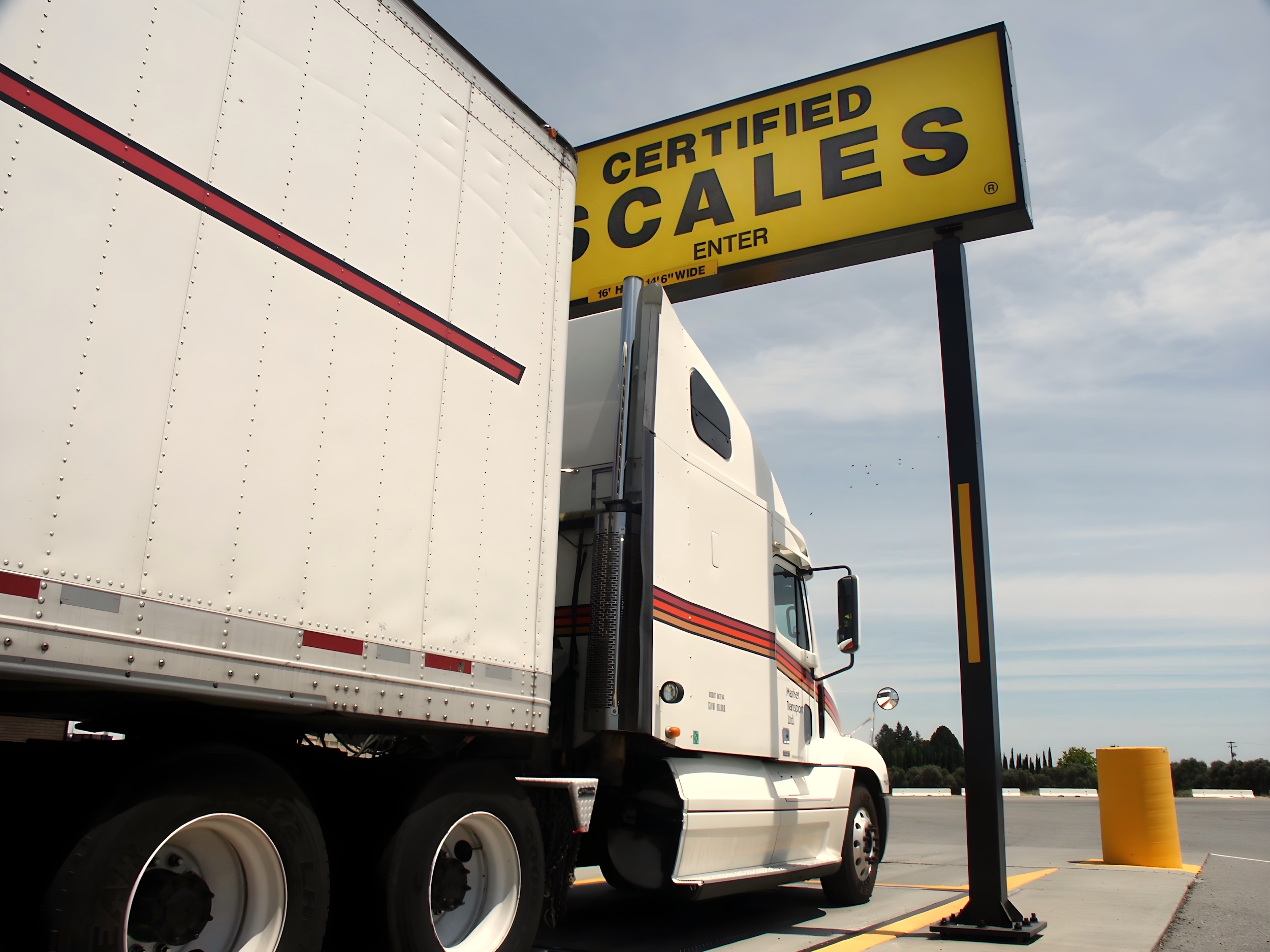
GVW stands for Gross Vehicle Weight. This refers to the weight of the vehicle at a particular point in time, taking into account all the components, including the cargo, passengers, fuel, tools, and accessories that have been added. GVW is a measure and not a rating, and it changes each time you add or remove something from the vehicle. You can get the most accurate reading from the CAT scales found in most Pilot and Flying J stations.
Gross vehicle weight rating (GVWR)
GVWR is the maximum safe operating weight the manufacturer certifies for that vehicle, calculated from the limits of the engine, suspension, brakes, and frame working together. It is printed on the driver’s door jamb label. No aftermarket modification changes it without a formal re-certification. GVWR is the number the law enforces. It also determines what vehicle class the truck sits in and whether its driver needs a CDL. As explained in the fleet VIN guide, GVWR is encoded into the vehicle identification number itself.
Payload Capacity = GVWR – Curb Weight
Payload is the overall carrying capacity of a vehicle, including the weight of the cargo and passengers, as well as any additional weight placed on it. For instance, if a truck has a GVWR of 26,000 lbs and a curb weight of 18,500 lbs, its payload capacity will be 7,500 lbs. However, in real life, shooting for 80%-90% of this number will give you some leeway.

GAWR and GCWR: The two ratings fleet managers often overlook
The GAWR is determined for each axle independently by the manufacturer. While a vehicle whose total weight is below the total GVWR could still violate the law, this will occur only when the load on one of the axles exceeds its individual GAWR. One example of this is improperly loaded flatbed or box trucks.
GCWR (Gross Combined Weight Rating) governs any towing setup. It is the total maximum weight of the truck plus the trailer combined. For any operation pulling a load, GCWR is the controlling number, not GVWR alone.
Neither rating is printed prominently on the door jamb label the way GVWR is, which is why both get missed. A load can look legal by gross weight and still trigger a citation at the scale if per-axle limits are exceeded.
US commercial vehicle weight classes
FMCSA regulations kick in at a GVWR of 10,001 lbs. CDL requirements begin at 26,001 lbs. All vehicles over 10,001 lbs are subject to DOT roadside inspections across all six inspection levels.
| Class | GVWR range | Example vehicles | CDL / FMCSA note |
| 1 | 0 to 6,000 lbs | Small pickups, SUVs | No CDL, no FMCSA |
| 2 | 6,001 to 10,000 lbs | Full-size pickups, cargo vans | No CDL, no FMCSA |
| 3 | 10,001 to 14,000 lbs | Medium cargo vans, step vans | FMCSA CMV threshold begins |
| 4 | 14,001 to 16,000 lbs | City delivery trucks | FMCSA regulations apply |
| 5 | 16,001 to 19,500 lbs | Bucket trucks, larger delivery | FMCSA regulations apply |
| 6 | 19,501 to 26,000 lbs | Box trucks, single-axle trucks | Full FMCSA CMV regulations |
| 7 | 26,001 to 33,000 lbs | Refuse trucks, city transit buses | CDL required |
| 8 | 33,001 lbs and above | Semi-trucks, heavy haulers | CDL required; federal 80,000 lb limit on interstate highways per 23 USC § 127 |
The consequences of exceeding GVWR: Fines, safety, and wear
Legal
Federal civil penalty authority under 49 U.S.C. § 521(b) sets the ceiling at $16,000 per axle for commercial vehicles operating outside size and weight regulations. State penalties land on top of that. Most states run a tiered per-pound schedule, ranging from around $100 to $1,000 or more per 1,000 lbs over the limit, with the exact figures varying considerably by jurisdiction. Repeat violations can lead to operating suspension. On the CSA side, overweight violations register in the Vehicle Maintenance BASIC, which affects a carrier’s safety percentile and the rates shippers offer them.
Safety
FMCSA data on cargo tank rollovers puts the annual count at over 1,300 in the US, roughly four every single day. Overloading shifts a vehicle’s center of gravity upward and makes the load harder to control through turns and emergency maneuvers. Stopping distances also stretch considerably when a vehicle is over its rated weight, and that gap between legal load and what the truck is actually carrying becomes the gap between avoiding an incident and
Wear and mechanical consequences
Chronic overloading does not fail immediately. It compounds. Brake components wear faster than baseline. Tires delaminate. Suspension degrades ahead of schedule. Transmission temperatures run hot. None of this shows up at the weigh station because these are gradual failures, not sudden ones. As laid out in the predictive maintenance guide, overloading is one of the more consistent early indicators of accelerated component wear, and the damage accumulates well before a driver has any reason to flag a problem.

GVWR and the 2026 Section 179 deduction: What fleet procurement needs to know
GVWR determines more than compliance. It determines which tax bucket a vehicle lands in the moment you buy it.
For 2026, the IRS caps the Section 179 deduction for SUVs with GVWR between 6,001 and 14,000 lbs at $32,000. Vehicles in that weight range that are not classified as SUVs, along with vehicles over 14,000 lbs GVWR, are treated as equipment and may qualify for 100% bonus depreciation on the remaining basis after any Section 179 election.
A commercial van rated at 6,200 lbs GVWR and one rated at 5,800 lbs GVWR are in entirely different IRS categories. The first-year deduction difference between those two configurations can run into the tens of thousands of dollars. For fleet procurement teams evaluating vehicle specs, GVWR belongs on the same spreadsheet as payload capacity and acquisition cost.
Tax rules change year to year, and state-level deductions vary. Have a tax professional review your specific fleet acquisition plan before locking in vehicle specs.
How telematics detects chronic overloading before it becomes a violation
A vehicle running at 110% of its GVWR on every delivery run will not appear on any daily report as an overloading event. It will appear as a brake job that comes due 40,000 miles early. Then a tire failure. Then, a DOT out-of-service order is issued at the next roadside inspection after the inspector notices what the maintenance records show.
Most fleet management workflows have no mechanism for catching this. There is no alert when a driver loads 500 lbs past the payload limit. No flag when it happens three days in a row. The first hard signal is usually a repair invoice, and by then the damage is already done.
What shows up in OBD-II data from a vehicle that is regularly overloaded:
- Brake pressure readings are trending outside the normal range for that vehicle’s class and route profile
- TPMS readings showing pressure drops consistent with tires deforming under excess load
- Transmission temperature spikes that track above baseline for comparable trip distances
- Fuel consumption running above the expected range for the vehicle class on similar routes
Any one of these in isolation looks like a maintenance flag. As a pattern across multiple trips on the same vehicle, it points to a load problem, not a parts problem. These signals feed directly into predictive maintenance models that can flag the pattern before it becomes a component failure.
Overloading rarely announces itself. A driver loads the truck, closes the doors, and gets on the highway. Nothing on the dashboard says the vehicle is at 108% of its GVWR. Nothing flags the fact that the brake system is now working harder than it was rated for, that the tires are deforming under load, or that the transmission is running hot on a route it has done a hundred times before.
The damage compounds quietly. By the time it surfaces — as a brake job, a tire failure, or a DOT out-of-service order — the vehicle has already logged thousands of miles in that condition. Standard fleet management workflows have no mechanism for catching this in real time. There is no overloading alert in a mileage log.
What does show up is in the OBD-II data: brake pressure trending outside the normal range for that vehicle’s class, TPMS readings dropping below baseline, transmission temperatures tracking above expectation for the route. These are the early indicators of a load problem — and they appear well before the weigh station or the repair invoice.
Intangles monitors 250+ vehicle parameters across a fleet, including the specific signal patterns that correlate with chronic overloading. The result is visibility into a problem that most fleets have no other way to catch.
Discover how Intangles detects overloading patterns across your fleet with predictive vehicle health monitoring before they become breakdowns, fines, or liability claims, and speak with our team to see what your vehicles are already showing.
KNOW MORE
Frequently Asked Questions
What is the difference between curb weight and gross weight?
Curb weight is the empty weight of the vehicle, which includes a full fuel tank, full fluids, no passengers, and no cargo. GVW refers to the current gross weight of the vehicle at any given moment, whether loaded or not. The gap between the two on any particular trip gives an indication of the weight being transported by the vehicle.
Where do I find the GVWR on a commercial vehicle?
It can be found on the sticker provided on the safety certification by the government on the driver’s door jamb. It is also included in the vehicle’s VIN and the manufacturer’s specification sheets. If you have modified the car after it was made, you should check that it reflects the recertification that might have taken place during modification.
What happens if a commercial vehicle exceeds its GVWR?
Federal civil penalties reach $16,000 per violation under 49 U.S.C. § 521(b), with state fines and potential out-of-service orders added on top. Longer term, chronic overloading accelerates brake wear, degrades suspension, and shortens vehicle lifespan in ways that don’t show up at the weigh station until it’s already an expensive problem. CSA score damage in the Vehicle Maintenance BASIC can follow as well.
What is GAWR, and why does it matter separately from GVWR?
GAWR is the maximum weight rating assigned to each individual axle. A vehicle can sit comfortably under its total GVWR and still be cited at a weigh station if one axle is over its GAWR because the load was not distributed evenly. A flatbed with cargo piled toward the rear is a common real-world version of this. Weigh station officers check per-axle loads independently of gross weight.
How do I calculate payload capacity for my fleet vehicle?
Payload capacity equals GVWR minus curb weight. Both figures are on the door jamb label. A Class 6 box truck with a GVWR of 26,000 lbs and a curb weight of 18,200 lbs has a payload capacity of 7,800 lbs. Targeting 80 to 90% of that on a loaded run leaves margin for real-world load variation. For fleets regularly running close to payload limits, Intangles’ predictive health monitoring surfaces the OBD-II signals that indicate a vehicle is consistently being loaded past its design threshold.







We’re looking forward to meeting you