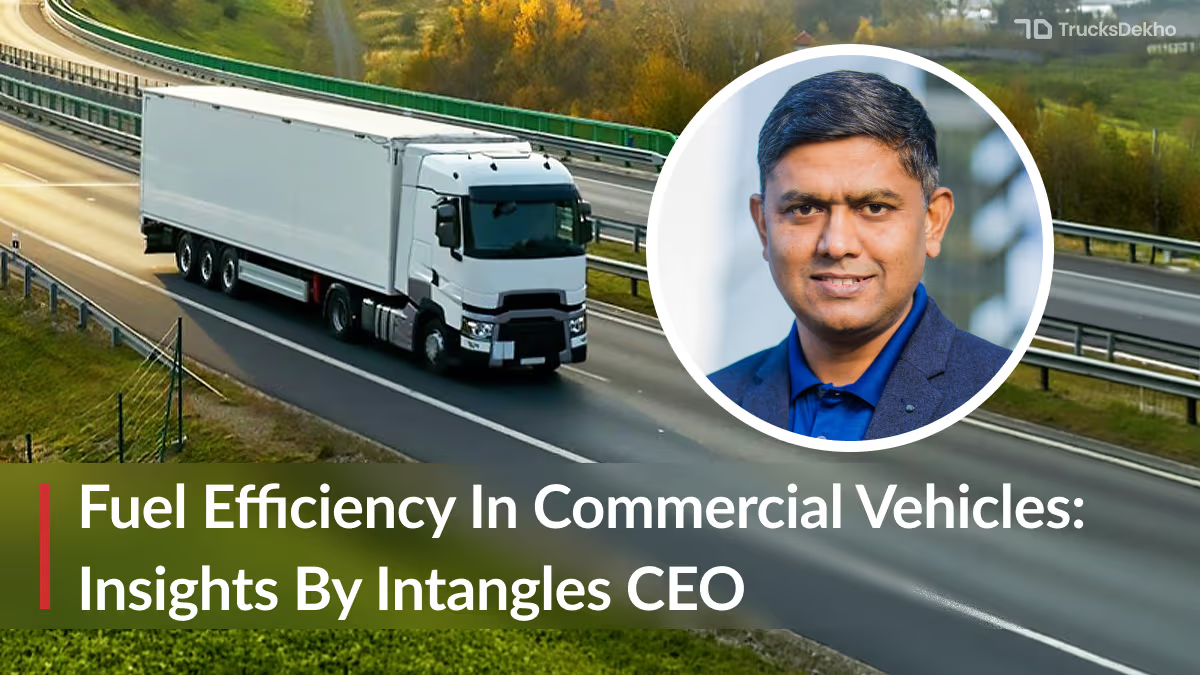
Fuel efficiency plays a significant part in the success and profitability of commercial fleets. Over the course of a vehicle’s life, even a slight increase in mileage can result in significant cost savings because fuel is one of the highest operating costs for transport operators. Improved fuel efficiency helps fleet owners save operating costs, boost margins, and enhance overall operational efficiency in the fiercely competitive logistics and transportation sector.

Predictive analytics uses advanced algorithms and artificial intelligence (AI) to reduce fuel consumption, forecast commercial vehicle failures, optimise routes, and enhance asset utilisation in place of reactive maintenance or human planning. This helps fleet managers optimise downtime, lower operating costs, and boost overall efficiency. Let’s discuss it in more detail with Anup Patil, CEO and Co-founder of Intangles.
Q1. With fuel prices and geopolitical tensions creating uncertainty globally, how vulnerable is India’s commercial transport sector to rising fuel costs today?
Fuel prices have always had a strong bearing on commercial transport economics, because fuel remains one of the largest operating expenses for fleet operators. In many Indian freight operations, particularly long haul applications, fuel can account for more than 50 percent of operating costs. As a result, periods of global price uncertainty naturally make fuel efficiency and cost discipline even more important for the sector.

Honourable PM Modi’s fuel conservation appeal in May 2026, triggered by the US-Iran conflict’s impact on global crude markets, sharpens this further. Fuel prices are no longer a reliable constant for fleet operators to plan around. Fleet operators need systems that help them identify where fuel is being lost and act on it before it reaches their bottom line.
At Intangles, we see fuel efficiency improvements of 2 to 10% achievable across connected fleets without additional hardware. In a cost structure where fuel is the single largest line item, that recovery is substantial.
Q2. PM Modi has recently spoken about the need to reduce fuel consumption. From a logistics industry perspective, what practical steps can fleet operators take immediately without affecting delivery timelines?
In most fleets, the first gains come from operational precision across three areas.
Driver behaviour is the most immediately actionable. Many vehicles are operated by drivers who have not received structured coaching on fuel-efficient technique. Poor driving practices alone account for approximately 5% of a fleet’s total fuel cost per vehicle. Across Intangles deployments, structured coaching has reduced harsh driving measurably, with improvements visible within weeks.
Vehicle health is the second and most underestimated area. Degraded vehicle health accounts for another 5% of fuel cost per vehicle, accumulating without any visible symptom until a breakdown forces intervention.

Idling is the third. It is often treated as unavoidable, but idling losses account for approximately 0.5% of total fuel cost per vehicle, a figure that compounds significantly across a fleet operating year-round.
Q3. When fleet operators investigate rising fuel costs, what are the most common problem areas they usually discover?
There is rarely one large problem. There are typically several moderate inefficiencies, each invisible on a standard fuel report, compounding into a significant cost drag.
Fuel theft is the most consistently underestimated. It only surfaces when fuel consumption is correlated with trip distance, driver identity, and fill location simultaneously. Standard fuel bills and kilometre logs do not make that connection.
Vehicle health degradation is equally silent. A clogged DPF forces more frequent regeneration cycles and raises backpressure, both increasing fuel consumption. Air intake restrictions, fuel rail pressure deviations, and early-stage engine overheating all degrade combustion efficiency progressively without triggering a fault code. By the time one appears, the efficiency loss has been accumulating for days or weeks.

Driving behaviour and route inefficiency complete the picture: harsh acceleration, overspeeding, poor gear discipline, congested corridors, and prolonged loading delays all contribute independently.
What operators consistently discover is that their fuel problem is a visibility problem. The losses are present and recoverable. They simply do not appear in fuel bills, kilometre logs, or basic GPS reports. The only way to recover them is to connect vehicle health, driver behaviour, fuel data, and trip intelligence into a single view and act on deviations early.
Q4. Many Indian fleets already use basic fuel-level sensors and GPS tracking. Why is simple monitoring no longer enough to drive meaningful cost savings, and how is predictive analytics changing fleet management today?
Basic monitoring answers one question: what happened. It records a fuel drop, a location, a halt. What it cannot tell you is why fuel consumption is rising, whether the cause is driver behaviour, a degrading sub-system, route inefficiency, or theft. All four produce the same output on a standard dashboard and require completely different responses.
The dominant conversation among fleet technology providers has shifted from reactive tracking to predictive intelligence. Traditional telematics systems pull a limited number of vehicle signals, sufficient for location and basic scheduling but insufficient for detecting early anomalies before they cause failures. The industry is entering what analysts describe as a third wave of fleet technology, connecting vehicle health signals, fuel behaviour, driver performance, and route patterns into a single analytical layer.

At Intangles, our platform delivers 96% predictive accuracy. The value is not the accuracy figure itself. It is the intervention window it creates between a developing risk and an operator’s ability to act on it. Across deployed fleets, this has translated into a 75% reduction in powertrain breakdown events.
Q5. Driver behaviour heavily influences fuel consumption. How can data-driven driver analytics be used constructively to train and incentivise drivers, rather than just policing them?
When driver data is used punitively, behaviour changes temporarily around the system and reverts. When it is used to coach, benchmark, and reward, the change sustains because the motivation is internal rather than compliance-driven.
India’s driver shortage makes this economically critical. With a confirmed shortage of 2.2 million skilled commercial vehicle drivers, experienced drivers are genuinely difficult to replace. A data-driven coaching programme improves the skills and fuel efficiency of existing drivers while reducing attrition, generating returns on both fronts simultaneously.

Intangles monitors more than 20 behavioural parameters including overspeeding, harsh braking, harsh acceleration, harsh cornering, idling patterns, and continuous driving duration. These translate into scorecards that rank performance against peers or against a driver’s own historical baseline. Across deployments, this visibility has contributed to 20 to 30% improvements in driving behaviour.
Q6. Indian highways and city routes are highly unpredictable. How can smarter route planning reduce fuel consumption in such conditions?
Indian freight operations operate in a highly dynamic environment where multiple factors such as weather or congestion can increase fuel consumption. In such scenarios, the shortest route is not always the most fuel-efficient one. Smarter route planning uses real-time and historical data to identify where vehicles are losing time and fuel. It can help fleet operators avoid recurring bottlenecks, reduce idle time, improve hub-to-hub movement, assign the right vehicles to the right routes, and intervene early when delays begin to affect turnaround time.
At Intangles, our platform supports continuous hub to hub tracking, intelligent route assignment, route fences, geo-fences, real time movement visibility and delay monitoring. This helps fleet managers move from static route planning to dynamic route intelligence. Our solutions have helped improve fuel efficiency by 2 to 10% and the larger benefit is that fleets can reduce avoidable fuel burn without compromising delivery commitments.

The key is to treat every route as a live operating environment, not a fixed line on a map. When route planning is connected with vehicle health, driver behaviour, fuel consumption and trip performance, fleets can make faster decisions, reduce waste and keep deliveries predictable even in difficult Indian road conditions.
Q7. For small-and-mid-sized fleet owners, investment in advanced fleet technology can feel expensive. What kind of fuel savings or operational benefits typically justify the cost?
The investment question is not whether the technology is affordable. It is what operating without it is actually costing.
On fuel alone, a 5% efficiency improvement on a 10-truck fleet is a material monthly recovery. Intangles platform data shows fleets achieving ROI in under six months. Unplanned breakdowns are disproportionately damaging for smaller operators with no spare capacity to redeploy and no framework service agreements. Across Intangles deployments, powertrain breakdown events have reduced by 75%. Preventing two or three major breakdowns a year changes the financial profile of an SME operation materially.

Fuel theft is a third layer that rarely appears on standard reports. The loss only becomes visible when fill events, driver identity, trip distance, and location data are connected. For most SME operators, once those connections are made, the return on the technology investment is not a projection. It is already present in the operation, waiting to be recovered.
Q8. Implementing data-driven fuel intelligence requires digital literacy from fleet managers and dispatchers. What are the biggest cultural or operational hurdles Indian transport companies face when adopting these technologies?
The barrier is not digital literacy. Most experienced fleet managers have deep practical knowledge of their vehicles, routes, and drivers. The real barriers are trust, relevance, and simplicity of action.
Fleet operators adopt technology when the insight is trusted, actionable without specialist interpretation, and reaches the right person at the right moment. A dashboard requiring analyst-level interpretation before a dispatcher can act will not be used in an SME context where one person often manages operations, vendor relationships, and driver coordination simultaneously.

Alert fatigue is a related and frequently underestimated problem. Systems that generate hundreds of notifications quickly lose credibility. What fleet teams need is prioritised intelligence: severity ranked, with likely impact and a clear recommended action attached.
The AIS-140 mandate, requiring certified GPS units on all commercial vehicles registered from April 2019, means baseline connectivity is already in place across most of the addressable market. Predictive fleet intelligence builds analytical capability on data the vehicle is already generating, which lowers both the cost and the complexity of adoption significantly.
The cultural dimension is also real. A driver behaviour programme introduced as surveillance will be resisted. The same programme framed around coaching, fair benchmarks, and clear incentives generates a different response entirely. Operators who invest in change management around technology adoption, not just the technology itself, consistently see faster uptake and better sustained results.
Q9. What % savings are realistically possible using Intangles? Can you share a real example of significant fuel consumption reduction?
Realistic savings depend on fleet type, route profile, vehicle age, and how consistently an operator acts on the intelligence the platform surfaces. Technology does not save fuel. Operational decisions informed by technology do.
Across Intangles deployments, fuel efficiency improvements range from 2 to 10%, fleet uptime improvements from 10 to 30%, warranty cost reductions of 10 to 15%, and a 75% reduction in powertrain breakdown events.
A concrete example: a 20-tanker petroleum distribution fleet based in Bangalore was running contracted routes with fuel bills that looked normal on standard reports. Nothing had flagged a problem. Intangles surfaced a 20% fuel efficiency gap that had gone undetected, translating to ₹72 lakh in annual losses and ₹6 lakh in recoverable savings every month, with zero operational disruption and no modifications to the vehicles. The full case study is available at intangles.ai/lpind/fuel-s2.
The deployment pattern is consistent across fleets. The first three months surface the most visible returns: losses identified with location and route-specific precision, idling reduced through targeted coaching, and vehicles with degraded health and elevated consumption caught before any fault code appears. After that, returns shift to sustained optimisation as the platform builds fleet-specific intelligence over time.
For operators evaluating the investment, the more useful question is not what % saving is achievable. It is what the current visibility gap is costing in theft, avoidable breakdowns, and degraded vehicle health that existing systems are not measuring. In most cases, once that is answered with data rather than estimates, the return is already present in the operation, waiting to be recovered.
Bottomline
Fleet operators are paying more attention to commercial vehicles, operating techniques, and technology that provide improved fuel efficiency as freight demand rises and fuel costs continue to fluctuate. Predictive analytics will become more crucial in reducing operating costs, improving safety, and increasing fleet productivity as commercial fleets continue to adopt digital technologies. It enables companies to create fleet operations that are more intelligent, reliable, and prepared for the future.





We’re looking forward to meeting you