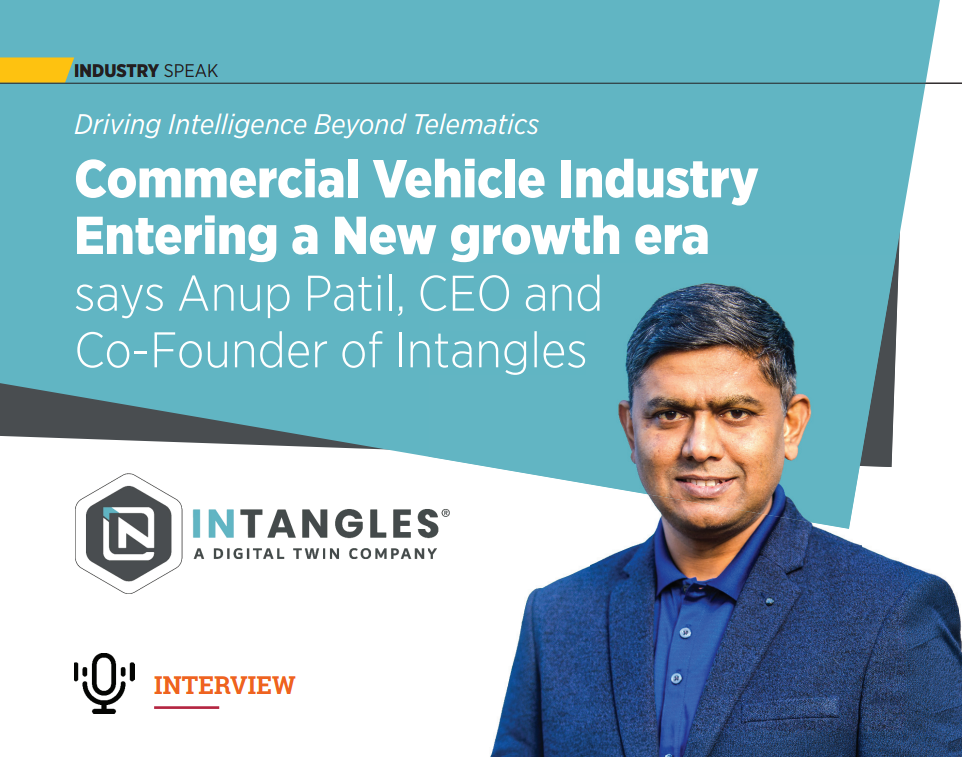
Industry Speak: Driving Intelligence Beyond Telematics
Commercial Vehicle Industry Entering a New Growth Era
Interview with Anup Patil, CEO and Co-Founder of Intangles
Bus Coach India | July 2026 • Vol. XVII • Issue 07 • New Delhi
As India’s commercial vehicle sector enters a new phase of expansion, digital intelligence is becoming as critical as the vehicles themselves. Rising infrastructure spending, rapid fleet electrification, stricter safety regulations, and increasing pressure on fleet profitability are driving operators to adopt smarter, data-led solutions. In this interview, Anup Patil shares his perspective on the evolving commercial vehicle market, the growing role of AI-powered fleet intelligence, and how Intangles is strengthening its presence across India’s mobility ecosystem while expanding globally.
Q1. HOW DO YOU VIEW THE CURRENT INDIAN AUTOMOTIVE MARKET, PARTICULARLY THE COMMERCIAL VEHICLE SEGMENT? WHAT IS INTANGLES’ MARKET PENETRATION AND PRESENCE IN THIS SECTOR?
The Indian commercial vehicle segment is in strong growth, and the recovery is broad-based and well-supported. Infrastructure investment is running at a scale the country has not seen in decades. Bus procurement is in its third consecutive year of sustained momentum, driven by STU replacement cycles, route network expansion, and the PM E-Drive scheme accelerating electric bus adoption at fleet scale. We believe it is a structural demand and not only a short upcycle.
Running alongside this growth is a significant shift in what operators are asking for. Fleet managers today are not asking whether to adopt technology. They are asking which technology genuinely connects fuel, uptime, safety, and driver behavior into one coherent system rather than four separate tools they have to reconcile manually. That shift in the question being asked reflects how seriously the industry is now treating operational intelligence as a competitive requirement.
Regulation is also reshaping the baseline. The government confirmed mandatory active safety requirements for heavy buses and trucks in early 2026, covering emergency braking, lane departure warning, drowsiness detection, and blind spot monitoring, with phased implementation through 2027 and 2028. For operators and OEMs, these timelines are already driving procurement and engineering decisions today.
Intangles has been working in this space since 2016. We operate across 18 countries, more than 500,000 vehicles, over 40 OEM and enterprise partners, and more than 500 people. Our OEM partnerships in India include Mahindra Truck and Bus and Force Motors, and prominent EV Bus OEMs. We serve freight and logistics, state and intercity buses, school transport, construction, mining, agriculture, cold chain, last-mile delivery, municipal operations, and gensets, across both ICE and electric fleets.
Q2. HOW IS INTANGLES’ DIGITAL TWIN TECHNOLOGY ADDRESSING THE EVOLVING NEEDS OF FLEET OPERATORS? HOW IS REAL-TIME DATA BEING USED TO IMPROVE FLEET PERFORMANCE, EFFICIENCY, AND DECISION-MAKING?
A coolant temperature reading or a voltage fluctuation means very little in isolation. What matters is whether it is normal or abnormal for that specific vehicle, under those specific operating conditions, at that point in its working life. Without that context, data becomes noise rather than intelligence.
Every vehicle on our platform has its own Digital Twin, a virtual model continuously updated from the vehicle’s onboard sensors and ECU, calibrated to that asset’s actual mileage, wear history, driver behavior, and duty cycle. This allows us to build an expected behavior model and detect deviations well before a fault surfaces through the vehicle’s own systems, across mixed fleets from different OEMs. The result is measurable reduction in powertrain breakdowns and sustained improvement in fleet uptime.
For ICE fleets, this translates directly into fuel intelligence. Rather than adding instrumentation, we work through the sensors the OEM has already installed in the vehicle. Our machine learning layer learns to distinguish genuine fuel movement from the distortion that tank geometry, road gradient, and vehicle motion introduce into a raw reading. That distinction is what allows us to identify a loss event with real confidence, giving fleet managers evidence as it happens rather than a pattern to investigate weeks later.
For electric fleets, the Digital Twin addresses dimensions conventional tools were never designed for. Standard Distance-to-Empty estimates fail because they ignore real-world variables. Our Ambient-Cognitive Range Prediction integrates motor torque, wheel speed, weather, HVAC and lighting load patterns, driver behavior, and BMS degradation history to deliver a range forecast that holds up operationally. The platform monitors battery coolant temperatures to flag overheating risk early, tracks cell-level voltage for imbalance, and profiles charging sessions to maintain the right fast-to-slow ratio.
The Digital Twin draws continuously from both the individual vehicle’s history and patterns across comparable vehicles on the platform. Our predictive models run at 96% AI accuracy. That is what moves operators from monitoring to anticipation, from reacting to what happened to acting on what is about to.
Q3. HOW CAN DATA SHARING BETWEEN OEMS, FLEET OPERATORS, AND TECHNOLOGY PROVIDERS CREATE A MORE INTELLIGENT MOBILITY ECOSYSTEM?
Intangles sits across relationships with more than 40 OEM and enterprise partners, which means we see something most single-OEM platforms never do: how the same fleet problem manifests differently depending on which manufacturer built the vehicle, which routes it runs, and which operator is managing it. That cross-OEM visibility is where the real pattern recognition lives, and it is only possible because the platform was architected for integration from day one rather than built inside one manufacturer’s ecosystem and retrofitted for others later.
The bus segment makes this particularly visible. A depot managing state-contract routes, school transport, intercity services, and electric buses simultaneously is almost always doing so across multiple OEMs. If intelligence stays locked inside each manufacturer’s data ecosystem, the operator never gets a single consistent view of fleet performance. They get fragments that have to be manually reconciled, which is both time-consuming and error-prone.
Opening that data benefits every party. OEMs gain access to real-world behavior across thousands of deployed units that no test environment can replicate, directly informing warranty planning and product development. Fleet operators get a more complete picture than any single source provides. Technology providers synthesize across multiple OEM relationships into something an operator can act on the same day.
The condition for this to scale is a clearer industry framework around consent, data ownership, and privacy. That work is still incomplete, and until it matures, the full value of ecosystem-level data sharing will remain partially unrealized. Platforms with established cross-OEM relationships are better positioned to deliver on that value when the framework catches up.
Q4. WHAT ARE THE BIGGEST CHALLENGES FLEET OPERATORS FACE TODAY, AND HOW IS INTANGLES HELPING SOLVE THEM?
After working with fleet operators across 18 countries since 2016, the challenges are consistent in their structure even when the markets differ. The core problem is almost always the same: operators are managing expensive, complex assets with information that arrives too late to be fully useful.
Unplanned downtime is the clearest expression of this. A breakdown mid-route does not cost only the repair. It costs the tow, the replacement, the delay, and often the customer. Most fleets are still organized around reacting to failures rather than anticipating them. Our platform identifies potential issues well before they would surface through the vehicle’s own systems, giving operators time to schedule an intervention rather than manage a crisis.
Fuel loss operates on the same dynamic but the information gap is worse. Unauthorized fills, adulteration, and underfilling happen continuously and silently, surfacing only when cumulative patterns in a month-end report suggest something has been going wrong for weeks. Because we work through the sensors the OEM has already built into the vehicle, we can surface these events in real time, changing the conversation from retrospective investigation to active prevention.
Driver behavior is the challenge most consistently underestimated, because its costs are distributed rather than concentrated. The same driver who brakes harshly is also idling longer, accelerating inefficiently, and accumulating wear across multiple components at once. Those effects show up separately in fuel costs, maintenance records, and insurance claims rather than in a single visible number. Our Driver Profiling module connects those dots, linking each behavioral pattern to its downstream consequence so that coaching is specific rather than general.
The fourth challenge is the one growing fastest: managing a fleet that includes both electric and diesel vehicles. The failure modes, health indicators, and range variables of an electric powertrain are fundamentally different from diesel, and running both on the same visibility tools produces blind spots on the electric side. Our EV intelligence layer addresses this within the same platform, so operators are not maintaining two parallel systems.
Q5. WHAT IS YOUR VISION FOR INTANGLES OVER THE NEXT FIVE YEARS, AND HOW DO YOU PLAN TO LEAD THE NEXT WAVE OF INNOVATION IN CONNECTED MOBILITY?
The direction we are moving toward is a world in which a commercial vehicle is never a black box. Not to the fleet operator, not to the OEM that built it, and not to the ecosystem of workshops, parts suppliers, and service networks that keep it running. Every system on that vehicle, the engine, the transmission, the fuel system, the battery, the driver behind the wheel, communicates its state continuously, and that state is understood deeply enough that what happens next can be anticipated rather than discovered.
We are already partway there. Our platform today correlates signals across multiple vehicle systems simultaneously, identifies anomalies that no single sensor would surface on its own, and tells an operator not just that something is wrong but what is wrong, why, and what to do about it, including specific repair strategies. That is a significant departure from where the industry was even five years ago. But it is not where this ends.
The next frontier is intelligence that operates at the network level, not just the vehicle level. When the platform covers vehicles continuously sharing behavioral data across varied geographies, duty cycles, and OEM configurations, it begins to see things that are invisible at the individual vehicle level. A component stress pattern emerging across a specific engine variant before any individual vehicle has thrown a code. A route characteristic in a particular geography that is systematically accelerating wear on a specific system. A charging behavior across an electric fleet segment that is shortening battery lifespan in a way that will only become visible in warranty claims two years from now. At scale, the data becomes a predictive instrument for the entire industry, not just the individual operator.
The logical extension of this is that fleet operators stop making maintenance decisions in the conventional sense. The platform identifies the issue, recommends the intervention, schedules it against the operator’s route plan, and coordinates with the service network to ensure the right parts and the right technician are available at the right moment. The operator’s job shifts from managing problems to reviewing outcomes. The vehicle, in effect, participates in its own maintenance.
For OEMs, the implication is equally significant. Real-world performance data flowing back from hundreds of thousands of deployed vehicles, correlated by geography, duty cycle, driver profile, and environmental condition, is the most valuable product development input that has ever existed. OEMs connected to this intelligence will design better vehicles, price warranties more accurately, and intervene in systemic issues before they reach field failure scale.
We see Intangles as the platform that sits at the center of this ecosystem. Not a telematics layer, not a monitoring dashboard, but the intelligence infrastructure through which vehicles, operators, OEMs, and service networks communicate with each other in a language of prediction rather than reaction. The capital to build toward this is in place following our USD 30 million Series B in October 2025, led by Avataar Venture Partners with continued backing from Baring Private Equity India and Cactus Partners. We were named AWS Sustainability Partner of the Year for Asia Pacific and Japan at the 2025 AWS Partner Awards, and Tech Startup of the Year in the AI category at the Entrepreneur India Awards. The scale to make the models meaningful is already there. The question for the next five years is how completely we can close the gap between what a fleet generates and what the people responsible for it actually know.
Q6. ROAD SAFETY IS BECOMING A TOP PRIORITY WORLDWIDE. HOW DO YOU SEE ADAS TRANSFORMING FLEET SAFETY? WHICH ADAS FEATURES ARE PROVING MOST EFFECTIVE IN PREVENTING ACCIDENTS IN COMMERCIAL VEHICLES?
India’s road safety challenge is one that the commercial vehicle industry has a direct responsibility to address. Heavy buses and trucks are disproportionately involved in severe accidents, and the contributing factors, driver fatigue, delayed reaction, blind zone incidents in dense traffic, are known and largely preventable with the right systems in place. ADAS is the most direct technological intervention available, and the regulatory momentum behind it is now unambiguous.
The government confirmed mandatory active safety requirements for heavy buses and trucks in early 2026, requiring Advanced Emergency Braking under AIS 162, lane departure warning, drowsiness detection, and blind spot monitoring, with implementation timelines from October 2027 through January 2028.
Emergency braking is the most consequential of the mandated systems in practice. It intervenes at the exact moment a driver fails to react, which matters most in heavy commercial vehicles where stopping distances are substantially longer. The physics of a loaded bus or truck in a rear-end situation are categorically different from a passenger vehicle, and the intervention has to be automatic to be effective.
Drowsiness detection is the one I would specifically emphasize for the Indian bus and long-haul context. The fatigue profile here is shaped by night operations, heat, route lengths, and driver schedules that accumulate stress across multiple shifts. Drivers in this environment frequently cannot self-assess their own impairment accurately. A system that reads steering pattern and eye behavior to flag degradation before it becomes a collision risk is not a feature. It is the core safety requirement for this operating environment.
Blind spot monitoring addresses a different exposure: dense urban corridors where pedestrians, cyclists, and two-wheelers sit in zones the driver physically cannot see during low-speed turns. This is a daily risk in every city bus operation in India, and it is highly preventable with the right system in place.
Our Video Telematics platform processes all alerts on-device rather than depending on a cloud connection first, which matters significantly across intercity and rural routes where network coverage is inconsistent. The system detects distraction, drowsiness, lane drift, and unsafe following distance and delivers an in-cabin voice alert while the driver can still act on it. Every event is timestamped, geotagged, and linked to driver identity and footage, giving managers something concrete to coach against and a reliable record for insurance and compliance. Across fleets running Driver Profiling and Video Telematics together, we document 20 to 30% improvement in driver behavior.
Q7. FUEL COSTS REMAIN A MAJOR CONCERN FOR FLEET OPERATORS. HOW DOES INTANGLES HELP REDUCE FUEL CONSUMPTION, AND HOW DOES YOUR FUEL MEASUREMENT TECHNOLOGY IMPROVE MONITORING ACCURACY?
The losses fleet managers find hardest to control are not the ones driven by crude prices. They are the ones happening inside the operation: fuel siphoned from the tank, adulteration at the point of filling, vehicles topped up at unauthorized stations, quantities recorded that were never actually delivered. These are continuous, quiet, and invisible until a month-end report surfaces patterns that are already weeks old.
The accuracy problem is what makes this harder to solve than it appears. OEM fuel sensors were not designed for enterprise-grade measurement precision. Tank geometry, vehicle gradient, fuel movement during transit, and parking angle all distort a raw sensor reading. Most conventional monitoring tools attempt to work around this distortion by setting thresholds, which means they either miss genuine loss events or generate enough false alerts that operators stop acting on them. Our machine learning models are trained specifically to separate environmental noise from genuine fuel movement, so we can identify the exact time, GPS location, and volume of an unauthorized fill or drain with confidence rather than approximation.
Critically, we do all of this through the sensors the OEM has already installed in the vehicle. There is no additional hardware to fit, no fuel tank to open and modify, and no impact on the manufacturer’s warranty. The system is calibrated and operational within minutes of installation. This matters to operators not just for cost reasons but because any modification to the fuel system creates complexity that most fleet managers want to avoid entirely.
Beyond theft and adulteration detection, tracking fuel cost per kilometer at individual vehicle level consistently surfaces mechanical inefficiency, a vehicle consuming measurably more than comparable units under identical conditions, well before any fault code would appear.
Driving behavior is the other dimension that belongs in this conversation. Harsh acceleration, excessive idling, free-running in neutral, and overspeeding each carry a direct and calculable fuel cost. Because our Driver Profiling module tracks these behaviors within the same platform, the fuel picture and the behavioral picture are connected rather than managed by separate teams working from separate tools. The combined effect is fuel efficiency improvement that compounds over time as behavior improves and mechanical inefficiencies are caught earlier.




We’re looking forward to meeting you