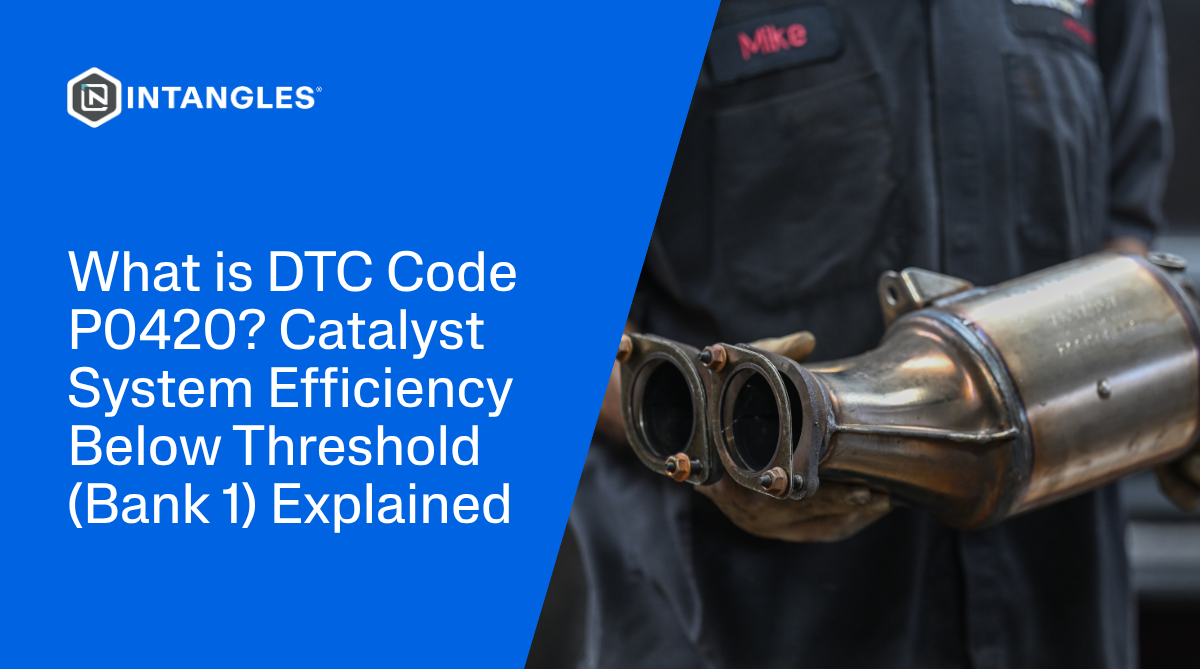
P0420 is the OBD-II code for Catalyst System Efficiency Below Threshold on Bank 1, set when the downstream oxygen sensor signal starts looking almost as active as the upstream signal, a sign the bank 1 catalytic converter has lost its ability to store and release oxygen efficiently. It’s one of the most common codes a fleet will ever see, since every gasoline engine has at least one bank 1 converter, and converters have a finite service life regardless of how well the rest of the vehicle is maintained.
KEY TAKEAWAYS
- P0420 means the bank 1 catalytic converter’s downstream oxygen sensor signal is behaving almost as erratically as the upstream signal, indicating lost efficiency.
- On any four- or six-cylinder engine with a single exhaust bank, P0420 is the only catalyst code that can ever appear, since there’s no bank 2.
- Straightforward age is a common cause, especially past 100,000 miles, but a misfire, a rich-running condition, or oil or coolant contamination can damage a converter well before then.
- A bad downstream oxygen sensor or a wiring fault can trigger P0420 even when the converter itself is still healthy.
- Replacing the converter before ruling out a misfire or fuel trim issue often means paying for a new converter twice, since the same root cause can damage it again.
- A vehicle with an active P0420 will fail an emissions inspection, which is often how the code gets found in the first place.
In this guide, we cover what triggers P0420, the most common causes, symptoms to watch for, how to diagnose it correctly before replacing parts, how to fix it, and why it matters more for fleets running multiple vehicles.
What P0420 means
P0420 might be the single most common code a fleet ever sees, and there’s a simple reason for that: every gasoline engine has at least one catalytic converter on bank 1, and converters have a service life that eventually runs out no matter how well the rest of the vehicle is maintained. On any four- or six-cylinder engine with a single exhaust bank, this is also the only catalyst code that can ever show up, since there’s no bank 2 to speak of.
The logic behind the code is the same as any catalyst efficiency check. The computer watches the oxygen sensor readings from in front of and behind the bank 1 converter. Before the exhaust reaches the converter, the upstream sensor’s signal jumps around fast, reacting directly to the engine’s constantly shifting air-fuel mixture. After the exhaust passes through a healthy converter, the downstream sensor’s signal is calmer, because a good converter stores and releases oxygen as part of the reaction that scrubs pollutants out, and that storage capacity smooths the signal. As the converter’s internal coating wears down with age, contamination, or heat damage, it loses that storage ability, and the downstream signal starts looking almost as jumpy as the upstream one. Once that similarity holds across a calibrated drive cycle, the computer logs P0420.
What causes it
Straightforward age accounts for a lot of these codes, especially past the 100,000-mile mark, but it’s worth checking for a cause that damaged the converter early rather than assuming it just wore out on its own. A misfire is the classic culprit: unburned fuel dumped into the exhaust from a misfiring cylinder overheats the converter’s coating fast, sometimes badly enough in a single drive to cause lasting damage. Running rich for an extended stretch has the same overheating effect, and that can come from a leaking fuel injector, a failing upstream oxygen sensor feeding bad fuel trim data, or a stuck-open fuel pressure regulator. Oil or coolant getting into the exhaust stream through a failing seal, gasket, or worn piston ring coats the catalyst surface directly and cuts its efficiency. A bad downstream oxygen sensor, or a wiring problem feeding it a false signal, can also trigger P0420 even when the converter underneath is still healthy, which is exactly why checking the sensor belongs early in the diagnostic process rather than last.
Symptoms to watch for
Most vehicles with a straightforward P0420 show no driveability symptoms at all beyond the check engine light. When the real cause is a misfire or a rich condition instead of simple age-related wear, drivers usually notice reduced fuel economy, a rough idle, or a sulfur smell from the tailpipe. A vehicle scheduled for an emissions inspection is going to fail with this code active, and that’s often how the problem gets found in the first place on a truck that otherwise seems fine.
Diagnosing P0420
Given how many different things can cause P0420, going straight to a converter replacement the moment it appears is the most expensive way to handle it, and often the wrong call. A technician should first check for other codes stored around the same time, particularly misfire or fuel trim codes, because fixing an active misfire or correcting a rich-running condition costs a fraction of what a converter does and might be the entire fix needed. Comparing live upstream and downstream oxygen sensor waveforms on bank 1 confirms whether the converter itself has genuinely lost efficiency. A visual check and smoke test of the exhaust ahead of the converter ruled out an air leak that could be skewing the upstream sensor’s reading.
Intangles tracks DTC history, misfire counters, and fuel trim data together across a fleet, so a maintenance team has the full picture in front of it before signing off on a converter replacement instead of relying on the code by itself.
Fixing P0420
efficiency, replacing it is the correct call, and it should be an OEM or CARB-compliant part depending on where the vehicle is registered, since a generic converter can fail an emissions retest even after installation. If the root cause turns out to be a misfire, a rich condition, or a leaking gasket contaminating the exhaust stream, that has to get fixed first. A new converter installed on top of an unresolved misfire tends to fail the same way within a similar mileage window, which just means paying for the part twice.
Why it matters for fleets
P0420 is already an expensive code on its own, but the real cost comes from replacing converters over and over because the actual root cause, usually a misfire or a fuel delivery fault, never gets addressed.
How Intangles supports P0420 diagnosis and repeat-repair prevention
Replacing a converter without first checking for a misfire or fuel trim issue behind it is how the same repair ends up happening twice. Intangles tracks DTC history, misfire counters, and fuel trim data together across a fleet, so that context is available before a converter replacement gets signed off, not pieced together after the fact.
| Capability | How it supports P0420 handling |
| Cross-signal DTC tracking | Surfaces misfire counters and fuel trim data alongside the P0420 code itself, instead of the code standing alone |
| Converter replacement validation | Gives a maintenance team the full diagnostic picture before authorizing a replacement, reducing unnecessary parts spend |
| Repeat-repair pattern detection | Flags when the same root cause across a mixed fleet is driving converter replacements, so the underlying issue gets fixed instead of the part alone |
Explore the platform or get in touch with our team to see how Intangles helps fleets catch a misfire or fuel trim issue before it turns into a repeat converter replacement.
KNOW MORE
Frequently Asked Questions
What does code P0420 mean?
P0420 means the computer has detected that the bank 1 catalytic converter’s downstream oxygen sensor signal is behaving almost as erratically as the upstream signal, which indicates the converter has lost its ability to store and release oxygen efficiently.
Does P0420 always mean the catalytic converter needs replacing?
No. A bad downstream oxygen sensor, a wiring fault, a misfire, or a rich-running condition can all trigger P0420 even when the converter itself is still healthy or was only damaged by an unresolved underlying issue. Replacement should follow a full diagnosis, not come first.
What is the most common cause of P0420?
Straightforward age is common, especially past 100,000 miles, but a misfire is the classic early cause: unburned fuel dumped into the exhaust from a misfiring cylinder can overheat and damage the converter’s coating quickly, sometimes in a single drive.
Can a bad oxygen sensor cause P0420 without the converter being bad?
Yes. A faulty downstream oxygen sensor or a wiring problem feeding it a false signal can trigger the code on its own, which is why checking the sensor belongs early in the diagnostic process rather than after a converter has already been replaced.
Will P0420 cause a vehicle to fail an emissions test?
Yes. A vehicle with an active P0420 will fail an emissions inspection, and that inspection is often how the code gets discovered in the first place, since most vehicles show no other driveability symptoms.
Should the converter be replaced before or after fixing a misfire?
After. A new converter installed on top of an unresolved misfire tends to fail the same way within a similar mileage window, which means paying for the part twice. The misfire or fuel delivery issue should be corrected first.
How can fleets avoid replacing the same converter twice?
Tracking DTC history, misfire counters, and fuel trim data together across the fleet surfaces the actual root cause behind a P0420 pattern, rather than treating each converter replacement as an isolated repair.




We’re looking forward to meeting you