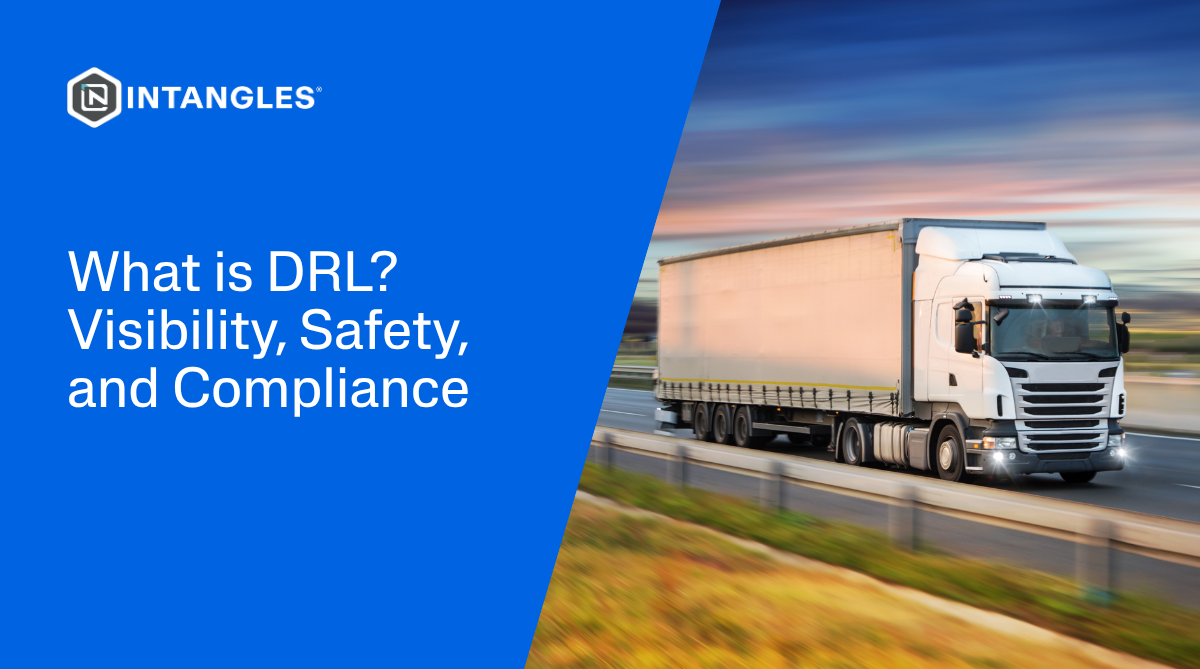
DRL stands for Daytime Running Light (also known as Daytime Running Lamp). DRLs are automatic front-facing vehicle lights that switch on the moment the engine starts. No switch, no driver action required. Their purpose is to make the vehicle more visible to other road users during daylight hours, not to illuminate the road ahead.
KEY TAKEAWAYS
- DRLs activate automatically on ignition, standardizing visibility across every vehicle, every driver, and every shift.
- They differ from headlights (which light the road ahead) and fog lights (which aid driver vision in low visibility) and the three systems are not interchangeable.
- DRLs are not federally mandated in the US, but non-functional DRLs on factory-equipped vehicles are citable FMCSA violations and a CSA Vehicle Maintenance BASIC hit
- Daytime Running Light failures often go undetected until a roadside inspection, triggering out-of-service orders, CSA score degradation, and unplanned downtime.
- Predictive telematics can identify the electrical faults that precede DRL failures before they affect safety or compliance.
- For fleets, DRLs are not just a lighting feature. They are part of a broader electrical health and preventive maintenance system.
This guide covers how DRLs work, why they matter for commercial fleet operations, where they create compliance obligations in the US, what happens when they fail, and how telematics-driven predictive monitoring keeps DRL systems reliable at fleet scale.
What are daytime running lights (DRLs)?
Daytime running lights are designed to improve how quickly and clearly a vehicle can be detected by other road users during daylight operation. Unlike headlights, DRLs prioritize vehicle conspicuity over illuminating the road ahead for the driver.
The terms DRL (Daytime Running Light) and Daytime Running Lamp mean the same thing in OEM documents, fleet management systems, and regulation guidelines. In current times, DRL is common in modern-day commercial vehicles operating in North America since the OEMs emphasize day visibility of their fleet.
Key things to understand about DRL lights:
- They improve the vehicle’s visibility to other road users during daytime driving.
- They activate automatically with the ignition system, removing dependence on the driver’s action.
- They operate at a lower intensity than headlights, minimizing glare and energy consumption.
- They are typically positioned at the front of the vehicle for maximum oncoming detection.
- They function independently from headlights, fog lights, and turn signals, each of which serves a different operational purpose.
In fleet environments, this consistency matters. DRLs help standardize daytime vehicle visibility across drivers, routes, and shifts, reducing the variability that comes from relying on manual lighting usage in changing road and weather conditions.
How do DRLs work?
A DRL system is wired directly to the ignition circuit. The moment the engine starts, the lights activate. When the driver switches on the headlights, DRLs either dim or switch off automatically to avoid redundancy and glare.
Modern DRL systems use LED technology, which provides adequate brightness at low power draw. In older vehicles, DRLs may use reduced-voltage versions of the standard headlight bulbs.
Operational characteristics at a glance:
- Ignition-linked activation with no manual control required.
- Auto-dimming or deactivation when headlights are switched on.
- LED or reduced-power bulbs for low energy consumption.
- Front-facing positioning for maximum detection distance from ongoing traffic.
- Integrated with vehicle electronics architecture and monitored through OBD and ECU data.
In modern fleets, this integration matters. Telematics platforms that connect to the vehicle ECU can detect abnormal electrical patterns, including those that precede DRL failures, before they affect safety or appear at roadside inspections.
Why are DRLs important for commercial fleets?
The value of DRLs for fleet operators goes beyond lighting. The impact touches safety outcomes, route reliability, regulatory compliance, and long-term cost management.
Safety and collision reduction
DRLs increase visibility of fleet vehicles from a distance, particularly in overcast conditions and glare. It has been proven through several studies that there is a link between the use of DRLs and a decrease in accidents involving fleet vehicles. In a 1985 SAE study by H.Stein, carried out in a North American fleet, it was found that the vehicles that used DRLs had 7% fewer accidents during the daytime. Based on NHTSA reports, the use of DRLs decreased accidents involving vehicles coming from the opposite direction by 5%, while pedestrian and cyclist deaths in single-vehicle collisions decreased by 12%.
FMCSA compliance and CSA exposure
There is no federally-mandated requirement for the use of DRLs in commercial vehicles in the US. On the other hand, regulations by FMCSA in Part 393 of 49 CFR state that all lights fitted on a commercial motor vehicle should be operable. Since the vast majority of modern Class 6-8 vehicles are equipped with DRLs from the factory, an operability issue is a violation of regulation 49 CFR 393.9 and can be issued during any roadside check. Non-operable lights are one of the highest violations at both Level I and Level II FMCSA inspections.
Insurance and litigation risk
A daytime collision involving a commercial vehicle with a non-functional DRL creates specific liability exposure, particularly if the vehicle was factory-equipped and the failure went undetected. US plaintiffs’ counsel routinely subpoenas maintenance records and telematics data. Documented proactive monitoring of electrical health and timely resolution of lighting faults is a materially stronger position than a reactive maintenance record, and for self-insured fleets, this distinction directly affects cost outcomes.
DRL vs. Headlights vs. Fog Lights
DRLs, headlights, and fog lights are not interchangeable. Each serves a distinct purpose.
| Feature | DRL lights | Headlights | Fog lights |
| Purpose | Make the vehicle visible to others | Illuminate the road ahead | Improve visibility in fog or rain |
| When used | Daytime, always on | Night or low-light conditions | Fog, rain, dust |
| Activation | Automatic (Ignition-linked) | Manual or automatic | Manual |
| Road illumination | No | Yes | Partial |
| Energy draw | Low | High | Moderate |
A vehicle running only DRLs in foggy or heavy rain conditions is not properly equipped for those conditions. Both systems may be required simultaneously, depending on conditions and jurisdiction. Ensuring vehicles are equipped with all three systems reduces safety and compliance risk across the fleet.
DRL regulations in the US and key markets
In the United States, there is no federal DRL mandate for commercial vehicles. However, under FMCSA 49 CFR Part 393, all installed lighting equipment must be operational. For fleets running cross-border routes into Canada, DRLs are a hard legal requirement for all vehicles manufactured since 1990.
| Region | Mandatory | What it means for US fleets |
| United States | No federal mandate | Non-functional factory DRLs are citable FMCSA violation and a CSA Vehicle Maintenance BASIC hit under 49 CFR 393.9. |
| Canada | Yes, since 1990 | Cross-border fleets must have functional DRLs. Non-compliance risks roadside enforcement and operating authority issues. |
| Mexico | No federal mandate | State-level enforcement varies. USMCA operators should verify current state lighting requirements. |
| European Union | Yes, since 2011 | Relevant for fleets sourcing equipment from EU OEMs. EU vehicles are built to DRL standards by default. |
The practical takeaway: non-functional DRLs on factory-equipped vehicles create real inspection and liability exposure regardless of mandate. Standardizing DRL maintenance across the entire fleet is the lower-risk approach.
Common DRL failures and operational impact
DRL failures tend to go unnoticed in fleet operations because they are not part of standard pre-departure checks. By the time a failure surfaces at a roadside inspection, it may have been present for weeks.
Common failure modes:
- Fuse or relay failures are often intermittent and difficult to detect visually.
- Wiring faults causing inconsistent or complete activation failure.
- LED degradation reduces light output before effective visibility thresholds.
- Moisture ingress in the lamp housing is accelerated on high-mileage routes.
The operational consequences compound quickly. An out-of-service order for a lighting defect removes a vehicle from active routes immediately. Repeated violations accumulate in the CSA system. In a collision, a discoverable maintenance failure weakens the carrier’s litigation position considerably.
How telematics helps monitor DRL reliability
Managing DRL health reactively, catching issues at scheduled inspections, is the minimum viable approach. For fleets focused on uptime and compliance readiness, predictive monitoring through telematics is significantly more effective.
Fleet telematics systems of today are integrated straight into the vehicle’s Engine Control Unit (ECU) via the On-Board Diagnostics (OBD) port. This way, the system offers constant insight into the voltage stability, alternator operation, and battery condition on which DRL relies. If any electrical problems are detected in advance, maintenance can be scheduled prior to the fault developing into an out-of-service situation.
How Intangles supports fleet visibility and electrical health
Intangles is a digital twin company serving the mobility industry across 18 countries, with more than 500,000 vehicles on the platform and a predictive AI accuracy rate of 96%. The InGenious device connects directly to the vehicle OBD port, with no modifications or additional sensors required, and feeds real-time ECU data into the InRoute platform. Across the fleets it serves, Intangles has helped reduce powertrain breakdown events by 75%.
For DRL reliability specifically, three capabilities are most relevant.
| Capability | What it does |
| Battery and alternator monitoring | Tracks voltage behavior against engine speed continuously, flagging abnormal readings and fluctuation trends that indicate electrical stress before a failure occurs. |
| Predictive health alerts | Use physics-based modeling and machine learning to surface electrical anomalies early. Alerts are prioritized by severity and include guided repair recommendations to keep vehicles inspection-ready. |
| Operations automation | Schedules maintenance from actual system health signals instead of fixed intervals, identifying electrical issues early enough to prevent unplanned breakdowns. |
Intangles connects through the OBD port and is compatible with 40+ OEM brands operating in the US market, including Volvo, Kenworth, Peterbilt, Freightliner, Mack, International, Western Star, Scania, and Mercedes-Benz.
DRLs are a proven safety technology with a measurable impact on daytime collision rates. For US commercial fleet operators, the compliance picture is specific: no federal mandate, but non-functional DRLs on factory-equipped vehicles are citable FMCSA violations that create real CSA score, inspection, and litigation exposure.
Managing DRLs at fleet scale requires viewing DRLs in a larger context of vehicle electrical health as opposed to simply a maintenance issue. Telematics will help detect the voltage problems and wiring defects that result in DRL malfunction, keep vehicles inspection-ready, and provide the documentation necessary for carriers during inspections.
Explore the platform or get in touch with our team to learn how Intangles helps fleets monitor electrical health, prevent roadside failures, and maintain inspection-ready vehicle systems through predictive telematics.
KNOW MORE
Frequently Asked Questions
What does DRL mean in a vehicle?
DRL stands for Daytime Running Light (or Daytime Running Lamp). These are automatic front-facing lights that activate when the engine starts to make the vehicle more visible to other road users during daylight hours.
Are DRLs the same as headlights?
No. DRLs make the vehicle visible to others during the day but do not illuminate the road ahead. Headlights provide driver vision in low-light or night conditions and are significantly brighter. The two systems operate independently and cannot substitute for each other.
Are DRLs required on commercial trucks in the US?
There are no DRL mandates federally in the United States that cover commercial vehicles. Nonetheless, Federal Motor Carrier Safety Administration regulations 49 CFR part 393 stipulate that all lighting systems should be operational. Given that contemporary Class 6 and above trucks are already equipped with DRL, failure to have an operational one constitutes a violation. Fleets operating international routes into Canada should also note the requirement for DRLs.
What happens if a DRL fails during an FMCSA roadside inspection?
An inoperative DRL unit on a manufacturer-installed truck constitutes a violation of 49 CFR 393.9, which may lead to an order to remove either the driver or the vehicle from service. Such a violation will be logged in the CSA database in the context of the Vehicle Maintenance BASIC.
Do DRLs improve road safety?
Yes. NHTSA data found DRLs reduced opposite-direction daytime fatal crashes by 5% and pedestrian and cyclist fatalities in single-vehicle crashes by 12%. For commercial fleets, the safety benefit is compounded by the consistency DRLs provide, eliminating visibility variability across drivers and shifts.
Can fleet telematics detect DRL failures?
Telematics platforms that monitor ECU data can detect the electrical anomalies, including voltage instability, relay issues, and wiring faults, that precede or accompany DRL failures. This makes predictive electrical monitoring an effective early-warning system for DRL reliability at fleet scale.




We’re looking forward to meeting you