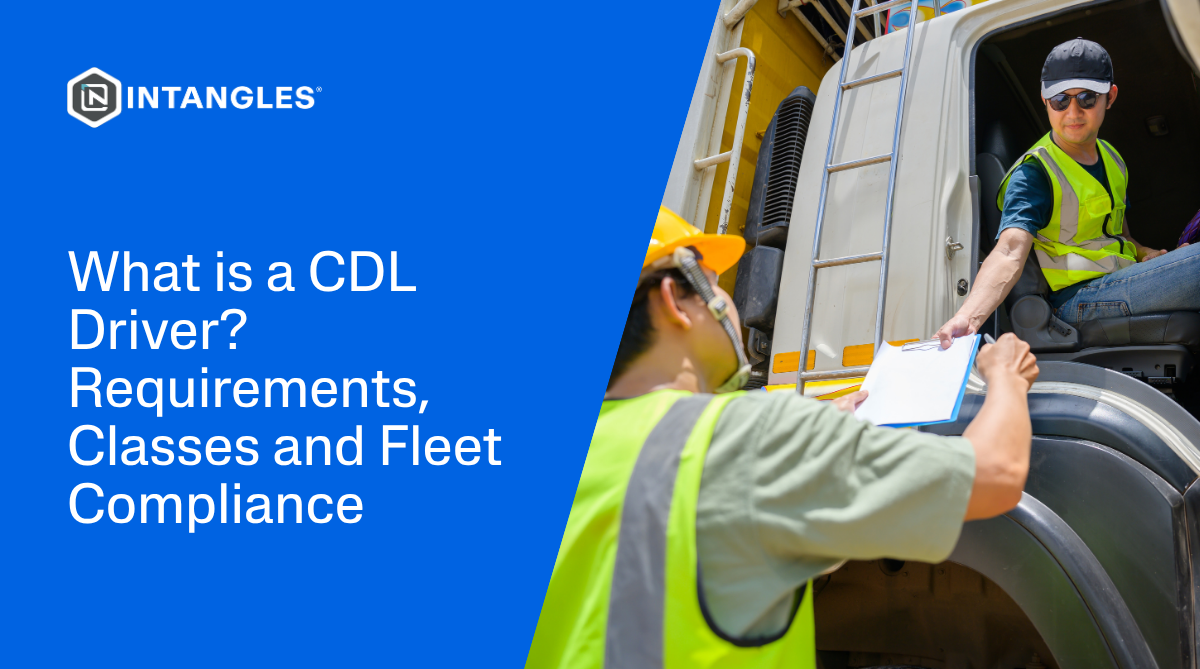
A CDL driver is a professional who holds a Commercial Driver’s License (CDL) – a federally mandated credential required to operate a commercial motor vehicle (CMV) in the United States. Issued by individual states under standards set by the Federal Motor Carrier Safety Administration (FMCSA), a CDL certifies that a driver has passed the knowledge and skill tests required to safely operate large or specialized commercial vehicles. A CDL is not a standard driver’s license – it requires significantly more training, testing, and ongoing federal compliance, reflecting the size, weight, and risk profile of commercial vehicles.
KEY TAKEAWAYS
- A CDL is required for anyone operating a CMV above 26,001 lbs GVWR, designed to carry 16 or more passengers, or transporting hazardous materials requiring placards.
- There are three CDL classes – A, B, and C – each covering different vehicle types and weight thresholds. Class A is the broadest and the standard for long-haul trucking.
- CDL drivers are subject to FMCSA Hours of Service rules and must use a certified ELD to record compliance automatically.
- Serious violations, including DUI, trigger CDL disqualification even when committed in a personal vehicle.
- Fleet operators managing CDL drivers face compounding compliance obligations across HOS, DVIR, drug testing, and medical certification – all of which telematics systems can automate and streamline.
Commercial driving is one of the most regulated professions in the United States. This guide covers what a CDL driver is, how classes, endorsements, and restrictions work, what federal compliance obligations apply, and how fleet telematics supports CDL driver management at scale.
Who needs a CDL?
A Commercial Driver’s License (CDL) is required for any driver operating a vehicle that meets one or more of these federal thresholds:
| Conditions | Thresholds |
| Gross Vehicle Weight Rating (GVWR) or Gross Combination Weight Rating (GCWR) | 26,001 lbs or more |
| Towed vehicle weight rating | Greater than 10,000 lbs |
| Designed to transport passengers | 16 or more |
| Transporting hazardous materials | Quantities requiring placards |
This applies to truck drivers, bus operators, large-vehicle delivery drivers, and specialized transport operators. Driving a CMV without a required CDL results in significant fines and legal consequences.
CDL classes explained
The FMCSA categorizes CDLs into three classes based on vehicle weight and configuration.
| CDL class | Vehicle requirements | Common vehicle types |
| Class A | Combination vehicles with GCWR of 26,001 lbs or more, towed unit exceeding 10,000 lbs | Tractor-trailers, tanker trucks, livestock carriers, doubles/triples |
| Class B | Single vehicles with GVWR of 26,001 lbs or more, or towing a trailer under 10,001 lbs | Straight trucks buses, box trucks, dump trucks, delivery vehicles |
| Class C | Vehicles below Class A and B thresholds, but carrying 16+ passengers or placarded hazmat | Passenger vans, smaller hazmat vehicles, some specialty CMVs |
Class A is the widest scope license-holders can generally also operate Class B and Class C vehicles. It is the standard requirement for over-the-road trucking and long-haul freight operations.
CDL endorsements and restrictions
The endorsement allows drivers to drive certain kinds of vehicles or haul specific cargo outside of their basic driving classification. Each requires passing a separate written test; some require a hands-on skills demonstration.
| Code | Endorsements | What it covers |
| H | Hazardous materials | Placardable hazmat transport; requires TSA security threat assessment, renewed every 5 years |
| N | Tank vehicles | Bulk liquid or gas transport |
| T | Doubles/Triples | Pulling two or three trailers in tandem |
| P | Passenger vehicles | Vehicles designed for 16+ passengers |
| S | School bus | Passenger requirements plus additional safety protocols |
| X | Combined Tank/HazMat | Combined N and H endorsement |
Restrictions appear as codes on the physical CDL and limit how or where the holder may operate. They are applied when a driver tests in a vehicle lacking certain equipment.
| Code | Restriction |
| E | No manual transmission vehicles |
| K | Intrastate commerce only |
| L | No air brake-equipped vehicles |
| O | No tractor-trailer CMVs |
| Z | No full air brake-equipped CMVs |
How to get a CDL
The process is administered by each state under FMCSA federal standards and follows this sequence:
1. Meet basic eligibility
Be at least 18 for intrastate operation, or 21 for interstate or hazmat transport. Hold a valid driver’s license and a DOT Medical Examiner’s Certificate.
2. Obtain a commercial learner’s permit (CLP)
Pass the written knowledge and vision tests. The CLP allows supervised practice driving on public roads.
3. Complete entry-level driver training (ELDT)
First-time Class A or B applicants and certain endorsement applicants must complete ELDT with a FMCSA-registered provider before the skills test.
4. Hold the CLP for 14 days
Federal regulations require a minimum 14-day holding period before taking the skills test.
5. Pass the CDL skills test
Three parts: Vehicle Inspection, Basic Controls, and Road Test – taken in the class of the vehicle the driver intends to operate.
Full-time CDL training programs typically take 3-7 weeks. Part-time programs run 2-3 months. It is illegal to hold a CDL from more than one state.
Interstate vs. Intrastate CDL
| Parameters | Interstate CDL | Intrastate CDL |
| Operating area | Across state lines | Within a single state only |
| Minimum age | 21 | 18 (varies by state) |
| Medical standards | Federal DOT standards | State standards (may vary) |
| Career scope | Unrestricted national operation | Limited to home state |
The K restriction on intrastate CDL limits career growth and geographic flexibility. Most long-haul and OTR roles require an interstate CDL.
Federal compliance obligations
Commercial Driver’s License drivers operate under strict federal oversight. Non-compliance carries significant consequences, including out-of-service orders, fines, and CDL disqualification.
Hours of service (HOS)
HOS rules limit driving time to prevent fatigue. Key limits for property-carrying drivers:
| Rule | Limit |
| Daily driving limit | 11 hours after 10 consecutive hours off duty |
| Daily on-duty window | 14 hours from shift start |
| Weekly limit (7-day) | 60 hours on duty |
| Weekly limit (8-day) | 70 hours on duty |
| Rest break | 30 minutes required after 8 cumulative driving hours |
Electronic logging devices (ELD)
Since December 16, 2019, when the ELD mandate reached full compliance, most commercial drivers who keep a record of duty status have been required to use an FMCSA-registered ELD. Vehicles with engines manufactured before model year 2000 are exempt from this requirement, since older engines generally lack the electronic control module (ECM) an ELD needs to connect to. The electronic logging device replaces the manual logbook and transmits data via an electronic connection to the enforcement officer
Driver vehicle inspection reports (DVIR)
Vehicle inspections have to be carried out both before and after trips by CDL drivers, with any deficiencies recorded in the DVIR. The defects that impair the safety of the vehicle have to be fixed before resuming operation. The digital DVIR process automatically records defects in the management system.
Medical certification and drug testing
A DOT Medical Examiner’s Certificate is required for the drivers. The certificate is valid for a period of 1-2 years, depending on the health status of the individual. For CDL drivers, drug and alcohol tests are conducted randomly, after accidents, and under reasonable suspicion. The violations are listed at the FMCSA Drug and Alcohol Clearinghouse and can be checked by employers before hiring.
CDL disqualification
Disqualification applies to violations in any vehicle-personal or commercial. The CDLIS tracks violations across states, preventing drivers from avoiding consequences by registering in another state.
| Offense | Disqualification |
| DUI/DWI in a CMV (first offense) | 1 year minimum |
| DUI/DWI in a CMV (second offense) | Lifetime |
| DUI in a personal vehicle (first offense) | 1 year CDL disqualification |
| Refusing a drug or alcohol test | 1 year minimum |
| Leaving the scene of an accident | 1 year minimum |
| Drug trafficking or terrorism using a CMV | Lifetime (may petition after 10 years) |
| Two serious traffic violations within 3 years | 60-90 days |
Outlook and maintaining your CDL
There is a huge demand for CDL drivers in logistics, freight, construction, and passenger transport because of the rising trend in e-commerce business, the aging demographics of CDL drivers, and the need to transport vital supplies. While entry-level CDL drivers may get annual salaries in the range of $40,000 to $50,000, seasoned drivers can earn salaries between $60,000 and $80,000 per year or even more. Drivers who require hazmat and tanker endorsements usually earn high salaries as well.
Maintaining a CDL license is a must, and some of its aspects are: renewing the CDL every 4 to 8 years, ensuring medical certification validity at all times, reporting new addresses immediately, and avoiding getting serious violations.
How fleet telematics supports CDL driver management
Managing a fleet of CDL drivers involves continuous compliance monitoring across HOS, DVIR, medical certification, and driver behavior – alongside dispatch, fuel management, and vehicle health. Telematics platforms reduce the administrative burden of this compliance stack while improving operational efficiency.
| Compliance area | How telematics helps |
| HOS tracking | ELD-integrated platforms automate RODS, surface approaching violations, and maintain audit-ready records |
| DVIR | Digital inspection workflows feed defect data directly into maintenance scheduling |
| Driver behavior | Continuous monitoring of speeding, harsh braking, and fatigue indicators reduces accident risk and insurance exposure |
| Fuel accountability | Idle time and consumption tracked per driver – separating true idle from operational idle for fair scoring |
| Vehicle health | ECU-level diagnostics detect fault progressions before they cause breakdowns or DOT out-of-service events |
How Intangles supports CDL fleet operations
Intangles is a fleet intelligence platform designed for commercial fleet operators managing CDL drivers in demanding operational environments. Its InGenious device reads directly from the vehicle’s ECU via the OBD port, capturing engine health, DPF status, fuel injection rate, and fault code patterns simultaneously – not just location and speed.
| Capability | What it does |
| ELD-integrated HOS monitoring | Automates Hours of Service tracking, surfaces approaching violations, and maintains FMCSA-ready records |
| DriveIQ driver scoring | Scores CDL drivers on speeding, harsh braking, hard acceleration, and idle time – normalized per distance and route |
| Digital DVIR workflows | Pre- and post-trip inspection records feed directly into maintenance scheduling |
| Predictive maintenance | Fault progression monitoring detects developing issues before roadside breakdowns or DOT out-of-service orders |
| Configurable compliance alerts | Real-time notifications for HOS thresholds, idle limits, and fault severity – configurable by vehicle group and context |
Explore the platform or get in touch with our team to learn how Intangles helps fleets stay FMCSA-compliant, reduce CDL driver violations, and manage HOS, DVIR, and vehicle health through connected fleet intelligence.
KNOW MORE
Frequently Asked Questions
What is the difference between a Class A, Class B, and Class C CDL?
Class A covers combination vehicles with a GCWR of 26,001 lbs or more, where the towed unit exceeds 10,000 lbs – the standard for tractor-trailer and OTR trucking. Class B covers single vehicles at 26,001 lbs or more, including straight trucks and large buses. Class C covers vehicles below those thresholds designed for 16 or more passengers or hazmat transport.
How long does it take to get a CDL?
Full-time CDL training programs typically take 3-7 weeks; part-time programs run 2-3 months. After receiving the CLP, most states require candidates to hold it for at least 14 days before taking the skills test.
What are the HOS rules for CDL drivers?
Property-carrying CDL drivers are limited to 11 hours of driving after 10 consecutive hours off duty, within a 14-hour on-duty window. Weekly limits are 60 hours in 7 days or 70 hours in 8 days. A 30-minute break is required after 8 cumulative hours of driving.
Can you lose your CDL for violations in a personal vehicle?
Yes. CDL regulations apply regardless of the vehicle being driven. A DUI conviction in a personal vehicle results in a one-year CDL disqualification on the first offense and a lifetime disqualification on a second offense.
Do CDL drivers need special insurance?
Yes. Commercial vehicles require commercial auto insurance – personal policies do not cover commercial use and are automatically voided for such purposes. Federal liability minimums range from $750,000 for general freight to $5 million for hazardous materials. Owner-operators must arrange their own coverage; employee drivers are typically covered under their employer’s fleet policy.




We’re looking forward to meeting you