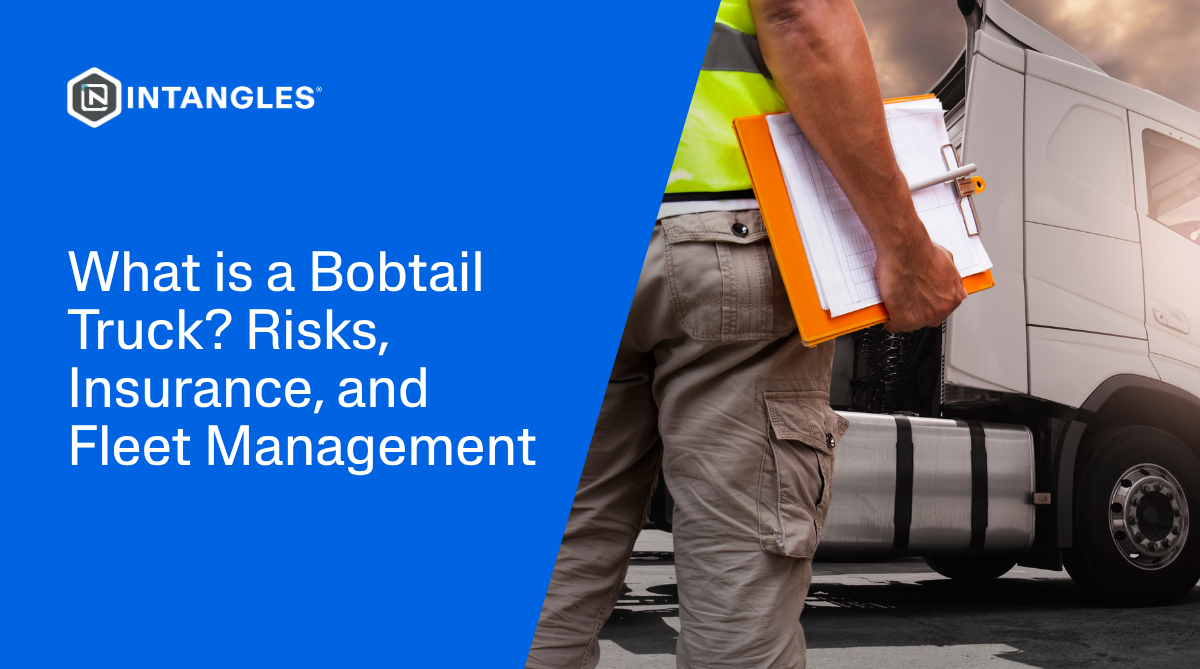
A bobtail truck is typically a Class 8 semi-truck tractor operating without a trailer attached. The cab and chassis are moving independently, with no load, no trailer coupling, and no rear weight distribution. In everyday trucking language, the driver is “running bobtail” or “bobtailing.”
KEY TAKEAWAYS
- A bobtail truck is a semi-truck tractor operating without a trailer. It is not carrying freight and not generating revenue on that move.
- Bobtailing is a normal and frequent part of fleet operations: repositioning, post-drop moves, depot returns, and maintenance runs all require it.
- Bobtail trucks handle differently than loaded or even unloaded tractor-trailer combinations. Braking distance increases and rear axle traction decreases, raising the risk of jackknifing and skidding.
- Separate bobtail insurance is typically required. Standard trucking liability policies often do not cover a tractor operating without a trailer.
- For fleet managers, bobtail moves represent untracked unpaid miles, driver risk exposure, and a fuel and vehicle health monitoring gap if telematics coverage does not extend to solo tractor operation.
In this guide, we explain what bobtailing means, how it differs from deadheading, why bobtail trucks are harder to handle, what insurance considerations fleets need to understand, and how telematics helps track solo tractor operation.
What does bobtail mean in trucking?
The term bobtail comes from the bobbed or shortened appearance of the truck: a full semi combination has a long profile, and removing the trailer leaves the tractor looking cut short. The name has been part of US trucking language for decades and is universally understood across carriers, dispatchers, and insurers.
“Running bobtail” specifically means the tractor is in motion without a trailer. It is distinct from a straight truck or box truck, which are purpose-built single-unit vehicles. A bobtailing semi is a Class 8 tractor designed to pull a trailer, or temporarily operating alone.
Bobtail vs. deadhead: What is the difference?
These two terms are often confused, but they describe different situations.
| Term | What it means | Trailer present? | Revenue generated |
| Bobtail | Tractor operating without a trailer | No | No |
| Deadhead | Tractor pulling an empty trailer | Yes | No |
Both are empty operational moves that create cost without freight income. But they are physically different situations with different handling characteristics, different insurance implications, and different risk profiles.
A driver deadheading has the stability benefit of a trailer, even an empty one. A driver bobtailing does not.
When do bobtail moves happen?
Bobtailing is not a rare exception. It is a routine part of how trucking operations work. Common scenarios include:
- Drop and hook operations: After dropping a loaded trailer at a customer location, the driver bobtails to the next pickup point or back to the terminal.
- Repositioning: Moving a tractor from one yard or terminal to another without a trailer available.
- Post-delivery returns: Returning to a depot after a delivery where no backhaul is available
- Maintenance and inspection runs: Moving a tractor to a shop or inspection facility without a trailer attached
- Leased operator moves: Owner-operators repositioning between loads when no trailer is assigned.
For large fleets running drop-and-hook freight models, bobtail miles can represent a meaningful share of total vehicle movement in a given week.
Why is bobtailing considered dangerous?
Bobtailing is one of the more counterintuitive aspects of commercial trucking. Drivers and fleet managers might assume a lighter, shorter truck is easier to handle. The opposite is often true.
Braking distance and rear axle behavior
A semi-truck’s braking system is calibrated for a fully loaded combination. The rear drive axles carry the most braking force. Without a trailer, those rear axles carry very little weight. Under hard braking, the rear axles can lock up and lose traction before the front axle stops the vehicle, creating the conditions for a jackknife or rear-wheel skid.
Reduced traction in adverse conditions
Weight over the drive axles is what gives a semi traction on wet, icy, or uneven road surfaces. A bobtailing tractor has significantly less weight over those axles than a loaded or even empty combination. In rain or snow, this makes bobtail operation genuinely more hazardous, particularly on inclines, highway on-ramps, and curves.
Suspension geometry
Semi-truck suspensions are tuned to carry trailer weight. Without it, the ride becomes stiffer and less predictable. This affects driver control during evasive maneuvers and contributes to driver fatigue on longer bobtail runs.
FMCSA accident data
The FMCSA’s large truck crash causation study consistently identifies loss of control as a leading factor in serious truck crashes. Bobtail operation, particularly in adverse weather, is a recognized contributing condition. Fleet safety programs that treat bobtail moves as lower-risk than loaded operations are not accounting for the full picture.
Common causes of bobtail truck accidents
Understanding why bobtail accidents happen helps fleet managers build more targeted driver training and risk controls.
- Hard braking on low-traction surfaces: The lightness of the rear axle causes it to lock instantly, leading to skids or jackknifes.
- Overconfidence after unloading: The driver, who has finished an assignment with cargo, switches his mentality. The lighter nature of the empty vehicle prompts drivers to use appropriate speed and following distance.
- Curves and highway ramps: The loss of rear axle traction causes uncertainty when driving around curves at high speeds. Ramps used for on/off highway activities become dangerous due to the possibility of rollover and skidding while driving at truck speeds.
- Rain, ice, and wet pavement: The lack of traction caused by a loss of rear axle weight becomes much worse in conditions of wet or icy roads.
- Sudden steering inputs: Without the additional mass of the trailer holding down the rear axle, sudden steering adjustments lead to an increased likelihood of rear wheel oversteer.
How to drive a bobtail truck safely
Safe bobtail operation deliberate adjustments to the habits that work well with a loaded combination. The vehicle is lighter but not easier to control.
- Increase following distance: Stopping distances increase in a bobtailing tractor. Add at least two to three seconds of following distance beyond what you would use with a loaded trailer.
- Brake earlier and progressively: Apply brakes gradually to avoid locking the rear axles. Sudden, hard braking is the primary trigger for rear-wheel skids and jackknife events during bobtail operation.
- Reduce speed on curves and ramps: Approach highway curves, exit ramps, and roundabouts at lower speeds than you would with a fully loaded combination.
- Avoid sudden steering inputs: Abrupt steering corrections at speed can cause the rear of the tractor to swing. Smooth, deliberate inputs reduce this risk.
- Increase caution in rain or snow: Wet and frozen surfaces amplify the traction deficit created by low rear axle weight. Treat adverse weather bobtail moves with the same caution as a loaded truck in poor conditions.
- Stay alert on long repositioning runs: Stiffer suspension without trailer weight contributes to driver fatigue on extended solo tractor moves. Plan rest breaks accordingly.
Bobtail insurance: What US fleets need to know
Standard trucking liability insurance typically covers a tractor when it is operating under a motor carrier’s authority, meaning when it is pulling a loaded or empty trailer on an active dispatch. The moment the trailer is dropped and the tractor moves independently, coverage may lapse under many standard policies.
Bobtail insurance (also called non-trucking liability or deadhead insurance in some policy structures) covers the tractor during those non-dispatch, unloaded periods of solo movement.
Key points for US fleet operators and owner-operators in 2026:
- FMCSA minimum liability requirements apply to vehicles operating in interstate commerce under motor carrier authority. Bobtail moves between drops may fall outside those active-authority periods depending on the policy language.
- Owner-operators who have leased their services to carriers need to check if the lease agreement obligates them to purchase bobtail insurance or if the insurance provided by the carrier covers the bobtail operations.
- On the other hand, fleet operators need to make sure that their commercial automobile insurance policy provides bobtail coverage for their tractors.
Insurance audits that review claim histories frequently identify bobtail incidents as coverage gray areas. Getting this confirmed in writing before an incident occurs is the lower-risk approach.
Bobtail operation and fleet management
For fleet managers, bobtail moves create a specific set of operational visibility challenges.
Unpaid miles and cost attribution
Bobtail miles utilize fuel, add engine hours to the clock, and cause tire, brake, and driveline wear without earning any money from cargo transport. Using the per-mile cost approach, the operation of solo tractors contributes to increased overall costs of operation per loaded mile. Without bobtail miles being accounted for independently, fleets are unable to determine their actual cost-per-loaded-mile figure.
Driver safety monitoring during bobtail
Driver behavior during bobtail moves is not always captured at the same fidelity as loaded operation. Speed, harsh braking events, and hard cornering during bobtail are particularly relevant given the handling characteristics described above, but they are easy to miss if dispatch systems only flag events on active load assignments.
Vehicle health during bobtail
Engine hours and idle time accumulate during bobtail moves regardless of whether a trailer is attached. Fuel consumption, DPF loading, and alternator stress all continue. For predictive maintenance programs that track vehicle health against engine hours and distance, bobtail miles need to be included in the data picture, not treated as invisible.
How Intangles supports fleet visibility during bobtail operations
Intangles is a digital twin company serving the transportation and logistics industry across 18 countries, with more than 500,000 vehicles on the platform. The InGenious device connects directly to the vehicle OBD port, with no modifications or additional sensors required, and feeds real-time ECU data into the InRoute platform continuously, regardless of whether the tractor is pulling a trailer or running bobtail.
For bobtail operation specifically, this matters in three areas.
| Capability | What it does |
| Fuel management | Tracks fuel consumption and idle loss across all vehicle movement, including bobtail miles, giving fleets a complete cost-per-mile view. |
| Vehicle health monitoring | Monitors engine load, DPF status, battery health, and fault codes continuously, including during bobtail operation. |
| Driver performance tracking | Tracks harsh braking, overspeeding, and other high-risk driving behavior during bobtail operation. |
Intangles connects through the OBD port and is compatible with 40+ OEM brands operating in the US market, including Volvo, Kenworth, Peterbilt, Freightliner, Mack, International, Western Star, Scania, and Mercedes-Benz.
Bobtail operation is a normal part of commercial trucking, but it creates distinct handling, insurance, fuel, and vehicle health challenges that fleets need to monitor closely. Full visibility into solo tractor movement helps carriers reduce operational risk, improve maintenance planning, and track true operating cost across all vehicle activity.
Explore the platform or get in touch with our team to learn how Intangles helps fleets monitor bobtail operation, reduce operational losses, and maintain full visibility into vehicle health and fuel performance.
KNOW MORE
Frequently Asked Questions
What is a bobtail truck?
A bobtail truck is a semi-truck tractor operating without a trailer attached. The term comes from the shortened appearance of the truck without a trailer. In trucking operations, a driver “running bobtail” is moving the tractor independently between drops, during repositioning, or on the return to a terminal.
Is bobtailing dangerous?
The handling danger is relatively great compared to what most motorists believe. With no load on the rear wheels, braking will take longer, as well as the ability for tires to maintain their grip on the road, resulting in skidding or jackknifing during hard braking. The danger level becomes even greater in cases of wet or icy roads.
What is the difference between bobtail and deadhead?
Bobtail means that the tractor is traveling without any trailer. Deadhead refers to the situation when the tractor travels with an empty trailer attached, with no freight on board. Both are empty operations, and neither generates any revenue; however, deadheading gives extra weight and stability to the trailer.
Do you need special insurance to drive a bobtail?
Yes, in most cases. A regular liability policy for trucks will generally include coverage for the tractor, provided that the tractor is under active motor carrier authority with a trailer attached. The bobtail policy (often referred to as non-trucking liability coverage) would provide protection for the tractor whenever the tractor is moving without being dispatched and attached to a trailer.
Do bobtail miles count toward vehicle maintenance schedules?
They should. Engine hours and mileage accumulate during bobtail operation regardless of whether a trailer is attached. Fuel consumption, DPF loading, and drivetrain wear all continue. Maintenance schedules that exclude bobtail miles will undercount actual vehicle usage and may result in missed service intervals.
Can fleet telematics track bobtail moves?
Yes, provided that the telematics solution is interfaced to the vehicle ECU, and not to the trailer. In OBD systems such as those developed by Intangles, real-time tracking, diagnostic, and driver management data are continuously collected, even when bobtailing, providing comprehensive monitoring of vehicle movements.




We’re looking forward to meeting you