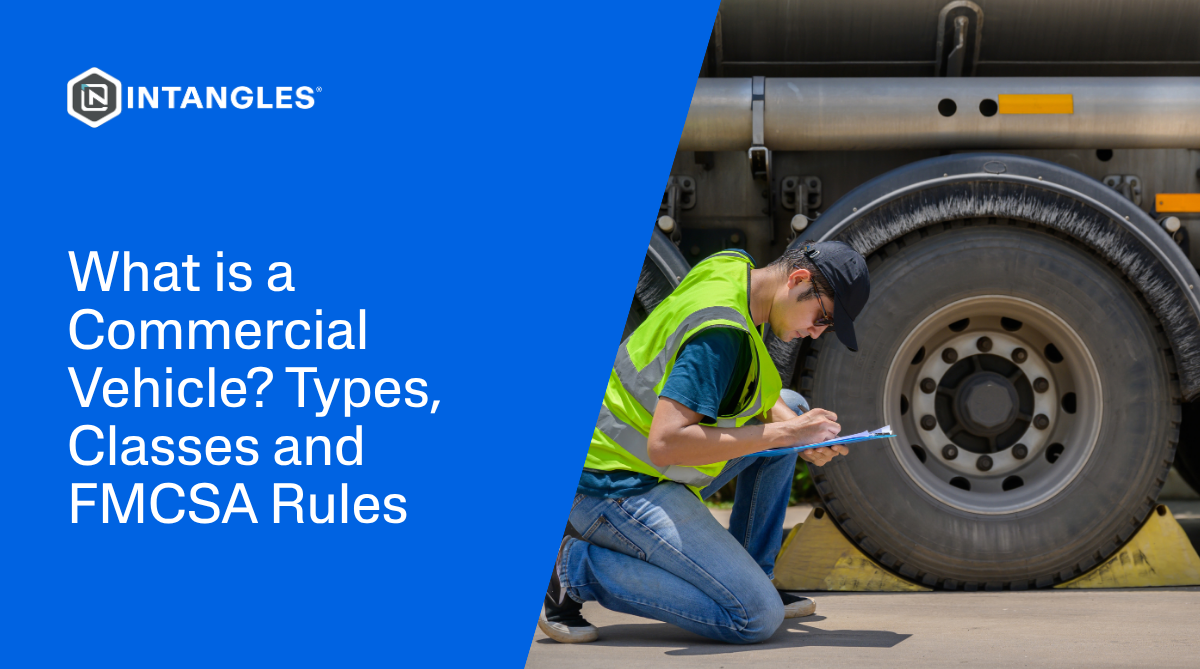
A commercial vehicle is any motor vehicle used primarily for business purposes, including transporting goods, hauling equipment, or carrying passengers for compensation. In the United States, the term has both a general meaning and a specific regulatory definition under federal law. Understanding the difference matters for fleet operators, owner-operators, and any business that puts vehicles on public roads.
KEY TAKEAWAYS
- A commercial vehicle is any motor vehicle used for business purposes, but the FMCSA’s definition of a commercial motor vehicle (CMV) is narrower and tied to specific weight, passenger, and hazmat thresholds.
- Vehicles that meet the CMV definition are subject to federal safety regulations, including hours of service, ELD requirements, drug and alcohol testing, and FMCSA registration.
- Commercial vehicles are classified by GVWR into Classes 1 through 8. Most federal CMV regulations apply to Class 3 and above.
- A CDL is required to operate vehicles over 26,001 lbs GVWR and other vehicles meeting a specific federal threshold.
- Fleet telematics and predictive vehicle health monitoring are increasingly essential for managing compliance, uptime, and operational costs at scale.
In this guide, we cover the FMCSA definition of commercial motor vehicle, weight classifications, common vehicle types, key federal compliance obligations, the biggest operational challenges facing US fleets in 2026, and how fleet technology supports commercial vehicle management.
Commercial vehicle vs. commercial motor vehicle: What is the difference?
In everyday language, “commercial vehicle” refers broadly to any vehicle used for business. In regulatory language, the FMCSA uses the term commercial motor vehicle (CMV) with a precise definition that determines which federal rules apply.
According to the Federal Motor Carrier Safety Administration (FMCSA), a vehicle is a CMV if it meets any one of the following:
- A GVWR or gross combination weight rating (GCWR) of 10,001 pounds or more
- Designed to transport 16 or more passengers (including the driver) for compensation
- Designed to transport 9 or more passengers for the motor carrier’s direct compensation
- Used to transport hazardous materials in quantities requiring placarding
If a vehicle meets even a single requirement, it will fall within the jurisdiction of the FMCSA, regardless of whether it operates in different states. The difference between the two: while an enterprise may use a light pickup locally for general transportation purposes, it will not be able to use a commercial motor vehicle, per FMCSA criteria. A fleet running Class 8 tractor-trailers operates CMVs with the full weight of federal compliance requirements.
Commercial vehicle weight classes
The Federal Highway Administration classifies vehicles into eight weight classes based on GVWR. These determine which regulations apply, what licenses are required, and how vehicles are registered.
Commercial vehicles:
- Light Duty (Class 1 and 2): Up to 10,000 lbs
- Medium Duty (Class 3 to 6): 10,001 to 26,000 lbs
- Heavy Duty (Class 7 and 8): Over 26,001 lbs
| Class | GVWR range | Common Examples |
| Class 1 | Up to 6,000 lbs | Light pickups, small vans |
| Class 2 | 6,001 to 10,000 lbs | F-250, Ram 2500, cargo vans |
| Class 3 | 10,001 to 14,000 lbs | Large cargo vans, F-350+ |
| Class 4 | 14,001 to 16,000 lbs | City delivery trucks, box trucks |
| Class 5 | 16,001 to 19,500 lbs | Bucket trucks, medium box trucks |
| Class 6 | 19,501 to 26,000 lbs | Single-axle straight trucks, school buses |
| Class 7 | 26,001 to 33,000 lbs | Large straight trucks, transit buses |
| Class 8 | Over 33,001 lbs | Semi-trucks, tractor-trailers, heavy dump trucks |
Classes 1 and 2 are generally exempt from FMCSA CMV regulations. Classes 7 and 8 carry the broadest set of federal compliance obligations and represent the backbone of US freight movement. According to the American Trucking Associations, trucks move approximately 72% of all freight tonnage in the US.
Types of commercial vehicles in the US
Semi-trucks and tractor trailers (Class 8)
The primary vehicle for long-haul freight. CDL required. Subject to the full range of FMCSA regulations, including ELD mandates, hours of service, and annual inspections.
Box trucks and straight trucks (Classes 4 to 7)
Used for local and regional delivery, distribution, and moving services. Straight trucks over 26,000 lbs GVWR require a CDL.
Passenger and transit buses (Classes 5 to 8)
Used for public transit, school transportation, and charter operations. Vehicles for 16 or more passengers are CMVs regardless of weight. CDL with passenger endorsement required.
Pickup trucks and cargo vans (Classes 1 to 3)
Used extensively in field service applications and final-mile deliveries. May or may not qualify as a CMV depending on GVWR and operational usage. It is recommended to determine its classification, especially when transporting hazardous materials or operating across state lines.
Specialty vehicles
Includes tankers, flatbeds, refrigerated transport, fuel and lube trucks, and construction equipment carriers. Classification depends on GVWR and payload. Many in oil and gas, construction, and agriculture are CMVs subject to FMCSA oversight.
Key federal regulations for commercial motor vehicles
Hours of Service (HOS)
The property-carrying drivers can drive for 11 hours after 10 hours of being off-duty, within the 14 hours of being on-duty. The violation of HOS is one of the highest-cited categories in roadside inspections by FMCSA.
Electronic logging device (ELD) mandate
Most CMV operators must use an FMCSA-registered ELD to record hours of service automatically. Short-haul and other narrow exemptions exist.
Commercial driver’s license (CDL)
Any CMV weighing more than 26,001 pounds GVWR, a vehicle designed to transport more than 16 passengers, or a vehicle that carries hazardous materials requiring placarding. CDL drivers are subjected to FMCSA drug and alcohol tests.
USDOT number and operating authority
Interstate CMV operators must register with the FMCSA and obtain a USDOT number. For-hire carriers also need a MC number. Failure to register is a federal violation.
Vehicle inspection and maintenance (Part 396)
Part 396 of 49 CFR is an important rule that calls for inspections, repairs, and maintenance of all CMVs. Inspections have to be done annually. Drivers conduct pre- and post-trip DVIRs.
Commercial vehicle compliance checklist
- USDOT number registration
- Operating authority (MC number) for for-hire carriers
- CDL verification for all qualifying drivers
- Hours of service compliance and record-keeping
- FMCSA-registered ELD in use and functioning
- DOT drug and alcohol testing program in place
- Annual vehicle inspections completed and documented
- Pre-trip and post-trip DVIRs completed each shift
- Maintenance records retained per Part 396
- Driver qualification files current and complete
- Minimum insurance coverage meeting FMCSA requirements
Biggest challenges for US commercial vehicle fleets in 2026
Rising maintenance costs
The cost of parts and labor keeps rising; therefore unexpected breakdowns are more costly than planned maintenance. Many fleets are shifting to predictive maintenance to identify failures early and schedule repairs before downtime occurs. According to S&P Global Mobility, US Class 6-8 truck registrations declined by 24% in 2025. This is putting additional pressure on fleet operators to make the most out of their assets.
Technician shortages
The commercial vehicle repair technician shortage has deepened. Predictive data that surfaces issues early gives maintenance teams lead time and reduces emergency repair dependency.
Fuel costs and theft
Fuel remains one of the highest controllable costs in fleet operations. Fleets without granular fuel tracking cannot distinguish genuine consumption from preventable loss. Modern fuel monitoring software helps fleets detect theft patterns, track fuel usage accurately, and reduce avoidable fuel expenses.
CSA score management
Vehicle maintenance violations, HOS infractions, and driver behavior citations accumulate in the CSA system over 24 months, affecting operating authority, insurance rates, and shipper relationships.
EV transition planning
Battery health monitoring is one of the main telematics needs as electric commercial vehicles become more widely used in fleets. The Federal Commercial Clean Vehicle Credit (IRC 45W), which offered up to $7,500 for vehicles under 14,000 lbs GVWR and up to $40,000 for heavier vehicles, was terminated early under 2025 legislation. No credit is available for vehicles acquired after September 30, 2025. Fleets evaluating EV adoption in 2026 should factor in the absence of this federal incentive and check for any remaining state-level EV purchase incentives instead.
How Intangles supports commercial vehicle fleet operations
Intangles is a digital twin company serving the transportation and logistics industry across 18 countries, with more than 500,000 vehicles on the platform and a predictive AI accuracy rate of 96%. The InGenious device connects directly to the vehicle OBD port, with no modifications or additional sensors required, and feeds real-time ECU data into the InRoute platform. Across the fleets it serves, Intangles has helped reduce powertrain breakdown events by 75%.
| Capability | How it helps fleet managers |
| Vehicle health monitoring | Tracks engine, aftertreatment, battery, and alternator, air intake, and fuel systems continuously. Surface fault codes and predictive alerts before issues become breakdowns or inspection violations. |
| Fuel management and loss quantification | Tracks idle-attributed fuel loss, fuel theft, and cost-per-mile across all vehicle movement. Maps every operational loss to a specific financial value. |
| Driver performance tracking | Monitors over 20 driving behavior exceptions. Advanced driver monitoring systems help fleets identify risky behaviors, improve safety scores, and reduce accident-related costs. DriveIQ scorecards enable fair peer-to-peer comparison normalized by distance and duty cycle. |
Intangles connects through the OBD port and is compatible with 40+ OEM brands in the US market, including Volvo, Kenworth, Peterbilt, Freightliner, Mack, International, Western Star, Scania, and Mercedes-Benz.
Explore the platform or get in touch with our team to learn how Intangles helps your commercial fleet.
KNOW MORE
Frequently Asked Questions
What is the FMCSA definition of a commercial motor vehicle?
According to the FMCSA, a CMV is any vehicle that either has a gross vehicle weight rating or a gross combination weight rating of 10,001 pounds or more, can accommodate 16 or more passengers for remuneration, can accommodate 9 or more passengers for direct remuneration to the motor carrier, or carries placarded hazardous materials.
What is the difference between GVWR and GCWR?
The GVWR represents the maximum weight rating of one vehicle. The GCWR represents the maximum weight of a tractor-trailer combination. Both of these measures are used to classify CMVs by the FMCSA.
Do I need a CDL to drive a commercial vehicle?
It is necessary to have a CDL if the CMV has a GVWR of greater than 26,001 pounds, carries 16 or more passengers, or transports placardable hazmat. Any vehicles that do not meet these criteria will not necessarily require a CDL, depending on their state requirements.
Do commercial vehicles need annual inspections?
Yes. According to FMCSA regulations of 49 CFR Part 396, all commercial motor vehicles (CMVs) have to be systematically inspected annually. The inspection records should be kept for a minimum of 14 months. Additionally, drivers should also perform pre-trip and post-trip inspections each time.
Can a vehicle be commercial without being a CMV?
Yes. A vehicle that is used for business purposes is considered a commercial vehicle. If the vehicle does not exceed the specified requirements set by the FMCSA regarding weight, passenger, or hazardous materials, then it is not considered to be a CMV.




We’re looking forward to meeting you