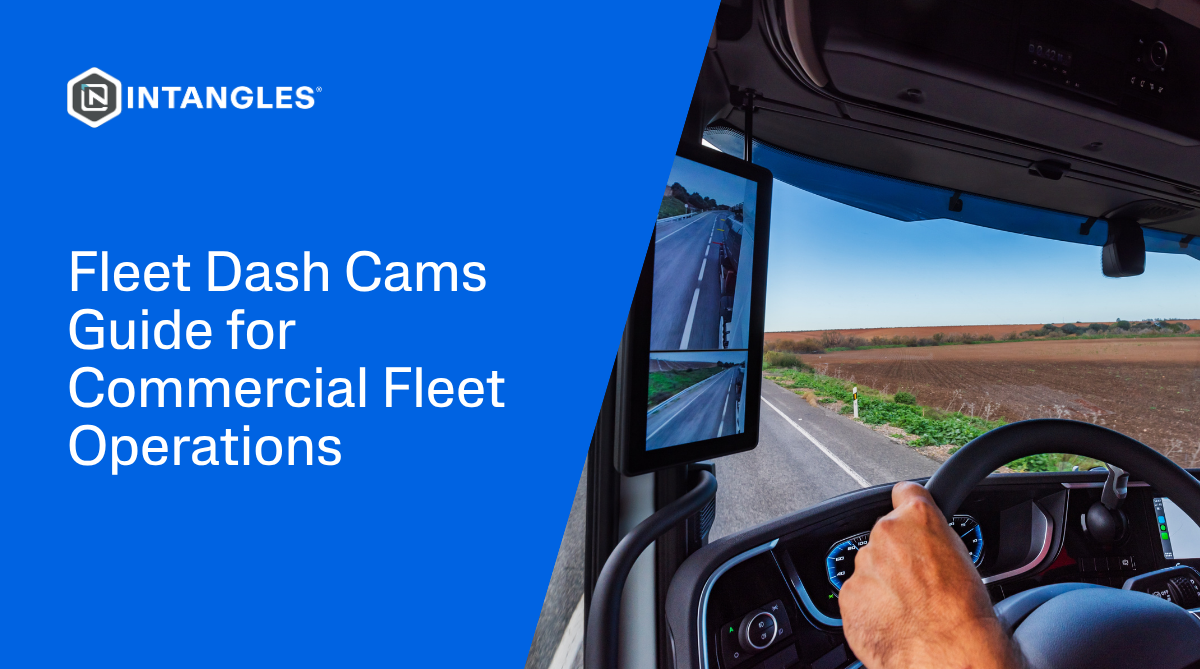
Fleet dash cams have shifted from optional recording devices to core safety infrastructure for US commercial fleets. According to the American Transportation Research Institute (ATRI), liability costs from large truck crashes have become one of the fastest-growing cost pressures facing US fleet operators, with nuclear verdicts exceeding $10 million becoming increasingly common. The FMCSA estimates distracted driving contributes to tens of thousands of commercial vehicle crashes annually. Fleet camera systems address both problems: they deter risky behavior before incidents occur and provide verified evidence when they do.
KEY TAKEAWAYS
- Fleet dash cams serve two functions: passive recording for post-incident review, and active AI detection that alerts drivers and fleet managers to risk events as they happen.
- AI-powered commercial vehicle camera systems detect distracted driving, fatigue, close-following, lane departure, and forward collision risk in real time – enabling live intervention before incidents occur.
- Verified dash cam footage is one of the most effective defenses against fraudulent accident claims, which ATRI has identified as a leading cost driver for US trucking fleets.
- Inward-facing driver monitoring systems raise legitimate privacy concerns. Fleets that communicate clearly about event-triggered (not continuous) review and pair footage with coaching – not punishment – see significantly better adoption.
- A dash cam without telematics integration is a recording system. Connected to GPS, driver scoring, and vehicle diagnostics, it becomes a fleet safety intelligence platform.
This guide covers how fleet dash cams work, how AI detection operates, types of commercial fleet camera systems, driver privacy considerations, common deployment mistakes, who needs fleet cameras, how to choose a system, and what Intangles delivers.
How fleet dash cams work
A fleet dash cam records video continuously while the vehicle is in operation, storing footage on an internal memory card or transmitting it to a cloud platform via cellular connection. Most AI fleet safety systems operate on a loop – overwriting older footage unless an event trigger locks and preserves a clip.
Triggers include sudden braking, hard acceleration, sharp cornering, G-sensor impact detection, or AI-flagged driver behavior. When fired, the system locks footage from a window around the event – typically 10-30 seconds before and after – and uploads it for fleet manager review.
How AI detection works in fleet dash cams
AI-powered driver monitoring systems go beyond passive recording. They process video in real time using onboard computer vision models – deep learning algorithms trained on millions of hours of commercial driving footage to recognize specific risk conditions with low false positive rates.
Edge AI processing
The AI runs directly on the camera’s onboard processor, not in the cloud. This means detection and alerting happen in milliseconds – fast enough to warn a driver before they drift into another lane, not after. Edge processing also reduces cellular data consumption because only flagged clips are uploaded, not continuous footage streams.
Computer vision models
Separate models handle different detection tasks – one for eye closure and gaze direction (fatigue and distraction), another for forward scene analysis (following distance, collision risk, lane position), and another for ADAS events (pedestrian detection, speed sign recognition). Each model outputs a confidence score, not a binary flag.
G-sensor fusion
Accelerometer data from the vehicle is fused with video analysis to improve detection accuracy. A harsh braking event combined with forward camera footage showing a near-miss produces a higher severity score than braking in isolation. This correlation reduces false positives from normal braking at intersections.
Event scoring and prioritization
Each detected event is scored by severity and type. Fleet managers see a ranked queue of high-priority clips – not a raw chronological feed. A drowsiness event outranks a phone use event; a near-collision outranks tailgating. This makes manual review tractable even across large fleets.
Telematics correlation
The most capable connected fleet safety platforms correlate video events with vehicle telemetry simultaneously – speed at the moment of detection, engine load, GPS location, and route context. A phone use event at 70 mph on an interstate is scored differently than the same behavior in a depot yard.
Types of fleet dash cams
| Type | What it records | Best for |
| Forward-facing only | Road ahead | Basic incident documentation, accident defense |
| Dual-channel (forward + inward) | Road and driver cab | Driver behavior monitoring, fatigue and distraction detection |
| Multi-channel | Road, cab, sides, or cargo | Passenger transport, high-value cargo, wide-body vehicles |
| Side-facing | Blind spot zones | Delivery vehicles, urban maneuvering, wide loads |
| AI-integrated video telematics | Road and cab with real-time AI detection | Full safety programs with coaching, ADAS, and fleet analytics |
Most US commercial fleets running driver safety programs use dual-channel systems. Forward-only trucking dash cams provide incident documentation but cannot detect distracted driving or fatigue – the two leading behavioral risk factors in commercial vehicle crashes according to NHTSA.
Who needs fleet dash cams?
Commercial vehicle camera systems add value across any operation where vehicles are driven by employees, contractors, or CDL drivers on public roads.
- Long-haul trucking: Nuclear verdict exposure and interstate liability risk make AI fleet safety systems essential. ELD camera integration aligns video with HOS records for unified compliance documentation.
- Last-mile delivery: High stop frequency, urban congestion, and pedestrian exposure create elevated incident risk. Cameras document the volume of minor incidents common in dense delivery routes.
- Construction fleets: Jobsite conditions and fatigue in early-start operations require both forward and side-camera coverage.
- Oil and gas fleets: Remote operations and long shifts create fatigue risk and liability exposure in isolated incidents.
- Passenger transport: FMCSA and state regulations require inward-facing cameras on many passenger vehicle classes. AI fatigue detection is critical for long coach and transit duty cycles.
- Field service and waste management: High public exposure, residential environments, and route repetition create pedestrian and bicycle risk that cameras document and deter.
Fleet dash cams and driver privacy
Inward-facing driver monitoring systems are the primary source of privacy concerns in fleet dash cam programs. These concerns are legitimate and should be addressed directly.
Use event-triggered review only
Footage accessed when a trigger fires, not as routine surveillance. Communicating this clearly reduces driver resistance significantly.
Write a clear dash cam policy before deployment
Specify what is recorded, when footage is reviewed, who has access, retention period, and how drivers can access their own records.
Know your state requirements
California, Illinois, and New York have more stringent inward-camera regulations for commercial vehicles. Verify state-level requirements before deployment.
Pair footage with coaching, not punishment
Programs that use video to support coaching conversations and recognize improvement consistently outperform punitive-only approaches.
Common fleet dash cam deployment mistakes
Installing forward-only cameras and expecting coaching outcomes
A forward-facing camera documents what happened on the road. It cannot detect driver fatigue, distraction, or phone use – the behaviors most likely to cause preventable incidents. Forward-only systems are incident recorders, not safety programs.
No driver communication policy before rollout
Deploying cameras without explaining what is recorded, who reviews it, and how it affects performance scoring creates immediate resistance and trust damage that is difficult to recover from.
Reviewing footage only after accidents
The operational value of AI fleet safety systems is proactive intervention – catching behavior patterns before they cause incidents. Fleets that only access footage post-incident are using 10% of the available safety benefit.
No integration with telematics or driver scorecards
A dash cam that operates in isolation from GPS tracking, vehicle diagnostics, and driver behavior scoring produces video evidence without operational context. Integration is what makes it a connected fleet safety platform rather than a camera.
Excessive manual clip review
Without AI event scoring and prioritization, fleet managers face an unmanageable volume of footage. Manual review fatigue leads to inconsistent enforcement and missed high-risk events.
Using video data for punishment instead of coaching
Driver monitoring systems are most effective when footage is used to support specific, evidence-based coaching conversations – not to generate disciplinary records. Punitive-only programs drive underreporting and workarounds.
How to choose a fleet dash cam
| Factor | What to evaluate |
| Camera channels | Forward-only vs. dual-channel vs. multi-channel based on safety program goals |
| AI capabilities | Real-time detection with in-cab alerts vs. post-event flagging only |
| Video resolution | Minimum 1080p for road footage; higher resolution improves license plate legibility |
| Night vision | IR or low-light sensors for 24-hour operation |
| Cellular connectivity | LTE for live streaming and cloud upload; verify coverage in your geography |
| Cloud storage and retention | Minimum 30 days for compliance and insurance purposes |
| Telematics integration | Does video data connect with GPS, driver scorecards, and fleet management software |
| ADAS features | Forward collision warning, lane departure, tailgating detection, pedestrian alerts |
| Privacy controls | Event-triggered vs. continuous recording; driver notification compliance |
| ELD camera integration | Does the system share data with your ELD for unified compliance records |
How Intangles delivers video telematics
ntangles integrates AI-powered video telematics into its fleet intelligence platform, combining commercial vehicle camera data with ECU-level vehicle diagnostics, GPS tracking, and DriveIQ driver scoring in a single operational view.
- Safety context: AI driver monitoring systems detect fatigue, distraction, phone use, and seatbelt non-compliance in real time, issuing immediate in-cab alerts. ADAS monitoring covers forward collision risk, pedestrian detection, lane departure, and tailgating.
- Coaching context: Video-verified events feed directly into DriveIQ scorecards alongside telematics behavior exceptions – speeding, harsh braking, idle time. Fleet managers conduct coaching conversations with objective, video-backed evidence, not score estimates.
- Operational context: Every video event is correlated with vehicle speed, engine load, GPS location, and route data at the moment of detection. A flagged event includes full operational context, not just a clip.
- Vehicle context: Unlike standalone AI fleet safety systems, Intangles connects video data to ECU-level diagnostics. A fatigue event during a trip where DPF loading is elevated and engine temperature is abnormal tells a different story than the same event in a healthy vehicle – and the platform captures both.
Intangles’ platform supports 20-30% improvement in driving behavior and up to 30 hours of on-demand video access for incident review and driver coaching.
Explore the platform or get in touch with our team to learn how Intangles video telematics helps US fleets reduce incident rates, defend against fraudulent claims, and build driver coaching programs grounded in AI-verified data.
KNOW MORE
Frequently Asked Questions
What is a fleet dash cam?
A fleet dash cam is a vehicle-mounted camera system that records road footage, cab footage, or both during commercial vehicle operation. Modern AI-powered fleet dash cams detect risky driver behavior in real time, alert drivers in-cab, and feed verified event footage into driver coaching and safety programs.
What is the difference between a dash cam and video telematics?
A dash cam records video. Video telematics integrates that video with GPS location, speed data, driver behavior scoring, and vehicle diagnostics – and adds AI to detect risk events in real time. Video telematics turns a recording device into a connected fleet safety intelligence platform.
Are inward-facing dash cams legal in the United States?
Inward-facing cameras are generally permitted in commercial vehicles across the US, but requirements vary by state. Some states require driver notification; others have specific rules for passenger transport. Fleet operators should verify state-level requirements before deployment, particularly in California, Illinois, and New York.
How do fleet dash cams reduce insurance costs?
Verified dash cam footage provides objective, timestamped evidence in disputed accident claims. Exculpatory footage eliminates fraudulent claim payouts, which ATRI has identified as a leading and growing cost driver for US trucking fleets. Many commercial auto insurers offer premium reductions for fleets with certified video telematics systems.
What should I look for in a fleet dash cam?
Dual-channel capability (forward and inward), real-time AI detection with in-cab alerts, minimum 1080p resolution, LTE cellular connectivity, ADAS alerts, integration with your telematics and fleet management platform, ELD camera integration, and a clear event-triggered privacy policy that drivers understand before deployment.




We’re looking forward to meeting you