KEY TAKEAWAYS
- OBD-II became mandatory on all new US cars and light-duty trucks from the 1996 model year, establishing a standardized 16-pin diagnostic port as the common access point for vehicle diagnostics and emissions data.
- In practical fleet operations, OBD-II is the port and protocol that telematics devices use to access engine control unit (ECU) data, fault codes and real-time vehicle parameters.
- Telematics platforms stream engine RPM, coolant temperature, fuel trim, vehicle speed and active fault codes from the OBD-II port into fleet management systems.
- US light-duty vehicles use OBD-II, while heavy-duty Class 6 to Class 8 trucks typically use the SAE J1939 protocol for richer commercial vehicle data.
- From the 2027 model year, OBD communication moves from SAE J1979 to SAE J1979-2 (OBDonUDS), and heavy-duty manufacturers transition from the 2027 engine model year. Telematics devices need to support the new protocol to read full diagnostic data.
- In California, from October 2026, SAE J1979-2 trucks with Clean Truck Check deadlines of January 1, 2027 or later must pass OBD testing with CARB-certified test tools.
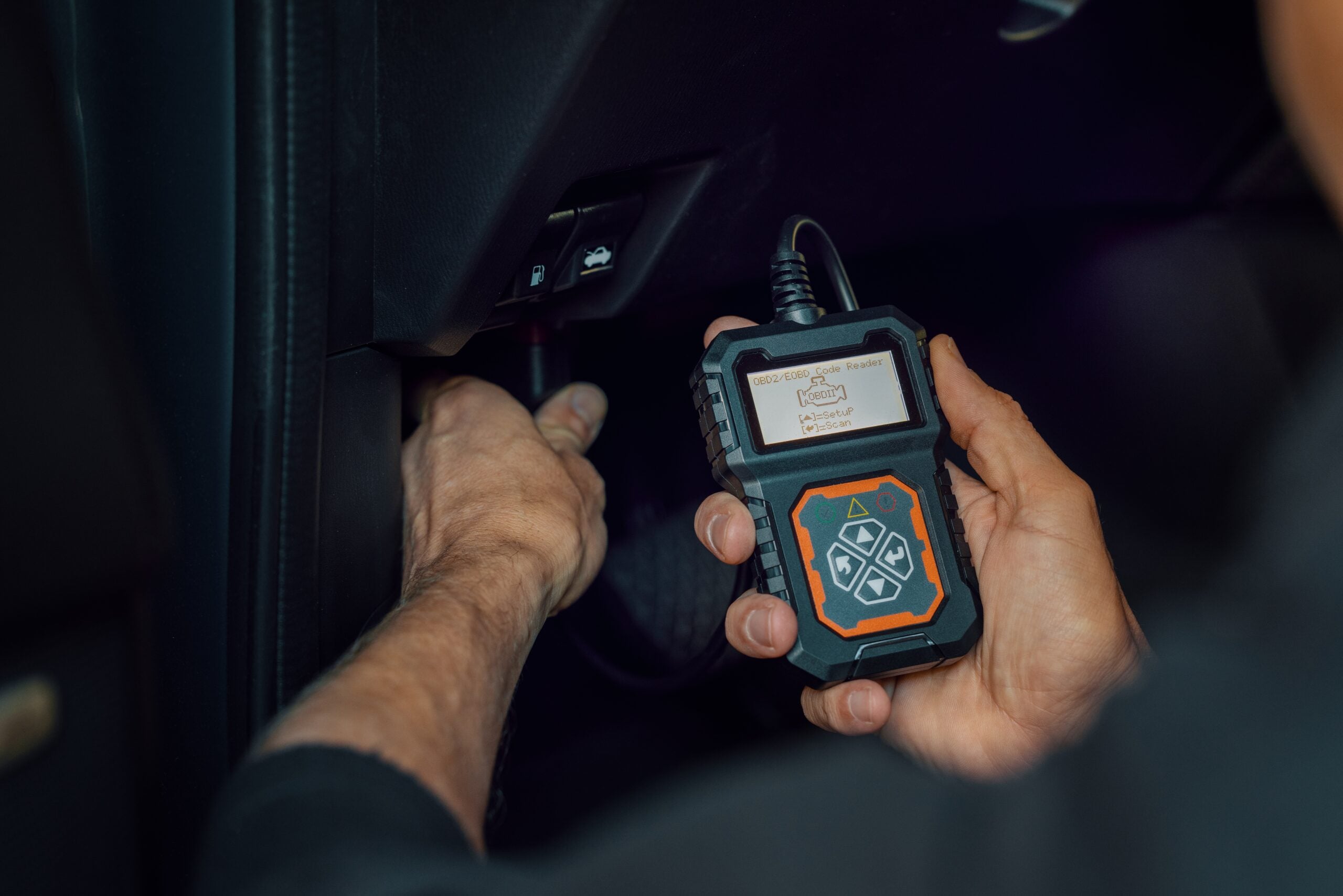
OBD-II (On-Board Diagnostics II) is the standardized vehicle diagnostics system required on all new US cars and light-duty trucks since the 1996 model year, under Environmental Protection Agency (EPA) and California Air Resources Board (CARB) rules tied to the Clean Air Act. It standardizes the diagnostic connector, communication protocols, diagnostic trouble codes (DTCs) and the way scan tools request vehicle data.
For fleets, OBD-II matters far beyond emissions compliance. Telematics devices, electronic logging devices (ELDs), maintenance software and vehicle monitors all plug into the same government-mandated port. The OBD-II port gives direct access to engine performance and operating data.
In this blog, you will learn what OBD-II does, how it developed from early on-board diagnostics to today’s standard, how it differs from J1939, how fleets use OBD-II data, and what the 2027 move to OBDonUDS means for your fleet’s telematics.
What does OBD-II actually do? The core functions
OBD-II performs four core functions that continuously monitor vehicle performance and diagnostics.
First, it runs continuous emissions monitoring. Modern vehicles constantly check oxygen sensors, catalytic converters, evaporative emissions systems, exhaust gas recirculation (EGR) and fuel delivery performance.
Second, it generates diagnostic trouble codes when a monitored component moves outside its acceptable operating range. The code is stored in the vehicle, and a warning light, such as the check engine light, alerts the driver. Most fleets have a set procedure for handling DTCs. For what each part of a fault code means, see what are DTC codes.
Third, it streams live data through a standardized set of parameters, known as PIDs. Fleets use them to track engine coolant temperature, RPM, fuel trim, throttle position, vehicle speed, mass airflow and oxygen sensor voltage.
Finally, it captures freeze frame data: a snapshot of operating conditions at the exact moment a fault occurs. This helps technicians diagnose intermittent issues, especially when the fault disappears before the vehicle reaches the shop.
Related article: DTC Codes Explained: A Fleet Manager’s Guide to Vehicle Fault Alerts
When did OBD-II become mandatory? A short history
OBD-II became mandatory for all new cars and light-duty trucks sold in the US from the 1996 model year. Before that, California’s first rules (OBD-I) required manufacturers to monitor only a few emission components, and each manufacturer used its own connector and codes.
- 1994: OBD-II systems began phasing in on new light-duty vehicles under federal and California rules.
- 1996: OBD-II became mandatory on all new US cars and light-duty trucks, with a standardized connector, fault codes and communication protocols. In California, nearly all 1996 and newer vehicles under 14,000 lb carry OBD-II, according to CARB’s On-Board Diagnostic Program.
- 2005: Federal OBD requirements expanded to heavy-duty vehicles and engines from 8,500 to 14,000 lb gross vehicle weight rating (GVWR).
- 2008: CAN bus communication (ISO 15765-4) became required for OBD-II on new US vehicles, improving data speed and telematics compatibility.
- 2010: EPA and CARB OBD requirements began phasing in for heavy-duty engines in vehicles over 14,000 lb GVWR.
- 2021: SAE published SAE J1979-2 (OBDonUDS), the successor to the SAE J1979 protocol used since 1996.
- 2023: CARB allowed manufacturers to use OBDonUDS from the 2023 model year.
- 2027: OBDonUDS becomes mandatory for combustion-engine vehicles from the 2027 model year, and heavy-duty manufacturers transition from the 2027 engine model year.
OBD-II vs J1939: Which protocol does your fleet use?
If your fleet runs both light-duty vans and Class 8 trucks, your telematics devices are reading two different standards. Which protocol a vehicle uses decides what operating data your fleet platform can access. SAE J1939 is the main diagnostics and communications standard for heavy-duty commercial vehicles.
| Feature | OBD-II | J1939 |
| Primary vehicle type | Passenger and light-duty vehicles | Heavy-duty commercial trucks |
| Common fleet classes | Typically Class 1 to Class 5 | Typically Class 6 to Class 8 |
| Connector type | Standard 16-pin OBD-II port | 9-pin Deutsch connector |
| Main purpose | Emissions and diagnostics | Full commercial vehicle communication |
| Data scope | Standardized set of PIDs | 1,000+ suspect parameter numbers (SPNs) |
| Protocol focus | Emissions compliance and light-duty diagnostics | Heavy vehicle CAN bus communication |
| Typical fleet use | Vans, pickups, service fleets | Long-haul trucks, construction fleets |
The difference matters because telematics devices have to speak the right protocol for each vehicle class. J1939 trucks share more operating data, including transmission, power take-off (PTO), brake and detailed engine data that OBD-II does not cover.
Which protocol a vehicle uses usually depends on its weight class and electrical architecture. J1939 dominates long-haul and heavy commercial trucking, while OBD-II remains the standard across light-duty fleets. Class 4 to Class 6 vehicles can use either, depending on the make.
Intangles supports both OBD-II and J1939 vehicles through predictive health monitoring, helping fleets manage mixed vehicle operations through one diagnostics layer. Its device connects through the vehicle’s diagnostic port with no modifications.
For how J1939 and OBD-II data flows from the vehicle to the cloud, see the IoT fleet data pipeline guide. For how driver behavior data comes through each protocol, see how driver monitoring integrates with fleet software.

How fleet managers use OBD-II data: 4 Key applications
Real-time vehicle health monitoring
Real-time health monitoring is the most common use of OBD-II data in fleets. Telematics devices stream engine and vehicle data continuously, which helps spot overheating, excessive idling, battery problems and active faults as they happen.
Predictive maintenance
Predictive maintenance relies on long-term parameter trends rather than isolated fault events. Drifting fuel trim, rising coolant temperatures, repeated oxygen sensor irregularities or abnormal idle patterns can signal component wear weeks before a DTC is set. Operations automation turns those early warnings into scheduled work orders.
ELD and HOS compliance
Many ELD devices connect directly to the engine to automate hours of service (HOS) logging. Engine signals such as ignition state, RPM and vehicle movement let the device record driving time automatically, in line with FMCSA’s electronic logging device requirements. Intangles’ DriveTime ELD logs hours of service for US fleets.
Driver behavior monitoring
Telematics systems use OBD-II data to flag speeding, harsh braking, rapid acceleration, excessive idling and other risky driving events. Fleets use these metrics for driver behavior monitoring, driver coaching, safety scoring and fuel savings.
What changes in 2027: OBDonUDS and what fleets should do
OBDonUDS, standardized as SAE J1979-2, moves OBD communication onto Unified Diagnostic Services (UDS), replacing the SAE J1979 protocol that OBD-II vehicles have used since 1996. SAE published it in 2021, CARB allowed manufacturers to adopt it from the 2023 model year, and it becomes mandatory for combustion-engine vehicles from the 2027 model year, as SEMA notes in its 2026 diagnostics briefing. For heavy-duty vehicles, manufacturers transition from the 2027 engine model year, and a small number of Volvo and Mack models switched early from 2024, according to the California Air Resources Board.
This is where fleets need to pay attention. Telematics devices and scan tools built only for the original SAE J1979 standard may not read full diagnostic data from 2027 and newer vehicles. As fleets replace vehicles, J1979-2 support becomes a basic requirement for keeping diagnostic visibility.
What fleets should do before buying 2027 vehicles:
- Ask your telematics and ELD providers whether their devices read OBDonUDS (SAE J1979-2) vehicles today.
- Check whether your shop’s scan tools support the new protocol.
- For California fleets, note CARB’s Clean Truck Check: from October 2026, J1979-2 vehicles with compliance deadlines of January 1, 2027 or later must pass OBD testing with certified OBD test tools.
- For electric vehicles, check support for ZEVonUDS (SAE J1979-3), published in December 2022 and required for zero-emission vehicles by the 2027 model year, with some exceptions.
The shift is part of a wider change in vehicle diagnostics as fleets add more connected, software-defined and alternative-powertrain vehicles. Instead of discovering a compatibility gap after the vehicles arrive, fleets that check now keep the same visibility across old and new vehicles.
Intangles is preparing its platform for the transition to OBDonUDS (SAE J1979-2). By combining OBD-II data, J1939 CAN bus data, proprietary vehicle signals and AI-driven analytics, Intangles delivers vehicle health insights across mixed fleets.
For how fleets in India are moving from OBD fault codes to AI-based vehicle health monitoring, see From OBD to AI: Vehicle Health Monitoring in India.
Intangles is a digital twin company whose predictive models operate at 96% accuracy, working with US fleets in trucking, construction and transit.
Discover how Intangles’ predictive analytics platform turns OBD-II and J1939 data into early warnings, so your fleet is ready for 2027 and beyond.
KNOW MORE
Frequently Asked Questions
What does OBD-II stand for?
OBD-II stands for On-Board Diagnostics II. It is the standardized US vehicle diagnostics system that monitors emission control systems, stores fault codes and gives scan tools and telematics devices access to vehicle data.
When did OBD-II become mandatory?
OBD-II became mandatory for all new cars and light-duty trucks sold in the US from the 1996 model year, under EPA and CARB rules tied to the Clean Air Act. CAN bus communication became required from the 2008 model year. Federal OBD rules reached heavy-duty vehicles from 8,500 to 14,000 lb in 2005, and heavy-duty engines over 14,000 lb began phasing in from 2010.
Is OBD-II mandatory in all US vehicles?
OBD-II is mandatory on all US cars and light-duty trucks from the 1996 model year. Medium-duty and heavy-duty vehicles came under OBD requirements later, under separate emissions rules, and many heavy trucks report through the J1939 protocol instead.
Where is the OBD-II port located in a commercial vehicle?
Under SAE J1962, the OBD-II connector must sit within about 2 feet of the steering wheel, usually under the dashboard on the driver’s side. Medium-duty and heavy-duty trucks often use a 9-pin J1939 diagnostic connector, mounted near the driver’s footwell or the electrical panel.
What is the difference between OBD-II and J1939 for commercial trucks?
OBD-II and J1939 differ mainly in vehicle class and data depth. OBD-II covers cars and light commercial vehicles and focuses on emissions and standardized diagnostics. J1939 was built for heavy-duty commercial vehicles and carries much deeper operating data, including transmission, brake, power take-off and detailed engine data.
What is OBDonUDS?
OBDonUDS (SAE J1979-2) is the successor to the SAE J1979 protocol that OBD-II vehicles have used since 1996. It moves OBD communication onto Unified Diagnostic Services (UDS). SAE published it in 2021, CARB allowed it from the 2023 model year, and it became mandatory for combustion-engine vehicles from the 2027 model year. Zero-emission vehicles use a related standard, ZEVonUDS (SAE J1979-3).
Will OBD-II be replaced in 2027?
OBD-II is not being replaced, but its communication protocol is changing. From the 2027 model year, combustion-engine vehicles must use OBDonUDS (SAE J1979-2) instead of the original SAE J1979 protocol, and heavy-duty manufacturers transition from the 2027 engine model year. Telematics devices and scan tools that only support the old protocol may not read full diagnostic data from these vehicles, so fleets should check compatibility before buying 2027 vehicles.






We’re looking forward to meeting you