
KEY TAKEAWAYS
- AI fleet management systems use telematics, onboard sensors, and maintenance history to predict failures, cut fuel waste, and flag risky driving before they turn into costs.
- India recorded 5,13,563 road accidents and 1,83,382 road deaths in 2025, about 21 deaths every hour, according to provisional MoRTH data; in the ministry’s last full report (2024), over-speeding was linked to 70.3% of road deaths.
- India’s logistics cost was 7.97% of GDP, or ₹24.01 lakh crore, in 2023–24, down from 8.84% a year earlier, according to the DPIIT–NCAER Assessment of Logistics Cost in India.
- Intangles’ digital twin technology models vehicle components such as the diesel particulate filter, and its predictive AI has delivered up to a 75% reduction in powertrain breakdowns.
- AI fleet management applies across trucking, construction, mining, farming, oil and gas, transit, marine engines, gensets, and waste management.
- The IndiaAI Mission, approved in March 2024 with ₹10,371.92 crore, had onboarded more than 38,000 GPUs for shared AI compute by March 2026, building the base for AI adoption across sectors, including transport.
Fleet operators in India are dealing with a cost problem that’s hard to ignore. Fuel prices keep climbing, delivery windows keep shrinking, and the vehicles themselves have gotten more complex to maintain. Spreadsheets and gut instinct don’t really cut it anymore.
The pressure shows up on the road as well as in the budget. India recorded 5,13,563 road accidents and 1,83,382 deaths in 2025, about 21 deaths every hour, according to provisional data the Ministry of Road Transport and Highways shared with Parliament in July 2026. Accidents rose 5.3% from 2024. In the ministry’s last full report, Road Accidents in India 2024, over-speeding was linked to 70.3% of road deaths.
That’s where AI has started to matter. Connected vehicles, telematics devices, and onboard sensors throw off a constant stream of data. Most fleets just weren’t using it. AI changes that by sifting through maintenance records and live vehicle signals to catch problems early, trim fuel waste, flag risky driving, and give managers something to act on instead of just a dashboard to look at.
A decade ago, “fleet management” mostly meant knowing where your trucks were. Now it means knowing what’s likely to break next week, which routes are quietly burning extra diesel, and which drivers need a conversation before a minor habit becomes an accident. That’s a different category of tool entirely.
In this blog, you will learn how AI is reshaping fleet management systems in India, what the latest road safety and logistics cost data show, how AI improves maintenance, fuel, safety, and operations, and how it applies across nine fleet-intensive industries.
The evolution of fleet management systems in India
Fleet management in India has historically faced high operating costs, inefficient maintenance practices, and safety concerns. With fleets made up of diverse vehicles, from heavy commercial trucks to delivery vans, managing them has always been a complex task.
AI has transformed this landscape. By enabling real-time data analytics, predictive maintenance, and smarter decisions, AI helps fleet operators move from reacting to problems to preventing them. It doesn’t just improve efficiency; it lays the foundation for long-term reliability.
India’s fleet landscape in numbers
Fleet efficiency in India is tied to two national problems: road safety and logistics cost.
On safety, the provisional 2025 data show accidents up 5.3% on 2024, to 5,13,563, with 1,83,382 deaths. There is one encouraging sign: deaths on national highways fell 4.1% to 62,122, from 64,772 in 2024, the first year-on-year decline since the pandemic. Highways still carry a disproportionate share of road deaths, which is where long-haul commercial fleets spend most of their time.
On cost, the first official benchmark put India’s logistics cost at 7.97% of GDP, or ₹24.01 lakh crore, in 2023–24, down from 8.84% in 2022–23, according to the DPIIT–NCAER Assessment of Logistics Cost in India. That is far lower than the 13–14% figure quoted for years, but road transport remains a major share of that cost, so every kilometer of wasted diesel and every day of unplanned downtime still matters.
| Challenge | What it costs Indian fleets | How AI helps |
| Unplanned breakdowns | Towing, missed deliveries, idle drivers | Predicts component failures before they happen |
| Fuel waste and theft | Higher cost per kilometer | Benchmarks consumption and flags sudden drops |
| Risky driving | Accidents, claims, downtime | Flags over-speeding and harsh driving in real time |
| Compliance | Penalties and permit issues | Keeps tracking and reporting audit-ready, including AIS-140 |

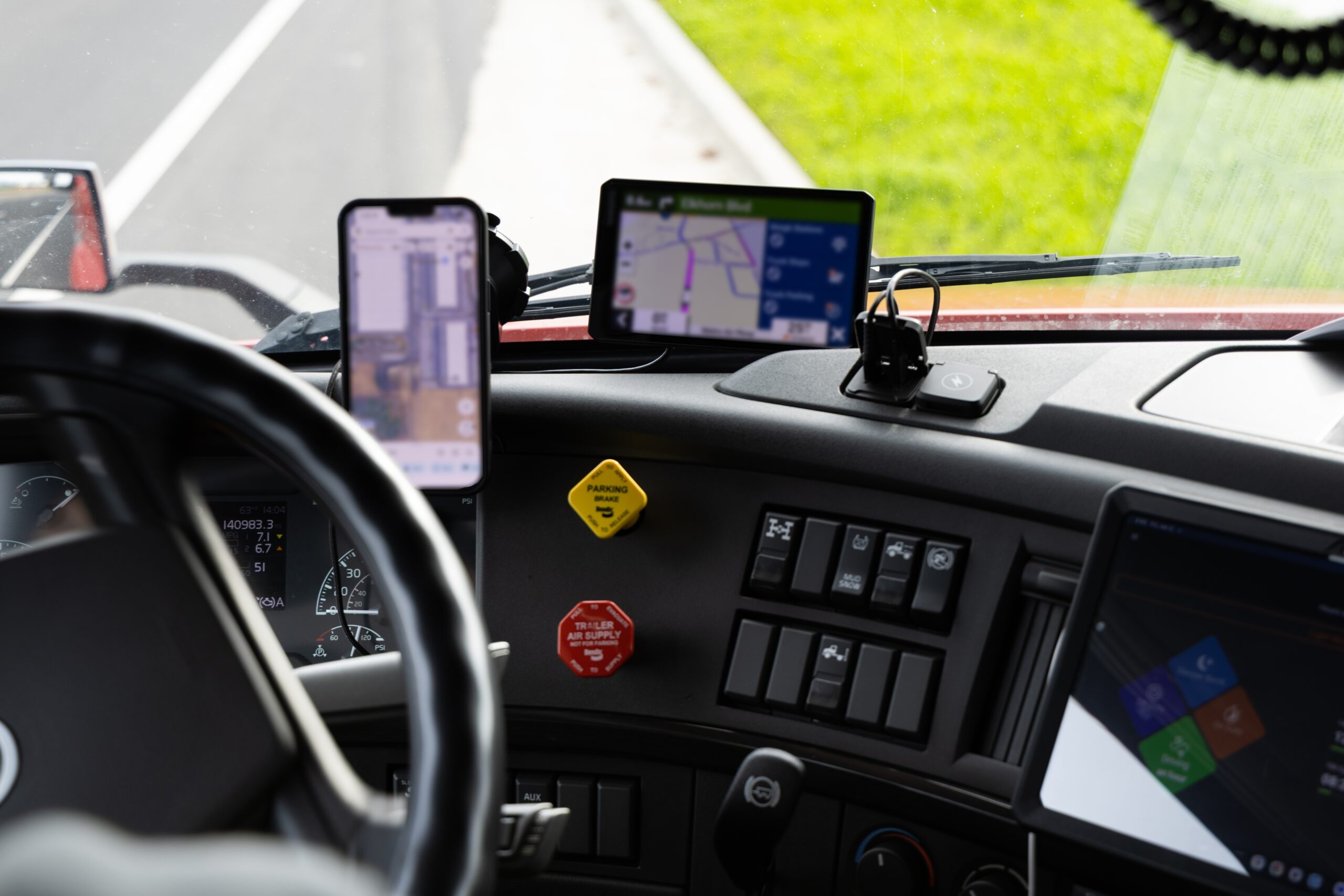
Note: This image is generated using ai. For illustrative purposes only.
Predictive maintenance: From repairs to proactive precision
One of the most transformative uses of AI in fleet operations is predictive maintenance. Vehicles on Indian roads endure harsh conditions, from extreme temperatures to uneven terrain, which makes them prone to frequent breakdowns. Traditional maintenance is reactive, often leading to unplanned downtime and inflated costs.
AI changes this by using predictive analytics. It collects and analyzes data from IoT sensors, telematics devices, and historical maintenance logs to predict potential failures. This proactive approach minimizes vehicle downtime and prevents costly repairs.
How Intangles applies this: Digital twins and DPF monitoring
Intangles’ digital twin technology creates virtual replicas of vehicle components, which makes fleet monitoring more precise and actionable. For example, its diesel particulate filter (DPF) monitoring provides real-time updates on filter performance on BS-VI trucks. This ensures timely intervention, prevents expensive breakdowns, and maximizes vehicle availability.
Fuel efficiency redefined: Cutting costs and carbon footprints
Fuel accounts for a significant portion of fleet operating costs, and inefficiencies in fuel management can erode profit margins. AI addresses this by optimizing routes, improving load distribution, and monitoring driver behavior.
Route optimization through AI
AI-powered systems analyze real-time traffic data, weather conditions, and road patterns to suggest the most efficient routes. This reduces fuel consumption, shortens delivery times, and improves customer satisfaction.
Load optimization
AI supports better load distribution by predicting demand and scheduling trips accordingly. Vehicles loaded closer to full capacity reduce the number of trips, saving fuel and lowering environmental impact.
By improving fuel efficiency, AI not only helps fleets cut costs but also supports sustainability goals.
Driver safety revolution: Empowering safer journeys
Safety is a critical concern for fleet operators, and AI makes a real difference. Driver-related risks such as fatigue, distraction, and harsh driving contribute significantly to accidents and vehicle damage.
Behavior monitoring and training
AI systems monitor driver behavior in real time, identifying risky practices such as sudden braking, speeding, or improper lane usage. Fleet managers receive actionable insights that let them run targeted training to address these behaviors.
Advanced driver assistance systems (ADAS)
ADAS features such as automatic emergency braking and lane departure warnings are becoming more common on new commercial vehicles in India. Combined with telematics-based driver behavior monitoring, they give fleets both in-cab alerts and the data to coach drivers over time.
Impact in India
With over-speeding linked to 70.3% of road deaths in 2024, monitoring and coaching that target speeding and harsh driving address one of the biggest risks on Indian roads, and they protect valuable assets at the same time.
Smart operations: Real-time monitoring and instant decisions
AI raises operational efficiency by enabling real-time monitoring and decisions. This matters most for fleets that operate across diverse geographies and face different conditions on every route.
Seamless data integration
AI platforms collect and integrate data from multiple sources, including GPS trackers, vehicle sensors, and telematics devices. This data is processed in real time, giving fleet managers a complete view of operations, including time-stamped trip records that back up the bilty, or lorry receipt, when a delivery’s timing is disputed.
Actionable insights for better decisions
AI doesn’t just collect data; it turns it into actionable insights. Fleet managers can anticipate issues, track performance metrics, and turn insights into scheduled maintenance tasks.
Intangles’ role
Intangles uses cloud-based AI processing for uninterrupted monitoring and analytics, helping fleets maintain peak efficiency, reduce delays, and improve customer satisfaction.
Breaking barriers: Overcoming adoption challenges in India
Despite its potential, AI adoption in fleet management faces challenges. Initial costs, a lack of technical expertise, and resistance to change are the most common hurdles.
Scalability and cost efficiency
While the upfront investment may seem daunting, AI solutions are scalable and cost-effective in the long run. Fewer breakdowns, better fuel efficiency, and safer driving translate into savings over time. For a step-by-step approach to evaluating platforms, see how to choose the best fleet management software.
Training and awareness
Providers are simplifying complex AI systems with training programs and user-friendly interfaces, and devices that connect through the OBD port without vehicle modifications make adoption faster.
Related Article: Top 10 Fleet Management Software Companies in India
Results from Indian fleets
The results of AI in fleet management are best measured in uptime. Intangles’ predictive AI runs at 96% accuracy across 500,000+ vehicles in 18 countries, and fleets using the platform have seen up to a 75% reduction in powertrain breakdowns.
These results show that AI isn’t just a technology upgrade; it’s a business enabler

The road ahead: AI’s future in Indian fleet management
The future of fleet management in India is closely tied to advances in AI.
Increased automation
AI systems will take on more complex tasks, from route planning to maintenance scheduling, moving fleets closer to highly automated operations.
Enhanced sustainability
AI will play a central role in reducing the environmental impact of fleets. Smarter fuel use, optimized logistics, and electric vehicle (EV) integration will drive sustainability.
Deeper insights with big data
As more data becomes available, AI systems will offer deeper insights and more tailored recommendations for each fleet.
AI innovations powering industry-specific fleet operations
Intangles provides industry-specific AI platforms designed for the challenges of trucking, construction, mining, farming, oil and gas, transit and coach, marine engines, gensets, and waste management.
Trucking: Keeping fleets on the road
In the trucking industry, vehicle downtime can lead to significant financial losses. Intangles addresses this with digital twin technology that creates virtual replicas of trucks, enabling predictive maintenance that identifies potential issues before they cause breakdowns. This proactive approach has delivered up to a 75% reduction in powertrain breakdowns for fleet operators. Real-time fleet monitoring also provides a complete view of operations, allowing immediate intervention.
Construction: Meeting tight project timelines
Construction projects often run under strict deadlines, where equipment reliability is crucial. Intangles’ AI-powered solutions predict equipment breakdowns well in advance, keeping machinery like excavators and loaders operational. By analyzing historical and real-time data, Intangles provides early warnings of potential issues, leading to lower maintenance costs and higher uptime.
Mining: Enhancing safety and efficiency
Mining operations run in rugged environments where equipment failure can be both costly and dangerous. Intangles’ predictive analytics reduces unexpected downtime in heavy machinery such as haul trucks and bulldozers by forecasting maintenance needs. Monitoring operational parameters in real time also supports safety and regulatory compliance.
Farming: Boosting agricultural productivity
In agriculture, equipment reliability directly affects productivity. Intangles’ AI-driven insights support farming operations by reducing unexpected downtime in machinery like tractors and combines. The platform analyzes equipment speed, idling time, and fuel consumption to help lower fuel expenses, while real-time asset tracking gives farmers better visibility into equipment usage.
Oil and gas: Ensuring equipment readiness
The oil and gas industry demands high equipment reliability. Intangles’ AI-powered platform provides real-time alerts about vehicle issues long before diagnostic trouble codes are triggered, preventing assets from breaking down in remote locations. Monitoring driving behavior and equipment usage also improves safety and keeps equipment ready for deployment.
Transit and coach: Delivering reliable public transport
Public transit operators must maintain high reliability to meet passenger expectations. Intangles’ predictive maintenance turns fleet maintenance into proactive management, reducing breakdowns and maintenance costs. A 360-degree view of the fleet helps identify vehicles that need immediate attention and keeps buses and coaches on schedule.
Marine engines: Optimizing performance at sea
For marine operations, engine reliability is paramount. Intangles’ AI-powered platform creates virtual copies of marine engines and analyzes their data to give early warnings of maintenance issues. Remote monitoring lets operators track engine metrics such as fuel efficiency and power output from anywhere.
Gensets: Ensuring reliable power supply
In industries that rely on generator sets (gensets) for power, unexpected failures can be costly. Intangles’ predictive maintenance platform detects issues before they cause a failure, provides real-time insights into fuel levels and consumption, and offers remote monitoring that reduces costs and improves genset efficiency.
Waste management: Streamlining operations
Waste management fleets need efficient operations to maintain public health standards. Intangles’ AI-powered solution detects potential vehicle issues before they lead to breakdowns. A complete view of the fleet helps managers find vehicles that need maintenance, and a database of diagnostic fault codes with repair guidance simplifies maintenance and keeps collection vehicles running.
How AI fleet management aligns with India’s national AI agenda
The growing adoption of AI across fleet-intensive industries also aligns with India’s national AI agenda. NITI Aayog’s National Strategy for Artificial Intelligence (2018) named smart mobility and transportation as one of five focus sectors, including predictive engine monitoring and maintenance. The IndiaAI Mission, approved in March 2024 with ₹10,371.92 crore, is now building the compute capacity, datasets, and skills that make AI practical at national scale: by March 2026, more than 38,000 GPUs had been onboarded through its AI compute portal for startups and researchers at subsidized rates.
The shift here is fundamental: fleet management used to mean reacting after something went wrong, and now it can mean catching the problem before it does. Manual inspections and fixed maintenance schedules worked when fleets were smaller and simpler. With real-time vehicle data, operators can spot risks earlier, get more out of each asset, and avoid the downtime that used to be a cost of doing business.
Fleets aren’t getting any smaller or simpler, though. More vehicles, more connectivity, more moving parts to track. The operators who turn that complexity into an advantage are the ones who act on what their data is telling them, not just collect it.
That’s the dividing line. It’s not the fleets with the most data that come out ahead; it’s the ones that act on it quickly and consistently. Across trucking, logistics, construction, mining, and industrial operations in India, that kind of AI-driven decision-making is fast becoming a basic requirement rather than an edge.
Discover how Intangles’ integrated fleet intelligence platform can predict breakdowns, cut fuel waste, and improve driver safety across your fleet in India.
KNOW MORE
Frequently Asked Questions
How does AI improve predictive maintenance in fleet management?
AI analyzes data from IoT sensors, telematics devices, and historical maintenance logs to detect early warning signs of component failure, so fleet managers can schedule repairs before a breakdown occurs. For Indian fleets running long hauls in heat, dust, and uneven road conditions, catching a failing component early avoids roadside breakdowns far from a workshop.
What is digital twin technology in fleet management?
Digital twin technology creates a virtual replica of a vehicle or its components, such as the diesel particulate filter on a BS-VI truck, and compares live performance against how that component should behave. Deviations show up early, which makes maintenance predictions more accurate.
How much can AI reduce fleet breakdowns?
Results depend on the fleet, the vehicles, and how quickly alerts are acted on. Intangles’ predictive AI, which runs at 96% accuracy across 500,000+ vehicles, has delivered up to a 75% reduction in powertrain breakdowns for fleets using the platform.
Which industries in India benefit from AI-powered fleet management?
AI fleet management applies across trucking and logistics, construction, mining, farming, oil and gas, transit and coach, marine engines, gensets, and waste management. Each sector has its own priorities, from uptime on remote mining sites to on-time performance for bus operators.
What are the main barriers to AI adoption in Indian fleet management?
The common barriers are upfront implementation cost, limited in-house technical expertise, and resistance to changing established processes, especially in small and mid-size fleets. Scalable subscription models, devices that connect through the OBD port without vehicle modifications, and simple mobile apps are lowering these barriers. Comparing fleet management software companies in India side by side also helps narrow the options.
How can AI help reduce road accidents involving commercial vehicles in India?
AI driver behavior monitoring flags over-speeding, harsh braking, and other risky habits in real time, so fleet managers can coach drivers before an incident. It targets a leading cause of crashes: over-speeding was linked to 70.3% of road deaths in India in 2024, according to MoRTH’s Road Accidents in India 2024 report, and provisional data put road deaths at 1,83,382 in 2025.







We’re looking forward to meeting you