
KEY TAKEAWAYS
- InGenious is Intangles’ plug-in OBD device: it connects to the vehicle’s diagnostic port, reads the truck’s own sensors and feeds a digital twin of every vehicle, with no tank sensors or extra hardware.
- It reads J1939, OBD2, UDS (including OBDonUDS, the diagnostic protocol US vehicles move to from the 2027 model year), J1708 and K-line, so one device type can cover diesel, gasoline, electric, hybrid, CNG, LNG, propane and E85 vehicles in the same fleet.
- A physics-based model learns each engine’s healthy behavior, such as oil pressure against load and speed or crankcase pressure against fuel rate, and flags drift before the vehicle sets a fault code.
- In Intangles’ North American fleet data, alerts have come hours to days ahead of the OEM fault code: about 190 hours for a failing battery, 64 hours for a lean fuel mix and 21 hours for low oil pressure.
- Alerts arrive in InRoute on the web and mobile app with repair guidance, so the shop knows where to start.
Most commercial fleets aren’t one kind of vehicle. A single operation might run diesel tractors, gasoline service vans, CNG refuse trucks and a growing number of electric or hybrid units, each from different manufacturers, each with its own diagnostic language. Standard telematics tells you where they all are. It rarely tells you which one is about to fail.
That’s the gap predictive maintenance closes, and for a mixed fleet it depends on one thing more than any algorithm: getting reliable health data out of every vehicle, whatever its make or powertrain.
In this blog, you will learn what Intangles’ InGenious device is, what it reads, how it connects across different vehicle types, how its data turns into predictions before fault codes appear, what early detection looks like in practice, and how it goes beyond standard telematics.
Why is InGenious?
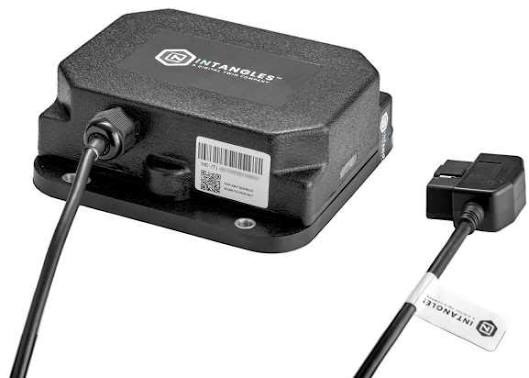
InGenious is the plug-in device at the heart of Intangles’ digital twin platform. It connects to the vehicle’s OBD port and works with the truck’s own sensors, so there’s no drilling, no tank sensors and no extra hardware, and the vehicle warranty stays intact.
The connection is read-only. On the standard 16-pin OBD-II connector, InGenious uses only six pins: power (pin 16), chassis and signal ground (pins 4 and 5), CAN High and CAN Low (pins 6 and 14) to receive the vehicle’s CAN messages, and pin 1 to detect whether the ignition is on. Power in, ground back, data out, without touching the vehicle’s wiring. On heavy trucks that use the 9-pin J1939 connector instead, an adapter cable does the same job.
From that one connection, it reads the health, fuel and driving data that Intangles’ models use to predict failures, and sends it to InRoute, Intangles’ fleet intelligence platform on the web and mobile app.
What data does InGenious read?
InGenious reads more than 450 data signals per vehicle across health, fault codes, fuel and DEF, driving behavior and location.
| Data | Why it covers |
| Health signals | Engine temperature, oil pressure, boost pressure, fuel rail pressure, fuel trim, crankcase pressure, battery voltage, tire pressure, aftertreatment and DPF condition, and more (450+ data signals per vehicle) |
| Fault codes | Every fault code, graded minor, major or critical, with suggested remedies by severity |
| Fuel and DEF | Fuel fills, drains and suspected theft without a tank sensor, using patented machine learning algorithms; DEF (AUS-32) level, consumption and pilferage on SCR-equipped vehicles |
| Driving behavior | 20+ driver behavior exceptions, such as overspeeding, idling, hard braking and free running, plus gear utilization and fatigue detection with rest recommendations, feeding a Driving Scorecard that ranks drivers against their peers. Braking behavior is tracked as part of driver behavior monitoring |
| Location | GNSS position for live location, trip history and route optimization |
How does InGenious connect across a mixed fleet?
One device type reads every major vehicle diagnostic protocol, runs on 12V and 24V systems and fits standard and OEM-specific ports.
| Built for | Details |
| Vehicle protocols | CAN 2.0 at up to 1 Mbps with ISO 15765, SAE J1939-21 and J1939-FMS; OBD2, WWH-OBD, UDS (ISO 14229) and KWP (ISO 14230) diagnostics; J1708 over RS485 (and MODBUS); K-line (ISO 9141 and ISO 14230) |
| Electrical systems | 8V to 32V input, so it runs on both 12V and 24V vehicles, with reverse polarity protection |
| Connectors | Plugs into the 16-pin OBD port; vehicle-specific adapter cables cover 9-pin heavy-duty connectors and OEM-specific ports, including Volvo 8-pin, Caterpillar 9-pin and Komatsu 12-pin, with splitters so a scan tool can stay connected |
| Powertrains | Diesel, gasoline, electric, hybrid, CNG, LNG, propane and E85 |
| Connectivity | 4G LTE on North American bands, Bluetooth, Wi-Fi and GNSS |
| Processing | Quad-core processing on the device or in the cloud; over-the-air updates |
| Conditions | Operates from −40°F to 185°F; IP65 ingress protection; tested for power transients (ISO 7637) and for vibration and shock |
| Backup and storage | Internal lithium-ion backup battery with overcharge and over-discharge protection; onboard flash memory |
| Mounting | Double-sided adhesive tape or M6 bolts on a bracket; plug-and-play, with no user-serviceable parts |
| Certifications | FCC and ISED certified; RoHS, REACH and WEEE compliant |
For a mixed fleet, the protocol list is what matters most. Heavy trucks speak J1939, light vehicles speak OBD2, older equipment may use J1708 or K-line, and newer vehicles are moving to UDS-based diagnostics. One device that reads all of them, and adapts to 12V and 24V systems and OEM-specific connectors, means one install process, one data model and one platform across trucks, vans and equipment. Before installing, fleets check each vehicle against Intangles’ device compatibility matrix. InGenious also reads OBDonUDS (SAE J1979-2), the new diagnostic protocol for combustion-engine vehicles: it becomes mandatory for light- and medium-duty vehicles from the 2027 model year, and heavy-duty manufacturers begin the transition with the 2027 engine model year, according to CARB’s SAE J1979-2 guidance. That means new trucks can join the same platform from day one.
For OBD basics and the 2027 change, see: What Is OBD-II? A US Fleet Manager’s Guide
Can electric vehicles run on the same platform?
Yes. InGenious supports battery-electric vehicles alongside diesel, gasoline and gas-powered units.
For battery-electric vehicles, it supports range prediction. It records charging cycles from the day it’s installed, extrapolates the vehicle’s charging history back to when it left the production line, and predicts state of charge (SOC) and distance to empty (DTE) using motor torque, vehicle speed, ambient temperature, weather forecasts and sunrise and sunset times, which affect HVAC and lighting use. Intangles’ EV monitoring also helps drivers find charging stations, plan routes around charging stops and schedule charging in off-peak hours. That puts diesel engine health and EV range in the same platform.
How does the digital twin turn InGenious data into predictions?
Fault codes are set when a reading crosses a fixed limit. InGenious data is used differently: a physics-based AI model builds a digital twin of each truck’s engine and systems, learns what health looks like for that specific vehicle, and watches for drift.
Some examples of the relationships it learns:
| System | What the model watches |
| Lubrication | Oil pressure against engine load and speed |
| Crankcase | Crankcase pressure against fuel rate, on every running hour |
| Air intake | Boost pressure against fuel rate |
| Fuel system | Fuel rail pressure mapped across operating conditions; air-fuel mix (fuel trim) across the engine’s range |
| Cooling | Coolant temperature and level on every trip |
| Electrical | Battery voltage against its safe range with the engine running |
| Aftertreatment | Every DPF regeneration logged with duration, mileage and burn quality |
When a reading drifts from its learned healthy line, the platform raises an alert, by text or in the web portal, with the likely root cause and what to do, often well before the ECU shows a diagnostic trouble code on the dashboard, across 450+ data signals per vehicle and with 96% predictive AI accuracy.
What does early detection look like?
These examples come from Intangles’ North American fleet data. Each shows how far ahead of the vehicle’s own fault code the alert arrived.
| System | What InGenious data showed | Warning before the fault code |
| Battery and charging | Voltage below the safe range with the engine on, declining for days | About 190 hours |
| Fuel trim | Engine running lean, outside the safe band | About 64 hours before misfire codes |
| Engine cooling | Engine temperature above the safe range | About 60 hours before the truck went offline |
| Air intake | Boost pressure about half what it should be for the fuel rate | About 56 hours before turbo and EGR codes |
| Oil pressure | Oil pressure below the minimum at idle | About 21 hours before the critical code |
| Crankcase | Pressure too high for the load, rising over days | Alert active a day before the fault code |
| DPF | Three of the last five regenerations failed or ran poorly | Alert with a prescribed next step (a highway drive or parked regeneration) |
In each case, the early alert turned a roadside failure into a repair the fleet could plan. Lead times vary from case to case; there is no single fixed warning window.

How is InGenious different from standard telematics?
A standard telematics device mainly answers where a vehicle is; InGenious and Intangles answer which vehicle is about to fail, and why.
| Standard telematics device | InGenious with Intangles | |
| Main question it answers | Where is the vehicle? | Which vehicle is about to fail, and why? |
| Fault visibility | Fault codes after they’re set | Drift flagged before the fault code |
| Fuel | Often needs a tank sensor | Fills, drains and theft without a tank sensor |
| Mixed fleets | Varies by protocol support | J1939, OBD2, UDS, J1708 and K-line in one device |
| Repair support | Code lookups | Likely causes, symptoms to check and prescribed next steps |
For telematics devices in general, read: Telematics Explained: How Data Intelligence is Transforming Modern Fleet Operations
From alert to repair: InRoute and guided repair
Alerts from InGenious data appear in InRoute, on the web and in the iOS and Android app:
- Predictive alerts with repair guidance: for a low fuel rail pressure alert, for example, the shop sees five likely causes, from a defective fuel pump to faulty wiring, and seven symptoms to check, so it knows where to start.
- Push alerts for health, fuel and safety on the mobile app, plus a live map with location, speed, fuel level and open faults.
- Reports to your inbox, and health, fuel, driver and compliance views on the web.
- Security: SOC 2 and ISO/IEC 27001, data encrypted in transit, and no data shared with third parties.
Operations automation turns alerts into scheduled maintenance tasks.
One install for truck health and driver safety
For fleets that also want video, Intangles’ InVision+ AI dashcam reads the same health, fuel and DEF data over CAN and OBD, alongside driver-facing and road-facing cameras that flag drowsiness, distraction, phone use, tailgating and lane departure. Video events sit next to health, fuel and location data in InRoute. For how video and vehicle data work together, see this guide to video telematics.
How to start with InGenious
- Pick a pilot group that covers each make and powertrain in your fleet.
- Plug in InGenious on each vehicle through the OBD port.
- Let the digital twin learn each vehicle’s healthy behavior.
- Route alerts to a named owner in your shop.
- Review results against your baseline of roadside failures and unplanned shop visits.
For choosing between platforms, see the predictive maintenance software buyer’s guide, and for how Intangles’ platform turns this data into fleet-wide health monitoring, see fleet health monitoring with Intangles’ digital twin.
Intangles is a digital twin company operating in 18 countries, with 500,000+ vehicles on its platform, working with fleets in trucking, construction and waste management.
Discover how predictive health monitoring with InGenious can flag failures across your mixed fleet before the fault code appears.
Frequently Asked Questions
What is the Intangles InGenious device?
InGenious is Intangles’ plug-in OBD device. It connects to the vehicle’s diagnostic port, reads the truck’s own sensors and sends health, fuel, driving and location data to Intangles’ digital twin platform, which predicts failures before the vehicle sets a fault code.
Does InGenious need tank sensors or extra hardware?
Which vehicles and protocols does InGenious support?
It reads CAN (J1939, ISO 15765), OBD2, WWH-OBD, UDS (including OBDonUDS, which US vehicles move to from the 2027 model year), KWP, J1708 and K-line, runs on 12V and 24V systems, and uses adapter cables for heavy-duty and OEM-specific connectors. It works across diesel, gasoline, electric, hybrid, CNG, LNG, propane and E85 vehicles. Check individual vehicles against Intangles’ device compatibility matrix.
How early can InGenious detect a fault?
It depends on the fault. In Intangles’ North American fleet data, alerts have come about 190 hours before the OEM fault code for a failing battery, about 64 hours before misfire codes for a lean fuel mix, and about 21 hours before the critical code for low oil pressure.
How is InGenious different from a standard telematics device?
A standard device mainly reports location and fault codes after they’re set. InGenious feeds a physics-based digital twin of each vehicle that flags drift before the fault code, tracks fuel without a tank sensor, reads five vehicle protocols and comes with repair guidance in InRoute.
Does InGenious work for predictive maintenance across a mixed fleet?
Yes. Because it reads multiple diagnostic protocols and works across powertrains, a fleet can standardize on one device and one platform for predictive maintenance, rather than running different systems for different vehicle types.
How is InGenious installed?
With the vehicle parked and the engine off, InGenious plugs into the vehicle’s OBD port, using a vehicle-specific adapter cable where needed, and is mounted with double-sided tape or M6 bolts where its GPS antenna has a clear view. Once powered, its LEDs show that it’s polling vehicle data, connected to the network and has a GPS fix.
Does InGenious work on electric vehicles?
Yes. For electric vehicles, it tracks charging cycles and predicts state of charge and distance to empty, taking into account motor torque, speed, ambient temperature, weather and time of day, and helps with charging-station location, charging-stop route planning and off-peak charging schedules, so EVs sit in the same platform as diesel and gasoline vehicles.







We’re looking forward to meeting you