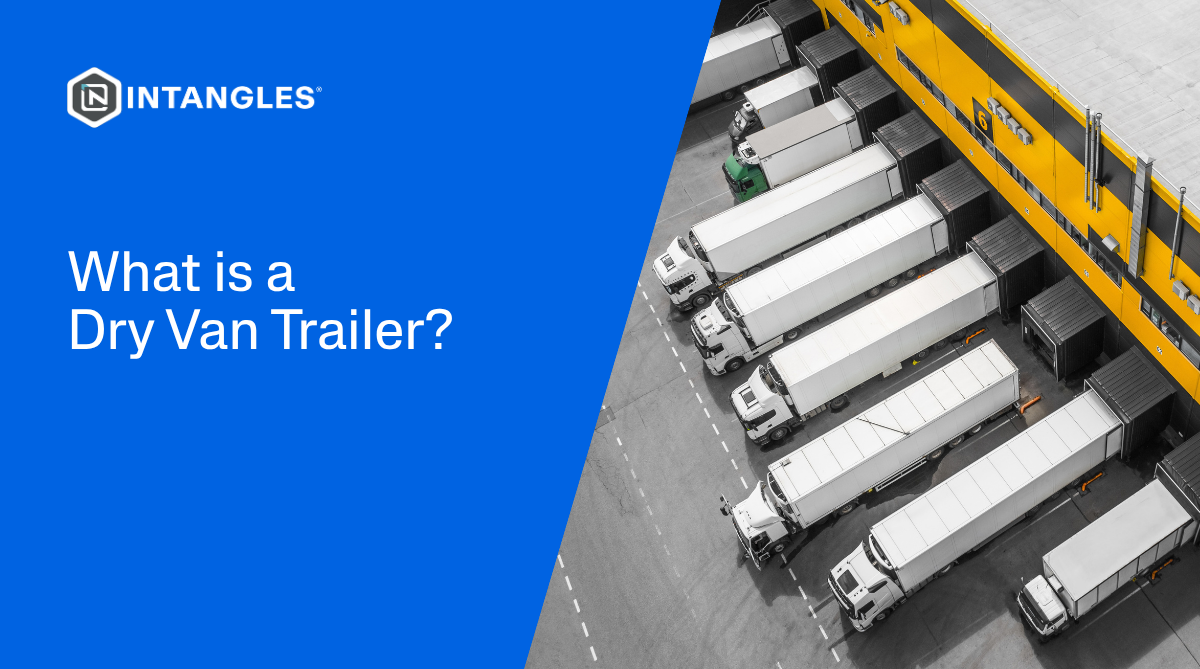
A dry van trailer is an enclosed, non-refrigerated trailer used to transport general freight that does not require temperature control. It protects cargo from weather, road debris, and theft while providing a secure space for palletized and boxed shipments. Because it fits standard loading docks and can carry a wide variety of freight, the dry van is the most widely used trailer type in the US trucking industry.
KEY TAKEAWAYS
- A dry van is an enclosed, non-refrigerated trailer built to keep freight dry and protected from weather and theft.
- The standard 53-foot dry van typically carries 42,000 to 45,000 lbs of cargo once the tractor’s weight is subtracted from the federal 80,000 lb gross vehicle weight limit.
- Dry vans handle dry goods, retail merchandise, packaged food, and building materials. Temperature-sensitive freight requires a refrigerated trailer, and oversized loads require an open deck.
- Federal cargo securement rules under 49 CFR Part 393 require tie-down capacity equal to at least half the cargo’s weight, checked early in a trip and at regular intervals throughout the run.
- Dry van rates have firmed through 2026 as driver shortages and carrier exits tighten capacity faster than demand is growing.
- Fleet health monitoring and fuel tracking have become standard tools for dry van operators, protecting margins in a tighter rate environment.
In this guide, we cover what a dry van trailer is, why it dominates US freight, how it compares to reefers and flatbeds, trailer specifications, cargo securement regulations, market conditions in 2026, and how fleet technology helps dry van operators stay profitable.
Understanding the difference
| Trailer type | Best for | Weather protection | Temperature control |
| Dry van | General freight | Yes | No |
| Reefer | Food and pharmaceuticals | Yes | Yes |
| Flatbed | Oversized freight | No | No |
Why dry vans dominate US freight
The dry van is not the most popular trailer in trucking by accident. It is the most useful piece of freight equipment for the broadest range of shippers, which is why it accounts for the majority of truckload capacity in the country.
Three things explain the dominance. First, the box keeps freight dry. Rain, road spray, and road grit stay outside regardless of weather, which covers the basic requirement for most non-perishable goods. Second, the enclosed design protects cargo from theft. Freight locked behind swing doors is harder to access than freight strapped to an open deck. Third, dry van trailers are built to the same floor height as standard US loading docks, so backing one up to a warehouse does not require ramps, lifts, or special equipment.
According to the American Trucking Associations, trucks move approximately 72% of domestic freight tonnage in the United States, highlighting the critical role dry van equipment plays in the freight economy. Dry vans carry a significant share of this freight because they can transport a wide variety of palletized and packaged goods.
Dry van trailer specifications
| Specification | Typical value |
| Standard length | 53 feet |
| Interior width | 96 inches |
| Interior height | 110 inches |
| Pallet capacity | 26 standard 48×40 pallets |
| Maximum cargo weight | 42,000 to 45,00 lbs |
| Federal GVW limit | 80,000 lbs (tractor + trailer + cargo) |
The industry-standard trailer length for long-distance haulage is 53 feet. Other available lengths include 48-foot trailers for regional routes and 28-foot pup trailers commonly used in LTL and last-mile logistics. All trailer types share the same interior dimensions, allowing identical palletizing regardless of trailer length.
Weight capacity typically determines how a trailer is loaded before available space does. Denser cargo such as canned foods, glass products, and metal parts often reaches 44,000 lbs before the trailer looks full.
How a dry van trailer is built
Most trailers are constructed from aluminum panels attached to an internal post-frame structure. Aluminum keeps the trailer light, allowing maximum payload capacity within federal limits. Some carriers continue to operate steel-sided trailers for their durability under heavy and frequent loading. Trailer floors are typically made of laminated hardwood or composite panels.
Rear doors are almost always swing doors on over-the-road trailers. Roll-up doors appear on trailers built for city routes with frequent stops, where the swing radius of a full door would create problems in tight dock areas. Newer trailers often include electronic door seals that log each door opening, giving shippers a tamper record between pickup and delivery.
What a dry van carries
If freight does not need temperature control and fits through the rear doors, a dry van is almost always the right equipment.
Grocery staples make up a large share of dry van volume: canned goods, dry pasta, cereals, bottled beverages, and packaged snacks. Retail goods moving from distribution centers to stores, including clothing, electronics, and household items, also move primarily by dry van. Building materials, paper goods, packaging supplies, lumber, and industrial parts that require no specialized handling round out the typical freight mix.
What a dry van cannot carry
Temperature-controlled cargo should not travel in an uncooled box. Fresh produce, frozen foods, pharmaceuticals, and certain chemicals require a reefer truck equipped with an active cooling system. Shipping temperature-sensitive cargo in a dry van can cause product quality failures and may violate FDA transportation requirements.
Freight that is too large or irregularly shaped to pass through the rear doors or fit within the trailer body requires a flatbed. Structural steel, heavy machinery, and large construction components are typical flatbed loads.
Dry van vs. reefer vs. flatbed
The right equipment choice comes down to two questions: does the freight need a controlled temperature, and does it fit inside a closed box?
| Feature | Dry van | Reefer | Flatbed |
| Enclosed | Yes | Yes | No |
| Refrigerated | No | Yes | No |
| Handles oversized freight | No | No | Yes |
| Weather protection | Yes | Yes | No |
| Typical cost per mile | Lowest | Highest | Medium to high |
| Common freight | General goods, retail, packaged food | Produce, frozen food, pharma | Steel, machinery, construction materials |
Refrigerated trailers carry a cooling unit at the nose that runs on its own fuel supply, capable of holding temperatures from well below freezing up to the mid-60s Fahrenheit. That equipment and the fuel it burns are what drive reefer rates consistently higher than dry van. Reefer freight also carries stricter compliance requirements under FDA food safety rules, which adds operational overhead.
Flatbed drops the enclosure entirely. It is the right call for freight that is too tall, too wide, or too irregularly shaped for an enclosed trailer. The tradeoff is no weather protection and a securement job built around chains and binders rather than a locked box. Flatbed rates have remained relatively strong throughout 2026, driven by construction activity, but that does not change what the equipment is designed for.
Dry van is the default choice for anything that stays dry and fits through standard rear doors. It is cheaper to source, easier to book capacity on, and available at virtually every loading dock in the country.
Dry van regulations and cargo securement
Cargo inside a dry van is subject to the same federal securement standards that apply to an open flatbed. The fact that the doors close does not exempt a load from FMCSA regulations under 49 CFR Part 393.
According to the FMCSA Cargo Securement Rules, carriers must ensure cargo is properly immobilized and secured to prevent shifting or falling during transit.
Core rule: under 49 CFR 393.102, the aggregate working load limit of all tie-downs must equal at least 50% of the cargo’s weight. For a 20,000 lb load, the minimum aggregate WLL of all tie-downs must be at least 10,000 lbs.
In a dry van, securement typically involves load bars or an E-track system securing pallets to the walls rather than chains and binders. Drivers must inspect cargo securement within the first 50 miles of a trip and at regular intervals thereafter, as loads may shift and straps may loosen once goods settle.
Weight distribution across axles carries its own requirements. Federal bridge formula rules under 23 USC 127 cap the load on any single axle group regardless of the trailer’s total gross vehicle weight rating. A trailer loaded with all the weight toward the rear axles can fail a roadside inspection even if it is under the 80,000 lb gross limit. Getting axle weights right is one of the more common points of failure during FMCSA roadside inspections.
Dry van market conditions in 2026
Rate conditions in the dry van market look substantially different from the soft environment carriers dealt with in 2024 and early 2025.
Load-to-truck ratios have tightened as the truckload market moves into a supply-driven recovery, with spot conditions elevated year-over-year and contract rates beginning to follow as tighter capacity works through bid cycles. According to ACT Research’s 2026 Freight Forecast, carrier exits, slower fleet expansion, and growing driver constraints are limiting available capacity, creating a recovery shaped by structural tightening rather than a surge in freight demand. DAT contract rates combining dry van, reefer, and flatbed rose in May and were up nearly 10% year-over-year, with ACT expecting spot-rate acceleration to drive a more meaningful contract-rate increase in the second half of 2026.
Capacity is leaving the market faster than freight volume is growing. Stricter roadside enforcement, rising insurance costs, and carriers holding off on equipment purchases have shifted pricing power back toward carriers after an extended period where shippers held most of the leverage. For fleet operators, the current environment offers a real opportunity to recover margin, but only if fuel costs and unplanned maintenance do not absorb the gains first.
How Intangles supports dry van fleet operations
For carriers operating dry van fleets, profitability increasingly depends on reducing fuel waste, avoiding roadside breakdowns, and keeping trucks earning miles. A dry van pulled off the road for a fault that could have been caught days earlier does not just generate a repair bill. It means a missed pickup window and a rejected tender that is hard to recover from when every available truck is supposed to be running.
Intangles connects to commercial vehicles via the OBD port through the InGenious device, with no modifications required, feeding real-time ECU data into the InRoute platform across more than 500,000 vehicles in 18 countries. At a predictive AI accuracy rate of 96%, the platform surfaces developing mechanical issues before they become roadside failures. Across the fleets it serves, Intangles has helped reduce powertrain breakdown events by 75%.
Capability | How it supports dry van |
Predictive Vehicle Health Monitoring | Continuously tracks engine, fuel system, battery and alternator, and aftertreatment system health. Surfaces fault codes and predictive alerts before mechanical issues ground a vehicle mid-route. |
Fuel Management and Loss Quantification | Tracks fuel consumption, idle-attributed waste, and cost-per-mile across every vehicle. In a tighter rate environment, fuel visibility is a direct margin lever. |
Driver Performance Tracking | Monitors harsh braking, overspeeding, harsh acceleration, and excessive idling across the fleet. Reduces the vehicle wear that shortens component life and increases breakdown frequency on active lanes. |
This is where predictive maintenance pays for itself in dry van operations: not in the cost of a single repair, but in keeping the truck available for every load it was scheduled to move.
At Intangles, dry van fleets are among the operations where fuel management and predictive health monitoring show the clearest return. The margins are thinner than reefer, the lanes are competitive, and the difference between a truck that runs and one that does not is the difference between a profitable week and a costly one.
Explore the platform or get in touch with our team to find out more about how Intangles helps dry van fleets reduce downtime, control fuel costs, and protect margins.
KNOW MORE
Frequently Asked Questions
What is the difference between a dry van and a box truck?
A dry van is a trailer pulled by a separate tractor. A box truck has both the cargo box and the engine on the same chassis. Dry vans operate as tractor-trailer combinations while box trucks are used for local and last-mile delivery.
How many pallets fit in a 53-foot dry van?
A standard 53-foot dry van fits approximately 26 standard 48×40 pallets in a single row. Double-stacking is possible depending on load weight and cargo type.
What freight cannot be transported in a dry van?
Freight requiring temperature control, including fresh produce, frozen foods, and pharmaceuticals, requires a reefer trailer. Freight that is oversized, too tall, or irregularly shaped requires a flatbed.
What is the difference between a dry van and a reefer?
A reefer has an active cooling unit that maintains a set temperature, making it suitable for perishables and pharmaceuticals. A dry van has no climate control. Reefer freight typically costs more per mile because of the cooling equipment and its operating fuel.
What securement rules apply to cargo inside a dry van?
Under 49 CFR 393.102, the aggregate WLL of all tie-downs must be at least 50% of the cargo’s weight. A 20,000 lb load requires a minimum of 10,000 lbs aggregate WLL across all tie-downs. Drivers must inspect securement within the first 50 miles and at regular intervals throughout the trip.
Are dry van rates going up in 2026?
Yes. Rate conditions have tightened through 2026 as available capacity decreases due to carrier exits, driver constraints, and slower fleet expansion. Spot and contract rates have both moved upward from the softer environment carriers experienced in 2024 and early 2025.




We’re looking forward to meeting you