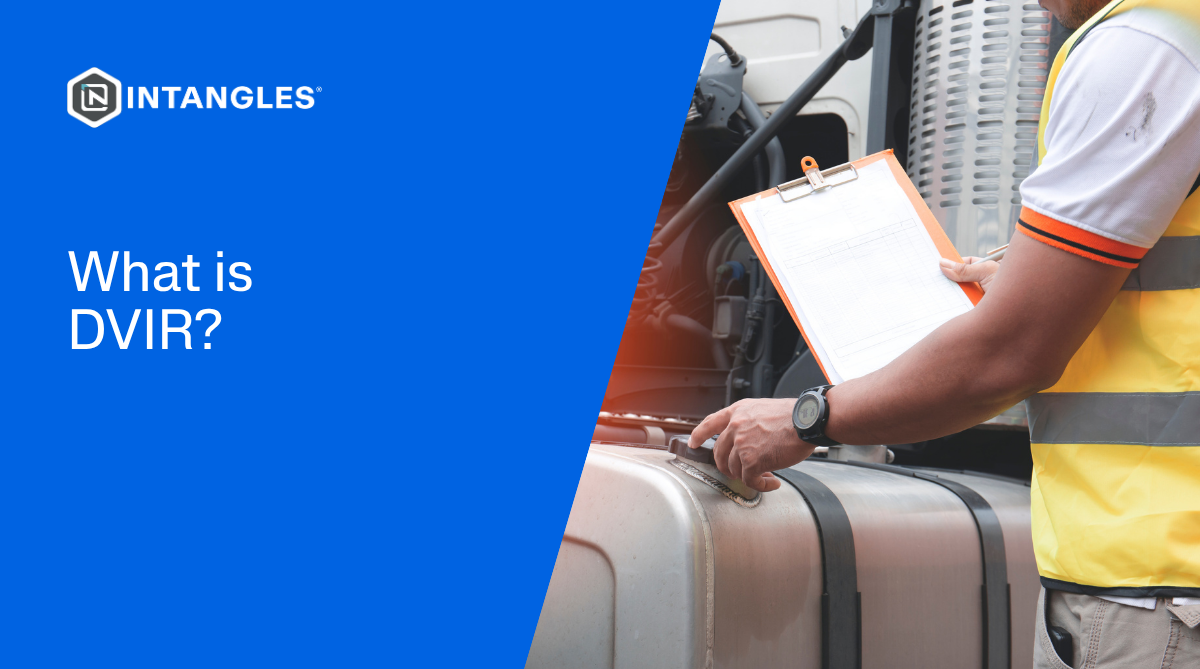
A DVIR, or Driver Vehicle Inspection Report, is a federally required document that commercial vehicle drivers must complete before and after every trip. It records the condition of the vehicle and any defects identified during the inspection. Under FMCSA regulations, DVIRs are a core component of commercial vehicle safety compliance and are mandatory for most drivers operating commercial motor vehicles in interstate commerce.
KEY TAKEAWAYS
- A DVIR is a federally required inspection report completed by commercial vehicle drivers before and after each trip under FMCSA regulations.
- Drivers must inspect specific vehicle parts and systems and report any defects or deficiencies that could affect safe operation.
- Carriers must review and certify that all reported defects have been repaired or are not safety-critical before the vehicle returns to service.
- DVIR records must be retained for at least three months and made available to FMCSA inspectors on request.
- Digital DVIRs are now widely adopted and accepted by the FMCSA, reducing paperwork burden and improving defect tracking across fleets.
- Incomplete or missing DVIRs are among the most commonly cited violations in FMCSA roadside inspections and contribute to CSA score degradation.
In this guide, we cover what a DVIR is, what it must include, the pre-trip and post-trip inspection requirements, how digital DVIRs work, DVIR retention rules, and how fleet management technology supports DVIR compliance in 2026.
DVIR definition and regulatory basis
DVIR stands for Driver Vehicle Inspection Report. The requirement is established under 49 CFR Part 396.11 of the FMCSA regulations, which mandates that every driver who operates a commercial motor vehicle must prepare a written report at the completion of each day’s work. A second regulation, 49 CFR Part 396.13, requires the driver to review the previous DVIR before taking the vehicle out on the next trip.
Together, these regulations create a continuous inspection loop: the outgoing driver reports defects, the carrier certifies repairs, and the incoming driver reviews the report before operating the vehicle.
What must a DVIR include?
Under 49 CFR 396.11, a DVIR must cover the following vehicle systems and components:
| Inspection area | Components covered |
| Service brakes | Including trailer brake connections |
| Parking brakes | Engagement and holding capacity |
| Steering mechanism | Play, binding, and component condition |
| Lighting devices | Headlights, brake lights, turn signals, clearance lights |
| Tires | Condition, inflation, tread depth, and sidewall damage |
| Horn | Audible signal function |
| Windshield wipers | Condition and operational effectiveness |
| Rear vision mirrors | Adjustments, condition, and visibility |
| Coupling devices | Fifth wheel, pintle hooks, drawbars |
| Wheels and rims | Cracks, damage, missing hardware |
| Emergency equipment | Fire extinguisher, warning triangles, spare fuses |
The report must also include the driver’s name, date, vehicle identification, carrier name, and the driver’s certification that the vehicle is in safe operating condition or that defects have been noted.
If no defects are found, the driver still must complete and sign the DVIR to that effect. A blank form is not compliant.
Pre-trip vs. post-trip inspection: What is the difference?
Many drivers and fleet managers use DVIR to refer specifically to the post-trip report, but the full compliance picture includes both pre-trip and post-trip inspections.
| Pre-trip inspection | Post-trip inspection (DVIR) | |
| When | Before the vehicle is operated | At the end of each day’s work or tour of duty |
| Regulatory basis | 49 CFR 392.7 | 49 CFR 396.11 |
| Purpose | Confirm the vehicle is safe to operate | Document any defects discovered during the trip |
| Required form | Not a specific form, but must cover required components | Written DVIR required |
| Carrier review | N/A | Required before next dispatch |
The pre-trip inspection is not always accompanied by a separate form, but drivers must systematically check all required components before operating the vehicle. Defects found during the pre-trip should be noted on the previous DVIR and reported to the carrier before departure.
The DVIR compliance process
A compliant DVIR process follows four steps:
Driver completes the post-trip DVIR
At the end of each working day, the driver inspects the vehicle, documents any defects, signs the report, and submits it to the carrier. If no defects are found, the driver certifies the vehicle as satisfactory.
Carrier reviews the report
A designated carrier representative reviews the DVIR. If defects are noted, they must determine whether the defects affect safe operation.
Repairs are made or defects are certified as non-safety-critical
Defects affecting safe operation must be repaired before the vehicle returns to service. Defects not affecting safe operation must be noted as such on the DVIR. A mechanic or authorized carrier representative signs off on the repair or certification.
Next driver reviews the previous DVIR
Before operating the vehicle, the incoming driver must review the most recent DVIR and sign it to confirm they have done so. This creates the continuous inspection loop required under 49 CFR 396.13.
DVIR retention requirements
FMCSA regulations require carriers to retain DVIRs for a minimum of three months. The records must be kept at the carrier’s principal place of business or at the location where the vehicle is assigned, and must be made available to FMCSA enforcement personnel on request.
For digital DVIR systems, electronic records must be stored in a format that can be retrieved, printed, and presented during inspections or audits. Cloud-based fleet management platforms that store DVIR records automatically satisfy this requirement in most cases, provided the records are accessible and exportable.
Digital DVIRs: FMCSA acceptance and fleet adoption
The FMCSA accepts electronic DVIRs as compliant with 49 CFR 396.11 requirements, provided the system captures all required information, allows drivers to certify the report electronically, and stores records in a retrievable format.
Digital DVIR systems offer several operational advantages over paper forms:
- Real-time defect notification
Reported defects are immediately visible to dispatchers and maintenance teams, reducing the lag between defect reporting and repair scheduling - Photo documentation
Drivers can attach photos to defect reports, improving repair accuracy and creating stronger documentation for compliance and insurance purposes - Automatic record retention
Records are stored and retrievable without physical filing systems - Audit trails
Digital systems timestamp every action: completion, carrier review, repair certification, and driver sign-off on review - Integration with maintenance workflows
Defect reports can trigger work orders directly in maintenance management systems
In 2026, digital DVIRs are standard practice across most mid-to-large US fleets. Paper DVIRs remain compliant but create manual overhead that most fleet operators have moved away from.
DVIR violations and CSA score impact
Missing, incomplete, or falsified DVIRs are citable violations under FMCSA regulations. These violations are recorded in the Vehicle Maintenance BASIC of the CSA Safety Measurement System, where they accumulate over a 24-month window and affect the carrier’s safety rating.
Common DVIR-related violations cited at roadside inspections:
- Driver failed to prepare a DVIR
- DVIR not reviewed by the next driver
- Defects noted on DVIR not repaired or certified before vehicle returned to service
- DVIR not available for inspection
- Required inspection items not covered
Beyond CSA scores, DVIR violations create liability exposure. In the event of a crash, a missing or incomplete DVIR record is discoverable evidence that the vehicle’s inspection status was not maintained.
How Intangles support DVIR and vehicle inspection compliance
For commercial fleets, DVIR compliance is only as strong as the underlying vehicle health information available to drivers and maintenance teams. A driver conducting a pre-trip inspection on a vehicle with no prior context has to rely entirely on visual checks. A driver reviewing a vehicle health dashboard that surfaces active fault codes, recent DTC history, and system-level anomalies can conduct a more informed inspection and report more accurately.
Intangles connects to vehicles through the OBD port via the InGenious device, with no modifications required, and feeds real-time ECU data into the InRoute platform across more than 500,000 vehicles in 18 countries. The platform’s 96% predictive AI accuracy means that many defects surface before they are visible during a manual inspection.
| Capability | How it supports DVIR compliance |
| Vehicle health monitoring | Surfaces active fault codes, DTC histories, and system anomalies that drivers and maintenance teams can reference alongside DVIR submissions, improving defect identification accuracy and repair prioritization. |
| Predictive Maintenance Scheduling | Identifies developing faults before they become DVIR-reportable defects, enabling repairs during planned maintenance rather than after a driver flags an issue that grounds the vehicle. |
| Operational Loss Quantification | Maps vehicle downtime caused by DVIR-related out-of-service events to financial cost, supporting the business case for proactive inspection and maintenance programs. |
Manual inspections remain essential, but they only provide a snapshot of vehicle condition at a specific moment in time. Intangles helps fleets add operational context to that process by continuously collecting data from critical vehicle systems and making it available through a single platform. This allows maintenance teams to validate reported defects faster, understand recurring issues across vehicles, and make more informed decisions about repair priorities and vehicle availability.
DVIR compliance is ultimately about maintaining a documented process for identifying, reporting, and resolving vehicle defects before they create safety risks on the road. While the regulatory requirements are straightforward, consistent execution across large fleets requires coordination between drivers, maintenance teams, and fleet managers. A structured inspection program supported by accurate vehicle data helps fleets improve accountability, maintain compliance, and keep vehicles operating safely throughout their service life.
Smog check failures are often the final symptom of issues that have been developing inside the vehicle for weeks. Continuous monitoring of engine, aftertreatment, and emissions systems gives fleet managers the visibility needed to detect problems earlier, schedule repairs proactively, and maintain compliance without unnecessary downtime.
Explore the platform or get in touch with our team to learn how Intangles helps fleets gain deeper visibility into vehicle performance, maintenance trends, and operational risks through connected vehicle intelligence.
KNOW MORE
Frequently Asked Questions
What does DVIR stand for?
DVIR stands for Driver Vehicle Inspection Report. It is a federally required document that commercial vehicle drivers must complete at the end of each working day under FMCSA regulations, recording the condition of the vehicle and any defects discovered during operation.
Who is required to complete a DVIR?
Drivers of commercial motor vehicles operating in interstate commerce are required to complete a DVIR under 49 CFR 396.11. This applies to vehicles with a GVWR over 10,001 lbs, vehicles transporting hazardous materials in placardable quantities, and vehicles designed to carry 16 or more passengers.
What happens if a defect is found on a DVIR?
The carrier must review the reported defect and determine whether it affects safe vehicle operation. Defects affecting safe operation must be repaired before the vehicle returns to service. A mechanic or authorized carrier representative must certify the repair on the DVIR. The next driver must review and sign the DVIR before operating the vehicle.
How long must DVIRs be retained?
FMCSA regulations require carriers to retain DVIRs for a minimum of three months at the carrier’s principal place of business or at the location where the vehicle is assigned. Records must be available for inspection by FMCSA enforcement personnel on request.
Are digital DVIRs accepted by the FMCSA?
Yes. The FMCSA accepts electronic DVIRs as compliant with 49 CFR 396.11 requirements, provided the system captures all required information, allows electronic driver certification, and stores records in a retrievable format.
What is the difference between a pre-trip inspection and a DVIR?
A pre-trip inspection is conducted before the vehicle is operated and is required under 49 CFR 392.7. A DVIR is the written report completed at the end of each working day under 49 CFR 396.11. The pre-trip inspection does not require a specific form, while the DVIR must be a written or electronic document covering all required vehicle components.




We’re looking forward to meeting you