KEY TAKEAWAYS
- An odometer reading is the total cumulative distance a vehicle has traveled from manufacture. It is the primary trigger for every scheduled PM interval in a commercial fleet.
- Manual odometer entry carries a 15-30% error rate, with monthly discrepancies averaging 200-500 miles per vehicle, enough to distort PM schedules, MPG calculations, and IFTA reports simultaneously.
- Modern telematics reads odometer data directly from the vehicle ECM through OBD-II and manufacturer-supported diagnostic interfaces. It matches the dashboard exactly, with no GPS drift and no manual input.
- Federal law (49 USC 32705) requires a signed odometer disclosure statement whenever a US motor vehicle is sold or transferred.
- Automated odometer tracking generates IFTA per-state mileage records and IRS mileage logs automatically, reducing the amount of manual reconciliation and compliance documentation fleets need to handle.
An odometer reading is the total cumulative distance a vehicle has traveled since it was manufactured. In a commercial fleet, it is not just a number on the dashboard. It is the primary trigger for every scheduled maintenance interval, the input for IFTA quarterly filings, the basis of IRS mileage records, and the data point that determines when a vehicle gets cycled out of service.
Fleet managers depend on odometer accuracy for decisions made daily: when to schedule an oil change, whether a vehicle’s fuel efficiency is dropping, and whether a unit is approaching the end of its economical service life. When that number is unreliable, every downstream decision built on it is unreliable too.
For fleets still relying on manual entry, that unreliability is common. Industry data shows manual mileage logs carry a 15–30% error rate, with discrepancies averaging 200–500 miles per vehicle each month. This guide covers what an odometer reading is, how to read one, how fleet managers use mileage data, and what it costs when that data is wrong.
What is an odometer reading?
An odometer reading is the total cumulative distance a vehicle has traveled since it left the factory. It is measured in miles in the US and is the legally significant mileage number used for maintenance scheduling, vehicle sale disclosures, and quarterly IFTA reporting.
There are two types every fleet manager should distinguish:
- Total odometer (ODO): Counts every mile from manufacture. Cannot be reset. This is the number that matters for PM intervals, federal disclosure requirements, and compliance reporting.
- Trip odometer: A resettable counter for measuring individual trip or shift distances. Useful for per-trip fuel efficiency calculations and driver mileage logs, but carries no legal weight on its own.
On the technology side, older mechanical odometers use gear-driven drum wheels that count wheel rotations. They are accurate enough but can be physically rolled back, which is the origin of odometer fraud in used vehicle markets. Modern digital odometers work through electronic sensors connected to the vehicle’s Engine Control Module (ECM). They are harder to tamper with, and the ECM stores the total odometer value that OBD-II diagnostic interfaces read directly, making that value available to fleet telematics systems in real time.
How to read an odometer: Digital and analog
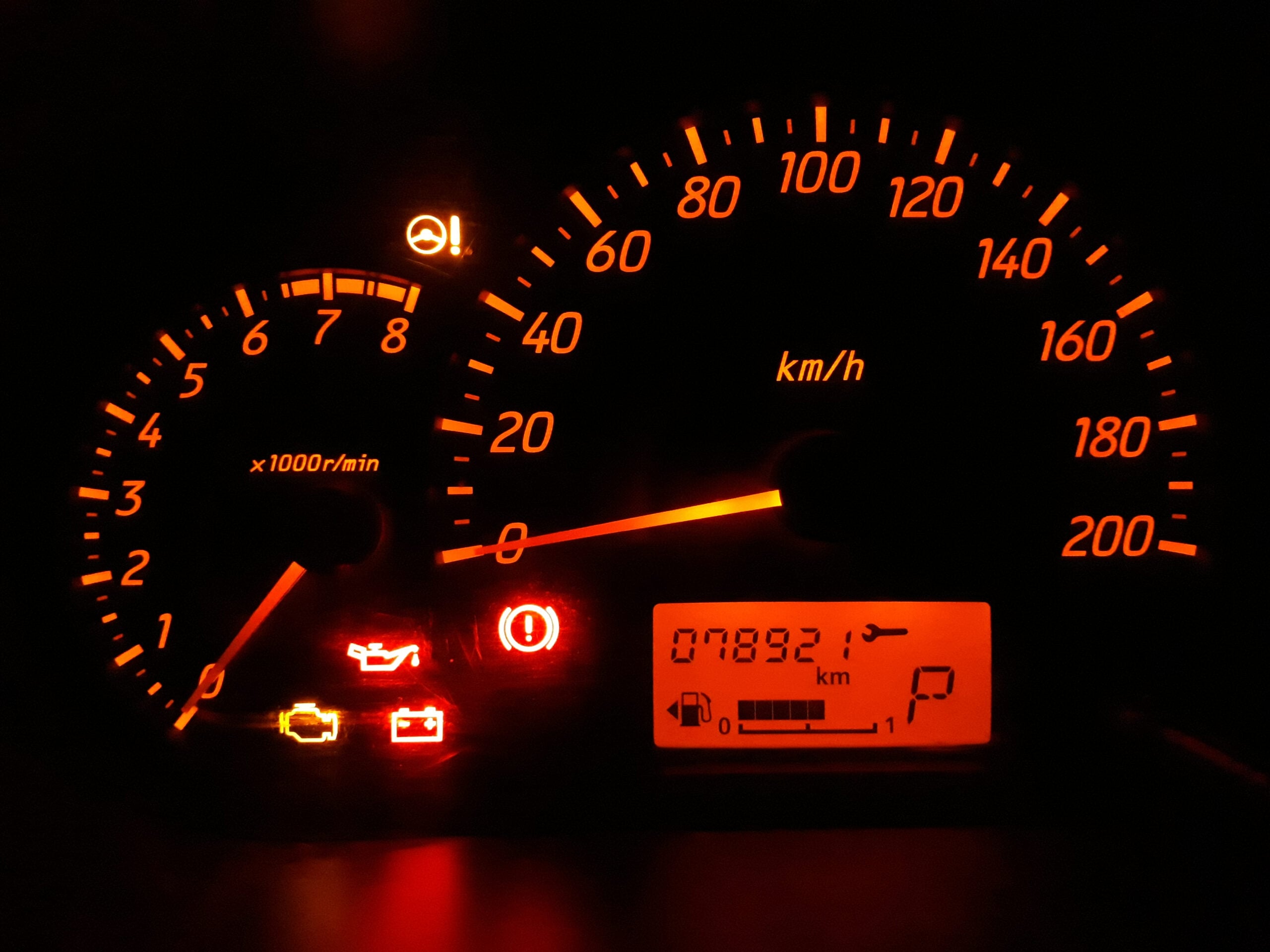
Digital odometers
Show mileage on the dashboard as a six-digit number. The rightmost digit displays tenths of a mile. A reading of 47,832.4 means 47,832 miles and four-tenths. Most dashboards toggle between total ODO and trip odometer using a stalk button or instrument cluster control.
Analog odometers
Use a row of rolling drum dials. Read them left to right. Each drum represents one digit. The rightmost drum, usually printed in white or a lighter color, shows tenths of a mile.
To reset the trip counter, press and hold the reset button on the instrument cluster (physical or touchscreen). This zeros the trip reading only. The total ODO is unaffected.
For telematics-equipped fleets, none of this requires a physical walk to the vehicle. The telematics device reads the ECM odometer value and pushes it to the fleet platform continuously. It is the same number shown on the dashboard, updated automatically.
How fleet managers use odometer readings: 5 Key applications
1. Preventive maintenance scheduling
Oil changes are due every 5,000–7,500 miles. Tire rotations every 5,000–8,000 miles. Brake inspections every 12,000–15,000 miles. Every interval runs off the odometer reading. Accurate mileage data is what makes predictive maintenance programs effective, helping fleets schedule service before wear turns into breakdowns. When the number is wrong, services get pushed, and components wear past safe limits before anyone notices.
2. Fuel efficiency calculation
Miles per gallon equals miles driven divided by gallons consumed. Both sides of that equation depend on accurate odometer data. When a vehicle’s mileage climbs faster than its fuel consumption falls, that gap is often an early signal of engine degradation. Fleet managers who pair odometer data with their fuel management system can catch this pattern weeks before it becomes a repair bill.
3. Vehicle lifecycle and replacement decisions
High odometer readings correlate directly with higher maintenance costs, increased breakdown risk, and lower resale value. Most US commercial fleets cycle vehicles somewhere between 150,000 and 300,000 miles, depending on vehicle class and duty cycle. Fleet managers typically evaluate mileage alongside maintenance history, utilization patterns, and overall vehicle condition to determine the optimal replacement window rather than relying on mileage alone.
4. IFTA mileage reporting
IFTA (International Fuel Tax Agreement) requires quarterly per-state mileage reports for every commercial vehicle crossing state lines. The input is odometer data. Automated telematics tracking generates those per-state mileage records without manual reconciliation, simplifying quarterly compliance reporting for fleet operations.
5. IRS mileage log compliance
IRS-compliant mileage logs require a start and end odometer reading for every business trip, along with date, purpose, and location. Telematics systems generate these logs automatically. Digital reports and app-generated records are acceptable formats, provided they are complete and internally consistent.
Why odometer accuracy matters: The cost of manual entry errors
As noted earlier, manual fleet mileage logs carry a 15–30% error rate, with discrepancies averaging 200–500 miles per vehicle each month. That is not a rounding issue. It is a systematic data problem that causes missed PM intervals before anyone realizes it has happened.
According to GPS-CMMS integration research, 34% of missed PM intervals in fleets without automated odometer tracking trace directly to manual entry errors. A missed oil change accelerates engine wear. A missed brake inspection is an FMCSA compliance violation before it is a safety issue.
The errors follow predictable patterns:
- A driver forgets to log mileage at shift end
- A driver logs an estimated number rather than checking the dashboard
- A fleet admin transposes digits: 47,832 entered as 47,382 is a 450-mile error on a single entry
- Multiple drivers share one vehicle and log at inconsistent intervals
Scale that up. A 400-mile monthly discrepancy per vehicle across a 50-vehicle fleet is 20,000 miles of phantom mileage per month. Every PM schedule, every MPG calculation, and every IFTA quarterly report is distorted at the same time. Not by a system failure, but by a data entry process that was never built to handle this volume.

How to automate odometer tracking: OBD-II and telematics
Modern telematics platforms read odometer data directly from the vehicle ECM through OBD-II and manufacturer-supported diagnostic interfaces, available on every US light-duty vehicle manufactured since 1996. What the device captures comes straight from the vehicle computer, identical to what the dashboard displays. No interpretation, no rounding, no driver involvement.
This distinction matters because GPS-estimated distance is not the same thing. GPS can drift 1–3% on winding or hilly terrain. On a vehicle covering 30,000 miles annually, that drift means a 300–900 mile variance per year. Across 50 vehicles, it is the kind of cumulative distortion that throws off both maintenance schedules and IFTA filings.
ECM odometer data has none of that drift. When a vehicle’s reading hits a configured PM threshold, the fleet management platform generates a maintenance work order automatically. No driver input, no admin entry, no missed interval. That work order flows into the CMMS schedule simultaneously, replacing the manual mileage-entry step that is responsible for the majority of missed PMs in non-automated fleets.
Related article: What is OBD-II? A US Fleet Management Guide for 2026
Odometer fraud: Federal law and fleet protection
Under 49 USC 32705, any US motor vehicle that is sold or transferred requires a signed odometer disclosure statement. The seller must certify the reading and flag any known discrepancies. Violations carry fines up to $10,000 per violation plus civil liability. The DOJ estimates the average consumer loss from odometer fraud at approximately $4,000 per vehicle when repair costs are included. NHTSA puts the national total at over $1 billion annually.
Fleets that sell or trade in vehicles without clean odometer records carry real post-sale liability if a mileage dispute surfaces later. A telematics-generated odometer history eliminates that exposure. Every ECM reading is timestamped and stored in the cloud, creating a tamper-evident record that holds up in a disclosure dispute and increases resale value by giving buyers a verifiable mileage history rather than a seller’s word.
Digital ECM odometers are significantly harder to roll back than mechanical ones. And when a telematics system detects an anomaly, a reading that drops unexpectedly or jumps backward, it flags an alert immediately. Paired with a complete VIN-level vehicle history, that record is the strongest mileage documentation a fleet can provide at disposition.
Stop entering mileage manually
Manual odometer entry looks like a small operational detail until you follow where the errors go. A wrong mileage figure at the start of the week means a PM interval triggered late, an IFTA report built on the wrong mileage, and an MPG calculation that does not reflect what the vehicle is actually doing. Multiply that across a fleet and across every month, and the downstream cost is not small.
The fix is not about discipline or better driver logging habits. Those approaches have been tried. The issue is structural: a manual process will always introduce errors at the volume and frequency that commercial fleet operations demand. The only reliable solution is removing the manual step entirely.
An odometer reading may seem like a simple dashboard number, but it drives some of the most important decisions in fleet operations. Maintenance schedules, fuel efficiency tracking, vehicle replacement planning, IFTA reporting, and compliance records all depend on accurate mileage data.
The challenge is that manual mileage tracking introduces errors at the exact points where fleets need precision. As vehicles, routes, and reporting requirements scale, relying on driver-entered mileage becomes increasingly difficult to manage and verify.
Automated odometer tracking eliminates those gaps by capturing mileage directly from the vehicle, ensuring that maintenance, compliance, and operational decisions are based on accurate, real-time data rather than manual estimates.
Intangles automatically captures odometer readings directly from the vehicle ECM, providing accurate mileage data in real time. This enables automated maintenance scheduling, mileage-based service alerts, fleet utilization tracking, and compliance reporting without relying on manual logs or driver input.
Explore how Intangles helps fleets automate mileage tracking, improve maintenance planning, and reduce compliance overhead, and speak with our team to learn more.
KNOW MORE
Frequently Asked Questions
What is an odometer reading?
An odometer reading is the total cumulative distance a vehicle has traveled since it was manufactured, measured in miles in the US, and displayed on the dashboard instrument cluster. The total odometer cannot be reset. It counts continuously from the vehicle’s first mile. Fleet managers use this number to schedule preventive maintenance, calculate fuel efficiency, satisfy FMCSA reporting requirements, and document mileage for IFTA quarterly filings.
What is the difference between a trip odometer and a total odometer?
The total odometer counts every mile from manufacture and cannot be reset. It is the legally significant number used for vehicle sale disclosures, maintenance scheduling, and compliance reporting. The trip odometer is a resettable counter used to measure individual trips or shift distances. It is useful for per-trip MPG tracking, but it carries no legal weight on its own and does not affect the total ODO reading when reset.
How accurate are fleet odometer readings?
It depends entirely on how mileage is captured. Manual entry in fleet systems carries a 15–30% error rate, with discrepancies averaging 200–500 miles per vehicle each month. Telematics systems that read directly from the vehicle ECM via OBD-II achieve 99.5% or better accuracy, limited only by the precision of the vehicle’s own computer. For fleets that rely on mileage data for maintenance scheduling, fuel analysis, and compliance reporting, ECM-based odometer readings provide a far more reliable source of truth than manually entered records.
Is odometer tampering illegal in the United States?
Yes. Under federal law (49 USC 32705), altering or misrepresenting a vehicle’s odometer reading is a federal offense. Sellers must provide a signed odometer disclosure statement when any US motor vehicle is transferred. Violations carry fines up to $10,000 per violation plus civil liability. Digital ECM odometers are significantly harder to roll back than mechanical ones, and a telematics-generated odometer history provides a tamper-evident record that protects fleets in post-sale disputes.
How do telematics systems read odometer data automatically?
A telematics device connects to the vehicle’s OBD-II port and reads odometer data directly from the ECM through OBD-II and manufacturer-supported diagnostic interfaces. The device captures the current reading and syncs it to the fleet platform continuously. When a vehicle’s odometer hits a configured PM interval threshold, the platform generates a maintenance work order automatically with no manual input required. Intangles reads ECM odometer data in real time through its predictive health monitoring platform, feeding it into PM scheduling, IFTA reporting, and fuel efficiency tracking from a single connection to the vehicle.






We’re looking forward to meeting you