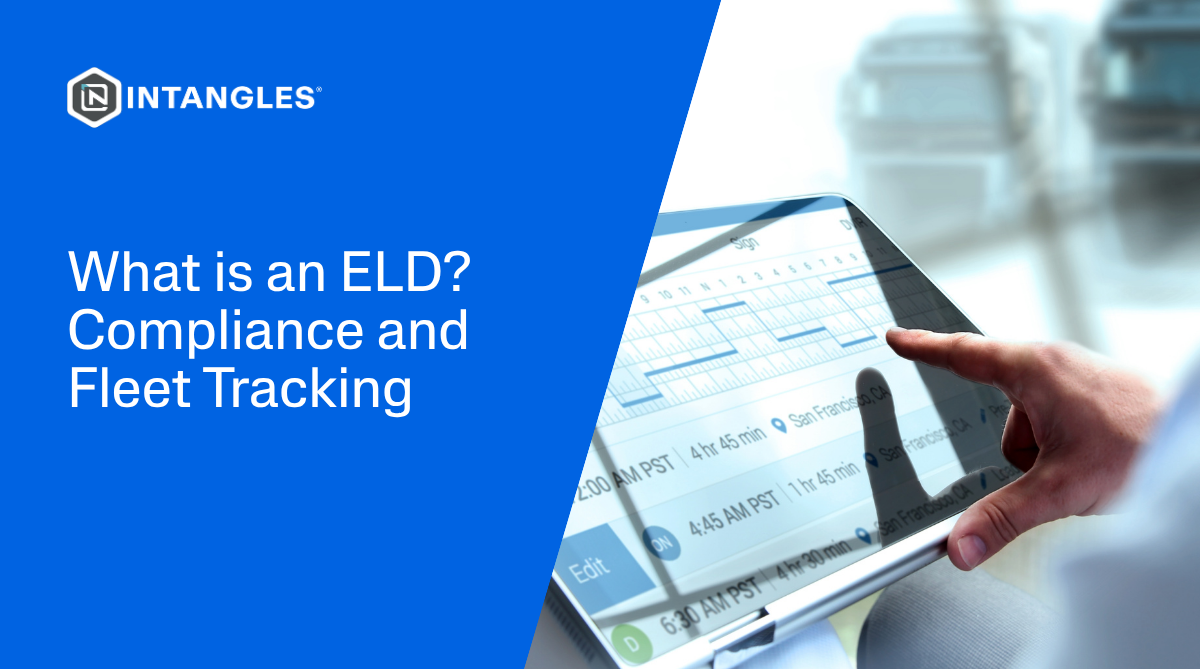
An Electronic Logging Device (ELD) is a hardware and software system that connects to a commercial vehicle’s engine and automatically records driving time, Hours of Service (HOS), and key engine data in real time. For most commercial motor vehicle (CMV) operators in the United States, ELDs are not optional. They are a federal mandate enforced by the FMCSA.
KEY TAKEAWAYS
- An ELD connects to a vehicle’s ECU and automatically records driving time, HOS, location, engine hours, and miles driven, replacing paper logbooks.
- The FMCSA ELD mandate applies to most CMV drivers who maintain Records of Duty Status (RODS); limited exemptions exist for vehicles older than model year 2000 and certain short-haul operators.
- ELDs must be self-certified by the manufacturer and registered with the FMCSA; appearing on the FMCSA list does not guarantee full compliance.
- A compliant ELD supports data transfer via Bluetooth, USB, or telematics; drivers must be able to display logs to roadside inspectors on demand.
- Modern AI-powered platforms go beyond HOS logging to deliver predictive maintenance, fuel loss quantification, driver coaching, and operational loss tracking, all from the same OBD connection.
But compliance is just the baseline. The fleets pulling the most value from their ELD investment are using the engine connectivity it provides to monitor fuel efficiency, predict failures, track driver behavior, and reduce operational costs, not just satisfy a regulator. In this guide, we’ll cover how ELDs work, what data they collect, and why modern fleets are using them for far more than compliance alone.
What is an ELD?
An ELD is an electronic logging device used by drivers of commercial motor vehicles to automatically record driving time and Hours of Service, as well as capture data on the vehicle’s engine, movement, and miles driven. ELDs keep truck drivers and dispatchers informed of driver status in real time to support compliance, roadside inspections, and operational planning.
ELDs consist of several interconnected parts: a telematics device that plugs into the vehicle’s OBD port, fleet management software accessible via desktop or mobile, and a driver-facing app used to certify logs and communicate with dispatch.
The FMCSA mandate requiring ELDs was published in December 2015, with full compliance required by December 2019. Its primary goals were to improve road safety by reducing driver fatigue and to replace paper logbooks with accurate, tamper-resistant digital records.
How does an ELD work?
ELDs follow a straightforward sequence from vehicle connection to inspection transfer. Here is how the process works from engine-on to roadside:
- The ELD connects to the vehicle ECU through the diagnostic port, typically OBD-II or the 9-pin J1939 connector on heavy-duty trucks.
- The device reads engine and movement data in real time, including ignition state, vehicle speed, and engine hours, without requiring any driver input to begin.
- Driving status changes are automatically recorded. When the vehicle exceeds 5 mph, the ELD switches the driver to driving duty status without manual entry.
- GPS position and engine hours are recorded with every change of duty status as well as with every passing hour while driving; thus, providing a record of the entire journey with timestamps.
- At the end of each day, drivers review their logs on the mobile app, and can sign off after making any necessary changes and/or adding comments or corrections.
- The log transfer is conducted wirelessly using telematics technology, USB, or Bluetooth technology during inspections, enabling safety authorities to view their logs within a matter of seconds.
What is an ELD record?
Beyond the step-by-step workflow above, a compliant ELD must capture and retain specific data fields as defined by the FMCSA ELD technical standard:
- Hours of Service
On-duty, off-duty, sleeper berth, and driving time logged against FMCSA rulesets. - Engine data
Engine hours, ignition on/off events, and vehicle miles at each duty status change. - Location
GPS coordinates at duty status changes and hourly during driving. - Unassigned driving
Driving time not attributed to a logged-in driver, flagged for carrier review. - Edit trail
All log edits timestamped and retained alongside the original; driving time cannot be edited.
Who needs to use an ELD in the US?
The FMCSA’s ELD mandate affects most CMV operators who must maintain RODS. In simple terms, if a driver uses paper log books, then they definitely will have to get an ELD.
| Exemption | Condition |
| Short RODS period | Drivers who use RODS for no more than 8 days out of any 30-day |
| Older vehicles | Vehicles manufactured before model year 2000 |
| Driveaway-towaway | Drivers of vehicles that are themselves the commodity being delivered |
To verify whether your fleet falls under the mandate, consult the FMCSA ELD Portal.
ELD compliance: What the FMCSA actually requires
The FMCSA does not approve or certify ELDs itself. Manufacturers self-certify their devices against the technical specifications in the ELD rule, then register with the FMCSA. Appearing on the FMCSA list does not guarantee full compliance. Fleet buyers should independently evaluate providers for reliability and security.
FMCSA minimum technical requirements for a registered ELD:
- Internal synchronization with the engine control module
- Automatic recording of driving time and required data fields
- GPS location recording at duty status changes and hourly during driving
- Electronic data transfer: telematics (wireless) or local (USB 2.0 or Bluetooth 4.0)
- Tamper detection and data integrity protections
- Driver log certification at end of each 24-hour period
- On-demand display capability for roadside inspections
- Malfunction diagnostic indicators
ELD compliance timeline:
| Date | Event |
| December 2015 | FMCSA published the ELD mandate final ruling |
| December 2017 | Deadline for drivers using paper logs to switch to ELDs |
| December 2019 | Full compliance deadline; AOBRD grandfathering ended |
| Ongoing | FMCSA maintains updated list of self-certified registered |
What to look for when choosing an ELD
Not all ELD solutions are equal. The cheapest option often carries the highest total cost of ownership when support failures or platform limitations become apparent at scale.
Compliance reliability
Verify self-certification documentation and confirm the provider maintains compliance through regulatory updates.
Driver ease of use
Complex apps create resistance and log errors. The interface should support quick status changes, clear HOS summaries, and simple log certification.
Data transfer methods
Confirm support for wireless telematics, bluetooth, and USB. Coverage across all three removes friction at roadside inspections.
Platform depth beyond HOS
Vehicle telemetry carries far more than duty status data. An ELD integrated into a broader fleet intelligence platform turns that ECU access into fuel data, vehicle health signals, driver behavior scores, and predictive maintenance alerts.
Support and uptime
ELD malfunction during an active inspection creates immediate compliance exposure. Evaluate the provider’s malfunction response protocol and 24/7 driver support availability.
System integration
For larger fleets, ELD data needs to flow into TMS, ERP, and dispatch systems without manual export steps. Confirm API availability before committing.
Beyond compliance: What AI-powered telematics adds on top of ELD
Telemetry provides the operator with direct access to the vehicle’s engine control unit, which has a lot more information than just hours of service. The fleets reducing costs most aggressively treat this onboard diagnostics connection as the starting point for a broader vehicle intelligence strategy.
Predictive maintenance
Every engine hour recorded for HOS also captures temperature, oil pressure, fuel rail pressure, boost pressure, DPF soot load, and DEF dosing behavior. AI platforms analyze these signals to identify deviations from expected behavior, often 20 to 45 days before a fault code appears.
Intangles’ Digital Twin technology builds a continuously updated virtual model of each vehicle using 450+ real-time signals. This is fundamentally different from fault-code-based maintenance, which only responds after a problem has already surfaced.
A practical example: a regional reefer fleet using Intangles detected early DPF soot loading patterns across three vehicles on the same lane. Maintenance was scheduled during off-peak windows before any drivability symptom appeared, avoiding three separate roadside breakdown events and the associated detention costs.
Fuel loss quantification
The same ECU access that logs odometer miles for IFTA reporting also enables precise fuel tracking. Intangles’ fuel management module uses OEM-installed sensor data enhanced with machine learning to calculate cost per mile, detect fuel theft, and surface idle-attributed fuel waste, with no additional hardware required.
Driver behavior scoring
HOS data tells you when a driver was driving. Intangles’ DriveIQ scorecard tells you how, tracking over 20 behavioral exceptions including overspeeding, hard braking, harsh acceleration, and free running, normalized per distance and time for fair comparison across routes and duty cycles.
Long-haul fleets using driver availability data from ELD records can reduce dispatch delays by understanding remaining HOS windows in real time, while DriveIQ coaching data helps identify which drivers need targeted training versus general reminders.
Operational loss quantification
Intangles maps every inefficiency to a specific dollar figure, enabling fleet managers to prioritize corrective actions based on quantified financial impact rather than raw alert volume.
Intangles platform results
Intangles’ InGenious device connects to the OBD port without external modifications, with 4G/LTE, Bluetooth, and Wi-Fi connectivity for flexible data processing on-device or in the cloud.
| Metric | Results |
| Predictive AI accuracy | 96% |
| Reduction in powertrain breakdown events | 75% |
| Improvement in driving behavior | 20-30% |
| Increase in fleet uptime | 10-30% |
| Improvement in fuel efficiency | 2-10% |
| Reduction in warranty costs | 10-15% |
Explore the platform or get in touch with our team to learn how Intangles’ vehicle health monitoring works across the platform.
KNOW MORE
Frequently Asked Questions
What is the difference between an ELD and an AOBRD?
An AOBRD (Automatic On-Board Recording Device) was regulated under the older 1988 rule and did not require graph grid duty status displays, unassigned driving warnings, or UTC synchronization. The AOBRD grandfathering period ended December 2019. All CMV operators now require a fully compliant ELD. See the FMCSA ELD rule overview for full details.
Can a driver edit an ELD log?
Yes. Edits require an annotation explaining the reason, the original record must be preserved, and driving time cannot be edited. The driver retains final responsibility for certifying the corrected log.
What happens if an ELD malfunctions during an inspection?
Drivers must report malfunctions to their carrier within 24 hours. The carrier must resolve the issue or apply for an exemption within 8 days. Paper Records of Duty Status are permitted during the malfunction period. Per FMCSA malfunction rules, a documented response procedure is required.
How much does an ELD cost?
Costs typically include hardware, installation, and a monthly software subscription. Platforms that bundle ELD compliance with predictive maintenance and fuel management deliver measurably higher ROI than compliance-only solutions.
Does an ELD work for all truck makes and models?
FMCSA-compliant ELDs must be compatible with the vehicle ECU. Intangles’ InGenious device supports a wide range of OEM makes across 18 countries with 500,000+ vehicles on the platform.
What is the difference between HOS compliance and driver performance monitoring?
HOS compliance tracks whether a driver is within legal driving hour limits. Driver performance monitoring tracks how they drive: speed, braking, acceleration, cornering, and idle behavior. A platform delivering both from the same hardware provides significantly more value than a compliance-only ELD.
Are ELDs required in Canada?
Canada’s federal ELD mandate took effect January 2023. Canadian carriers on cross-border US routes must also meet FMCSA requirements.




We’re looking forward to meeting you