KEY TAKEAWAYS
- Intangles’ DEF Dosing Monitoring Algorithm shifts DEF oversight from reactive, post-failure inspection to real-time, early-stage deviation tracking.
- MIDR (Modified Instantaneous Dosing Ratio) quantifies the real-time balance between DEF injection rate and fuel consumption, flagging underdosing before it triggers a derate.
- Underdosing and overdosing carry different risks: underdosing forces engines into derate or increased EGR activity, while overdosing wastes fluid and accelerates SCR component wear.
- When an abnormal MIDR value is detected, the system ranks probable causes by likelihood and surfaces a guided repair path, rather than just raising a flag.
- Mapping dosing anomalies to trip timelines and historical alerts helps fleets distinguish a one-off deviation from a systemic vehicle-level issue.
Modern diesel engines are no longer judged solely on performance; they are accountable to strict environmental benchmarks. Nowhere is this more evident than in the role of Diesel Exhaust Fluid (DEF) dosing, a function central to Selective Catalytic Reduction (SCR) systems.
What DEF dosing governs is chemical precision. When functioning correctly, it transforms harmful nitrogen oxides (NOx) into nitrogen and water vapor, keeping emissions within legal thresholds. When it falters, even slightly, the impact cascades: regulatory compliance risks, compromised fuel efficiency, and premature wear in emission control components.
Until recently, there was no real-time way to verify whether DEF dosing was performing at spec. Traditional methods relied on OBD fault codes, service intervals, or diagnostic inspections, all inherently reactive.
The newly introduced DEF Dosing Monitoring Algorithm from Intangles aims to change that. It shifts the focus from post-failure analysis to real-time detection and early-stage deviation tracking.
In this blog, we break down how MIDR quantifies dosing precision in real time, how the platform diagnoses a deviation and guides the repair once one is flagged, how trip-wise patterns separate a one-off blip from a systemic issue, and why closing this gap matters beyond compliance alone.
What DEF dosing needs monitoring and why it is often overlooked
Despite its critical function in reducing NOx emissions, DEF dosing is often treated as a peripheral concern, checked during emissions tests or flagged after a vehicle enters derate mode. This is problematic for two reasons.
First, the dosing rate is governed primarily by the fuel injection rate, which in turn varies with factors such as engine load, speed, ambient temperature, and exhaust flow. Second, suboptimal dosing does not always trigger immediate mechanical symptoms. Instead, it often leads to gradual SCR degradation, increased backpressure, and decreased combustion efficiency.
Moreover, compliance violations related to SCR failure can result in fines, forced downtime, and negative audit outcomes under EPA’s Clean Air Act enforcement authority. DEF systems are legally mandated under EPA emissions regulations for diesel engines built since 2010, so blind spots in dosing oversight carry both environmental and financial consequences.
To make this visible, the platform surfaces predictive alerts as soon as dosing begins to fall short of ideal thresholds.
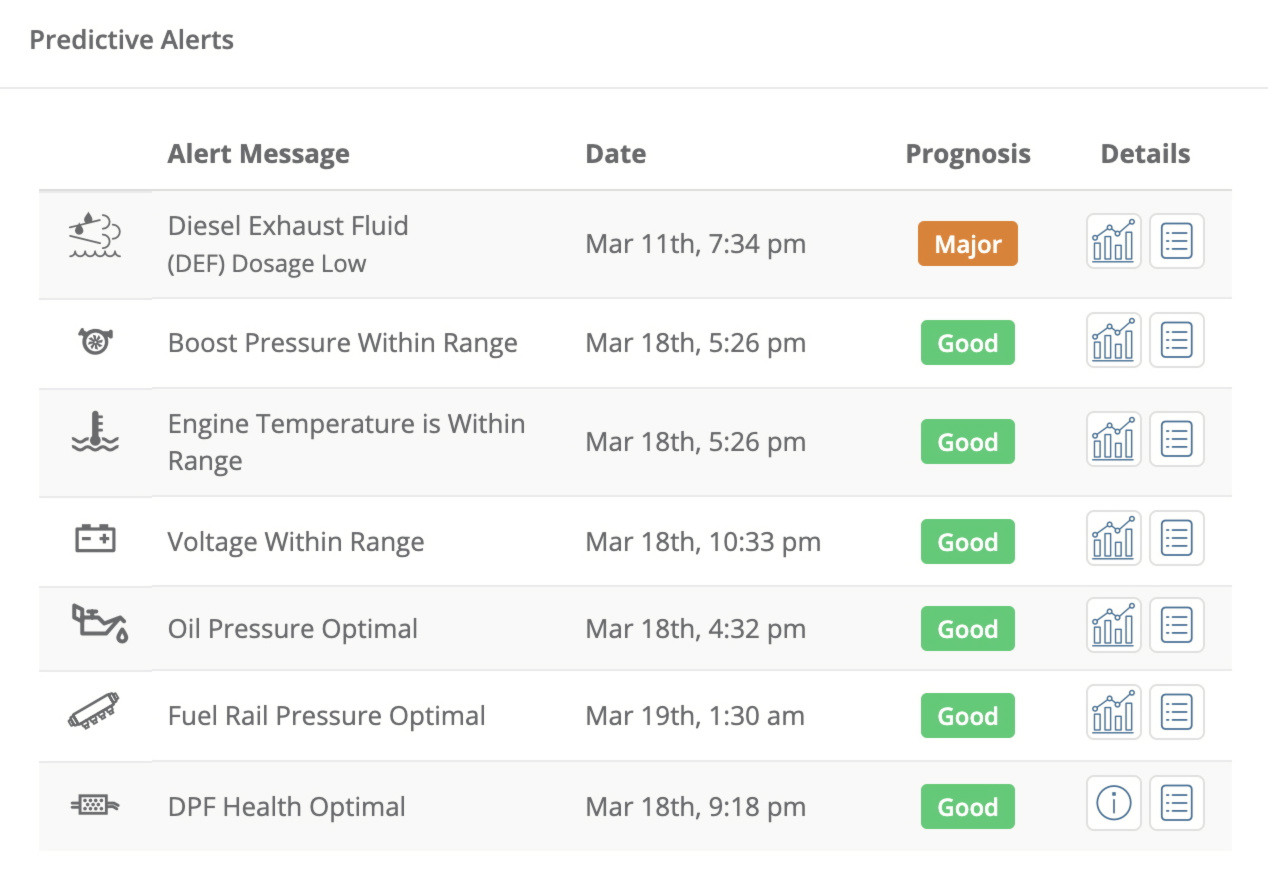
Predictive alert indicating a major issue with low Diesel Exhaust Fluid (DEF) dosing, surfaced before system derate.
Quantifying dosing accuracy with MIDR
At the core of the new system is a calculated value known as the Modified Instantaneous Dosing Ratio (MIDR). This metric reflects the real-time balance between DEF injection rate and fuel consumption: specifically, a logarithmic ratio of grams of DEF per hour to gallons of fuel per hour.
By tracking this value over engine hours, the system creates a detailed visual of DEF performance. Any deviation below the ideal threshold is automatically flagged. This enables rapid identification of underdosing scenarios, which can indicate clogged injectors, frozen DEF, sensor misreadings, or pump failure.
The system visualizes this data using a dynamic graph that contrasts actual MIDR against ideal dosing performance.
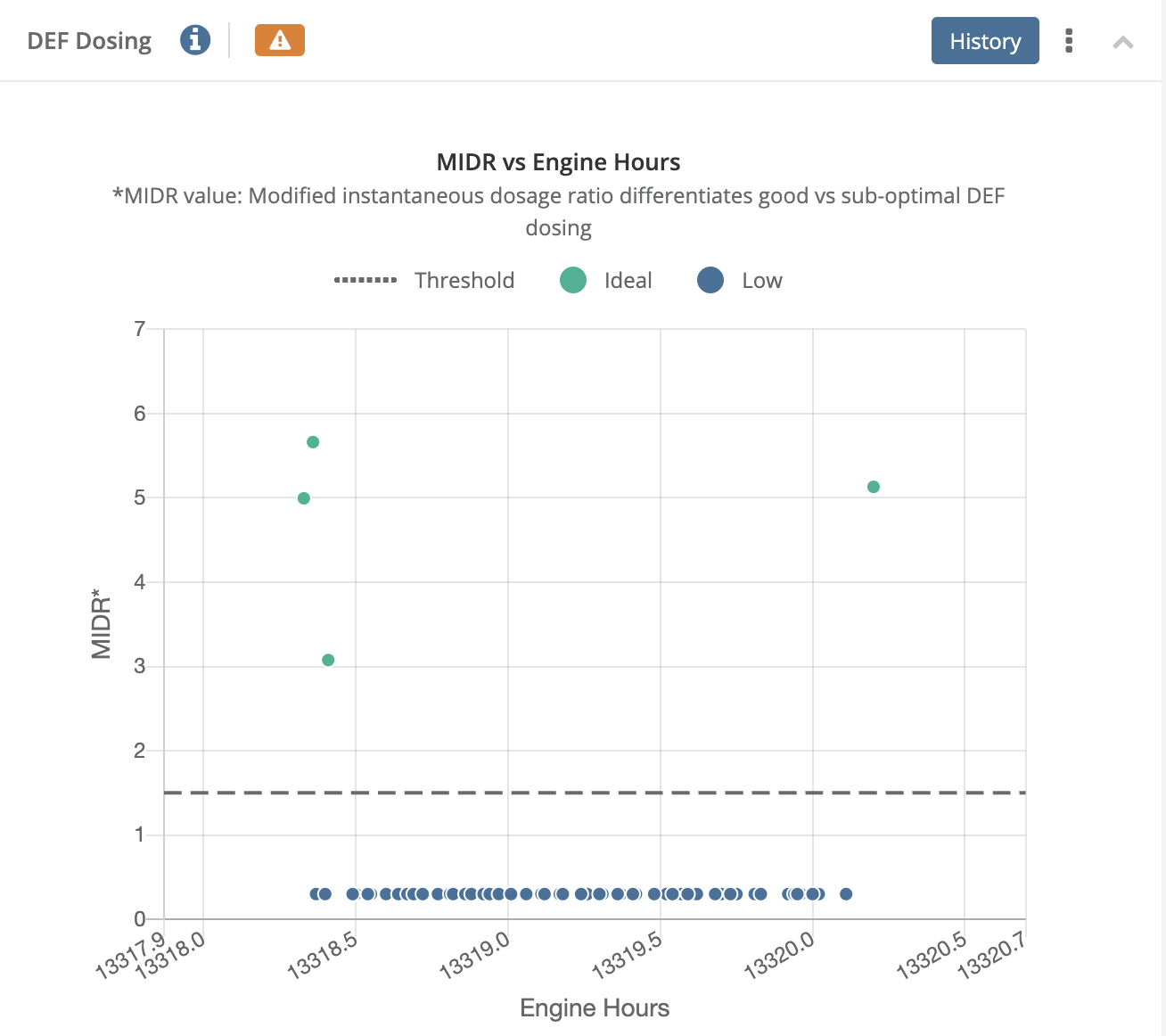
Predictive alert indicating a major issue with low Diesel Exhaust Fluid (DEF) dosing, surfaced before system derate.
From data to diagnosis: Actionable DEF analytics
When an abnormal MIDR value is detected, the system does not simply raise a flag. It compares the current value with historical trends, evaluates active fault codes, and suggests the most probable cause through an interactive guided repair interface.
For example, a gradual decline in dosing rate across multiple trips may point to scaling within the DEF line. A sudden drop might suggest temperature-induced crystallization or injector malfunction. The platform’s analysis ranks potential causes by probability, allowing technicians to prioritize diagnostics instead of troubleshooting blindly.
The platform also maps current readings against ideal standards, offering at-a-glance assessments of how serious a deviation is.
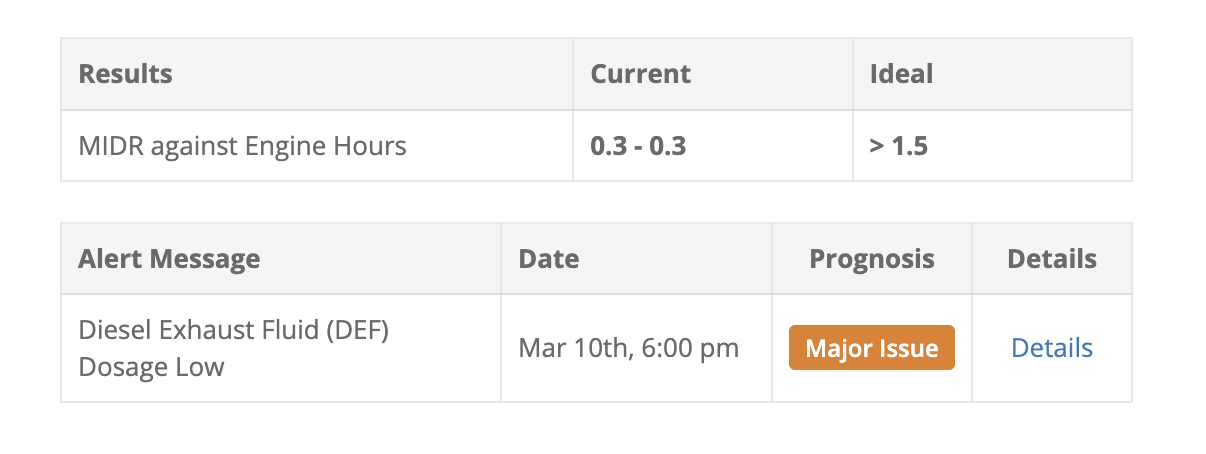
Comparison of actual vs. ideal MIDR values, automatically categorized by issue severity.
To aid maintenance teams, the alert panel is tied directly to repair suggestions based on symptom-cause correlations.
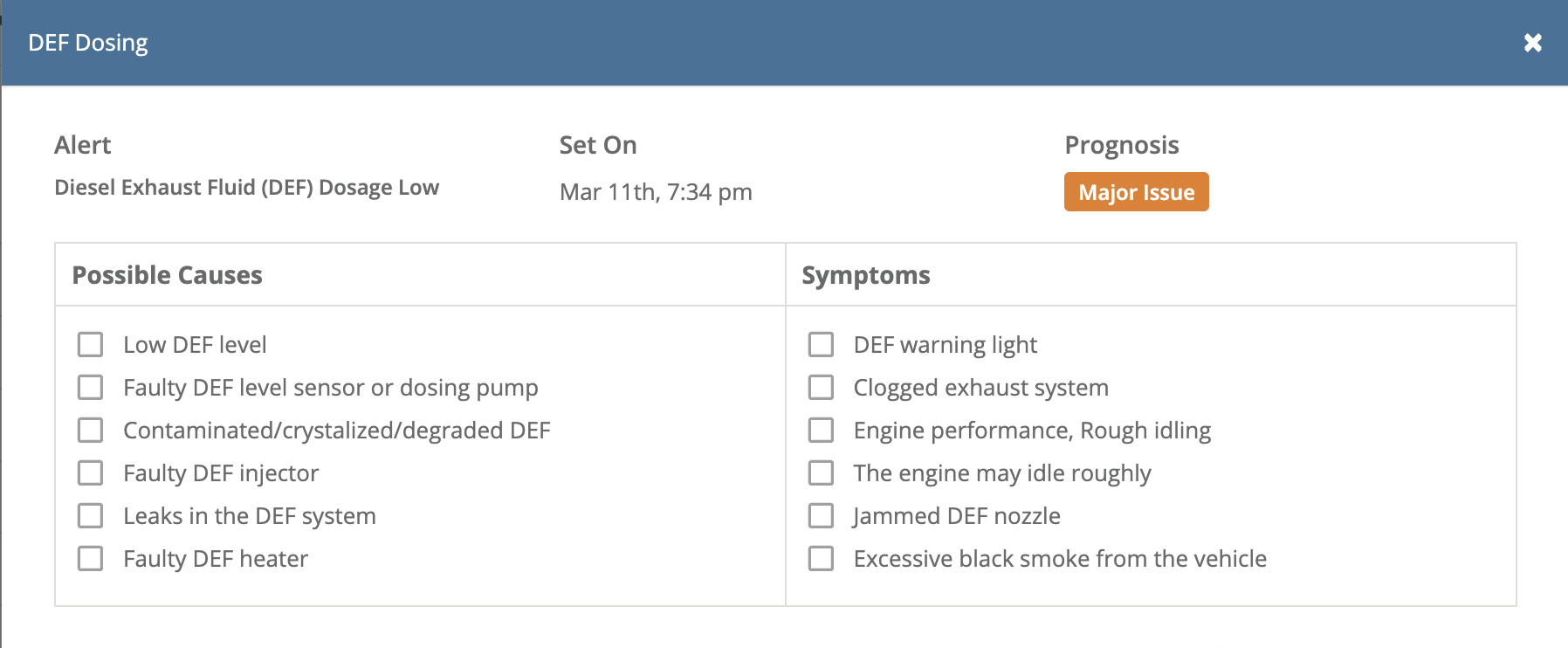
Guided repair view breaking down symptoms, likely causes, and severity for low DEF dosing alerts.
Understanding dosing patterns trip-wise
By mapping dosing anomalies to trip timelines, fleet operators can correlate dosing efficiency with operational factors: terrain, load conditions, or idling durations.
This trip-based insight is not just a historical archive; it helps reveal systemic inefficiencies. Vehicles that routinely operate below optimal MIDR thresholds may suffer from design-specific vulnerabilities, component mismatches, or calibration drift.
Paired with historical alert tracking, the system supports deeper investigations and more informed maintenance schedules.
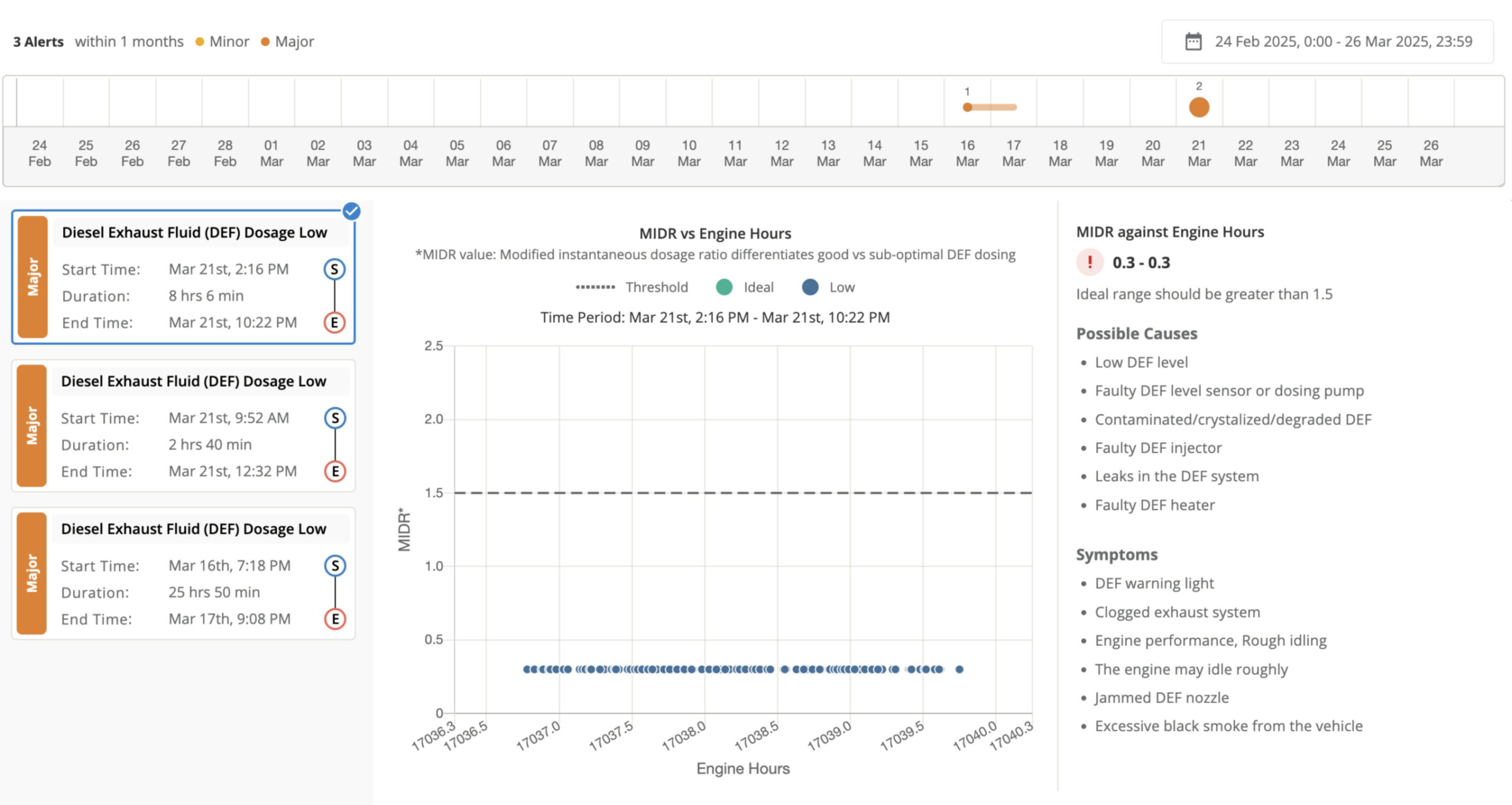
Historical log of DEF dosing and other predictive alerts, supporting trend-based diagnostics across fleet vehicles.
Why this matters beyond compliance
Non-compliance is only the surface-level issue. DEF system irregularities often create latent engine stress. Underdosing leads to insufficient NOx reduction, forcing engines into derate mode or increasing EGR activity, which raises exhaust temperatures and affects engine performance.
Overdosing wastes DEF fluid, increases crystallization risk, and causes premature SCR component wear. Both scenarios impact fuel economy, emissions, and long-term component reliability.
In commercial fleets, these margins accumulate into real cost: missed delivery windows, penalty accruals, higher service intervals, and reputational loss.
By mapping dosing anomalies to trip timelines, fleet operators can correlate dosing efficiency with operational
Integrating DEF monitoring into fleet diagnostics
The new monitoring feature shifts DEF dosing from an occasional service-line item to an actively monitored health parameter. It supports timely, data-driven diagnostics and allows for faster root cause identification during repair sessions.
Rather than reacting to fault codes after they appear, fleet managers can address dosing anomalies when they first emerge, improving compliance rates and maintaining the long-term health of emissions control systems.
Precision dosing monitoring is what turns DEF from a fluid you top off into a system you actually manage. The gap between “checked at the last service interval” and “flagged the moment it drifted” is the difference between a scheduled repair and a roadside derate.
Intangles built MIDR-based dosing monitoring to close exactly that gap, connecting it to the same predictive vehicle health monitoring framework that tracks the rest of the aftertreatment system, so a dosing anomaly is never treated in isolation from what else the vehicle is telling you.
Getting ahead of DEF dosing issues means fewer derates, fewer emergency repairs, and cleaner compliance audits, without adding a single sensor to the truck.
Discover how Intangles’ DEF monitoring solution can bring this same precision to your fleet’s dosing oversight.
KNOW MORE
Frequently Asked Questions
What is MIDR (Modified Instantaneous Dosing Ratio)?
MIDR is a calculated value that reflects the real-time balance between DEF injection rate and fuel consumption, expressed as a ratio of grams of DEF dosed per hour to gallons of fuel burned per hour. Tracking MIDR over engine hours lets a fleet see dosing performance as a continuous trend rather than a single point-in-time reading, so a deviation below the ideal threshold gets flagged automatically instead of waiting for a fault code.
What's the difference between DEF underdosing and overdosing?
Underdosing means the system isn’t injecting enough DEF relative to fuel consumption, which leads to insufficient NOx reduction and can force the engine into derate mode or increase EGR activity. Overdosing means too much DEF is being injected, which wastes fluid, raises the risk of crystallization, and accelerates wear on SCR components. Both affect fuel economy and long-term reliability, but they call for different fixes.
How is DEF dosing monitoring different from DEF level monitoring?
DEF level monitoring tracks how much fluid remains in the tank. DEF dosing monitoring tracks whether the fluid being injected into the exhaust stream matches what the engine’s fuel consumption calls for at that moment. A truck can have a full DEF tank and still have a dosing problem, such as a clogged injector or a failing pump, that a simple level check would never catch.
What causes a DEF dosing anomaly?
Common causes include clogged injectors, frozen DEF lines, sensor misreadings, and pump failure. The pattern of the deviation is often a clue: a gradual decline in dosing rate across multiple trips tends to point to scaling within the DEF line, while a sudden drop is more often linked to temperature-induced crystallization or an injector malfunction.
How does guided repair work when a dosing deviation is flagged?
When an abnormal MIDR value is detected, the system compares it against historical trends and active fault codes, then ranks the most probable causes by likelihood rather than just raising a generic alert. This gives technicians a prioritized starting point for diagnostics instead of troubleshooting blindly, and the alert panel links directly to repair suggestions based on those symptom-cause correlations.
Does DEF dosing monitoring require extra hardware or sensors?
No. MIDR-based dosing monitoring runs on data the vehicle’s existing systems already generate, calculating the ratio from DEF injection rate and fuel consumption data pulled through the standard diagnostic connection. No additional dosing sensors or fuel line modifications are required to get dosing-level visibility.







We’re looking forward to meeting you